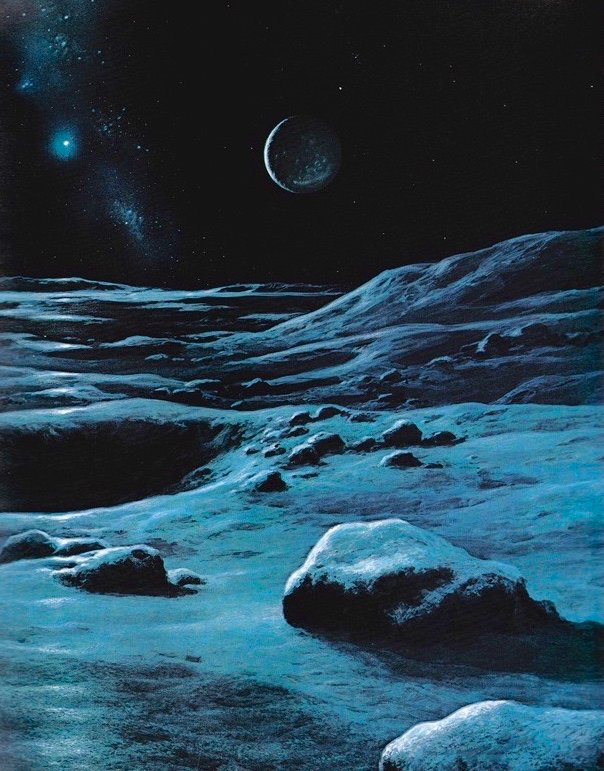
Several of the planets, or former planets, in this Solar System have a kind of iconic symbolism to them. Saturn is the “classic” planet with the ring round it. If you want a symbol of a planet, it serves well, mainly because otherwise a symbolic planet would just be a circle with no particular significance. Mars and Venus benefit from being next to Earth, Venus being the “planet of love” and Mars the “planet of war”, which is why we get invaded from Mars a lot in old sci-fi. Saturn, Uranus, Neptune and Pluto have all also been seen as the “outer limits”: as new discoveries were made, each of them was demoted from this position. In ‘Last And First Men’, Olaf Stapledon has the human race move to Neptune to escape the Sun’s increasing radiation about an æon from today, and although he acknowledged the existence of several planets beyond Neptune, he was writing just before Pluto was discovered and hence his Neptune occupies that rôle right then. Saturn worked very well in this niche because of its prominent rings, forming a kind of pale around it which reinforce the idea of limits. But for many of us alive in the last two-thirds of the twentieth Christian century, Pluto fills that slot.
Pluto has a remarkable astrological history which makes me wonder about the nature of that approach as opposed to the science of astronomy. Astrologers have been known to call Pluto “Lowell-Pluto” to distinguish it from the other astrological Plutos, Pagan-Pluto, Wemyss-Pluto and Thierens-Pluto, each named after their respective astrological advocates. The first of these is associated with Scorpio, like the Pluto we’re most familiar with, and was designated in 1911, nineteen years before Pluto was discovered. Wemyss-Pluto is far out, with a sidereal period several times that of Pluto as we know it, of 1 566 years, and rules over Cancer rather than Scorpio, and Thierens-Pluto is a renamed Osiris, a hypothetical planet paired with I*s*i*s (not sure what search algorithms do with that sequence of characters sans stars), and is one of four trans-Neptunian planets. All of these are known as hypothetical planets in astrology, and some have been given ephemerides (tables of their movements and conjunctions etc.). I won’t cover all these in enormous depth, but just want to observe that it’s interesting that astrologers “discovered” Pluto under that name long before it officially received it. Traditionally Scorpio was ruled over by “Negative Mars”, which makes sense because of the red giant Antares – “anti-Mars” – in that constellation. Negative Mars is nocturnal, feminine and negative as opposed to the Martial attributes of diurnality, masculinity and positivity. In astrology, there is a negative planet for each positive one, also referred to as feminine planets, although as I understand it this idea is not currently used.
Astrologically, Pluto is a disrupting and disturbing influence in keeping with the original idea that there had to be a massive planet beyond Neptune which was perturbing the orbits of planets further in, and also Pluto is a bit of an oddball, considered as a planet, because it isn’t a gas giant, unlike the four planets beyond the asteroid belt. Besides that, its orbit brings it closer to the Sun than Neptune for a dozenth of its year. Being associated with the underworld, partly because of its name, it also has associations with crime and “degeneracy”, and also obsessions. The era of its discovery is also considered significant. There have been attempts to write an extra piece for Holst’s ‘The Planet Suite’, composed before its discovery, which to my uneducated ear sounds appropriately atonal and modern, perhaps like Charles Ives or Messiaen.
Pluto, then, is Ultima Thule. Ultima Thule is the most distant location for the Greco-Roman world and it isn’t clear if it’s a real place. The Orkneys, among other islands, have been suggested as its real world equivalent. The original name was Thule, but it became metaphorically associated with the most distant possible place, hence “ultima”, meaning “last” or “final”. The back of beyond, in other words. The name Ultima Thule was also applied to a very distant trans-Neptunian object, 486958 Arrokoth, visited by the New Horizons probe after Pluto. It’s also given a name to the sixty-ninth element, thulium, I’m guessing because it’s the rarest of all the stable rare-earth elements, or was considered to be so at the time of its discovery. Thule was also used in Nazi ideology as the name for a far northern original homeland of the Aryan folk, and due to that association the name is no longer used for the object encountered above, Arrokoth, which was named officially by a Pamunkhey tribal elder in a ceremony in November 2019.
The “Ultima Thule” idea clearly has great power, and for a long time Pluto was a modern version of this notion. For instance, in ‘Not The Royal Wedding’, one of the ‘Not The Nine O’Clock News’ books, Brezhnev’s share of the royal wedding cake was described as the size of “a microbe’s frisbee seen through the wrong end of a telescope well beyond Pluto”, i.e. something very small indeed, and also distant. This is of course just one of countless examples of “Pluto as metaphor” used between 1930 and 2006, in which it has the attributes of being very cold, dark and distant. In fact this doesn’t quite work as well as might be thought, but before I go into that it’s fair to observe that one reason Pluto is such a potent symbol is that very little was known about it for a very long time, allowing all sorts of thoughts to be projected onto it from a great distance, with little accountability in a way, because it seemed unlikely that anyone would ever find out much about it.
I can’t help thinking that if the International Astronomical Union had decided to demote Pluto earlier, it would’ve been less likely that New Horizons would ever have been sent there. It was launched only seven months before the decision, and plans must have been underway for many years before that, so the mere act of changing Pluto’s status right then probably wouldn’t’ve been enough to do it, but had that happened long before, or if Pluto had never been considered a planet, I don’t believe the mission would’ve taken place. It’s fine to send a spacecraft to some Kuiper Belt objects, and also interesting and useful, but I don’t think it would’ve been good publicity for NASA to do that if it had never been regarded as a planet. The sheer distance probably makes it seem like an excessive mission to the minds of many non-astronomical folk, and it might therefore be associated with the idea that it was a waste of money. Nevertheless, we got a mission and I’m very happy personally that we did.
The surface temperature of Pluto is -226 to -240°C. Although this is colder than Uranus, that rather than Pluto is now deemed the coldest planet in the Solar System. NASA gives a temperature of -233°C. There’s no denying it’s cold. Only three elements would be gaseous at that point: hydrogen, helium and neon, although on a hot “day” fluorine would be close to achieving that. However, it’s still above the ambient temperature of almost all the Universe, which is -270°C, and of course well above absolute zero. There’s a remarkable story by Larry Niven of an astronaut who has frozen on Pluto but whose nervous system becomes superconducting during the day when the temperature gets high enough and is therefore still conscious, waiting perhaps centuries to be rescued, unable to move, which sounds like a recipe for madness or Hell, rather appropriately for a planet named after the kind of the underworld. Not a fiery Hell though.
It’s often said that the Sun is just a star from that distance. That is true, because it’s forty times as far as Earth from it, meaning that it wouldn’t show a visible disc to the naked eye, but on the other hand the Sun would still be hundreds of times brighter than Cynthia at its brightest, and would illuminate the dwarf planet about as strongly as the light we experience just after sunset. The surface wouldn’t look poorly-lit to us there. There would also be the light from Charon, a relatively extremely large and close moon, which is locked into the same position in the sky at all times, and is therefore invisible from the other side, and of course the other moons.
The coldness of Pluto has sometimes been represented in paintings of its surface in the form of the likes of snow and icicles. Whereas this communicates, mildly, the conditions there, it seems unlikely that it ever actually snows there at all. On Neptune’s moon Triton, the nitrogen atmosphere snows in the eighty-two year long winter. A point needs to be made here about Pluto’s climate and the influences on it. Pluto is not strongly illuminated by the Sun, but has a very eccentric orbit and a considerable axial tilt. Because of the weak radiation at that distance, the tilt, which would normally strongly influence the weather and seasons, such as they are, is less significant than the highly elliptical orbit. The axis tilts between 102° and 126°, which can also be thought of as being 54° and 88° but rotating in the reverse direction to most of the planets, and this means it has overlapping polar and tropical zones rather than polar, temperate and tropical ones. It sounds a bit weird to talk about Pluto having a tropical climate, and this is only relative as of course the maximum temperature at the equator at midsummer during its closest approach to the Sun is still enormously colder than the midwinter temperature at our own South Pole, which is true in fact of every planet from Jupiter outward though not necessarily their moons, but on Pluto water is effectively a kind of rock anyway so it’s not like we’re talking about rain and snow. Also, water ice is not the main constituent of the surface but frozen nitrogen with some methane and carbon monoxide. It’s easy to think of the carbon monoxide as a poisonous gas, but again, since its freezing point is -205°C, once again it’s something of a technicality that it happens to be toxic to us life forms living thousands of millions of kilometres away on a world so hot that we have oceans of molten rock, comparatively speaking.
Pluto’s day lasts getting on for a week. 6.4 days is a more accurate figure. The star that is the Sun would therefore be below the horizon in some places for more than three days at a time, and because of the highly tilted axis it would be in the sky for over a century, followed by more than a century of night. And it would in fact look very different when it wasn’t there because the night would be dark like ours, though perhaps lit by an extremely large and close moon in the sky, permanently hanging in the same position.
What, then, would it be like to live there? There is actually a more pressing question here: what would be the point of living there? Why would anyone bother? It took New Horizons nine and a half years to reach it and it takes five hours to send a signal at the speed of light over that distance, so people are not really going to be having real time conversations with anyone on Earth, or for that matter Neptune. There seems to be no practical reason at all to go there. Jupiter is a rich source of hydrogen and helium, Mars is relatively nearby and might once, or maybe even still, has life on it, but living on Pluto wouldn’t be much different from living in a space habitat that far out with the added difficulty of making it hospitable rather an building a friendly environment from scratch. There’s also a serious lack of useful resources within easy reach, and the surface gravity is extremely low at only a fifteenth of hours, meaning that unless something was done to maintain muscle mass, bone density, cardiac health and the like, living there would be a life sentence. You’d never be able to return to Earth, assuming you’d come from here in the first place. I think probably the main motive would be to do something extreme, a little like walking to a pole. It’s a Ranulph Fiennes-type thing to do. I can imagine the rest of the human population of the Solar System rolling their eyes at people choosing to live on Pluto and wondering what the heck the point of it all was.
This is not to say that the place has no merits. Its orbit is sufficiently large that the Centauri system would actually just about visibly shift position in the sky through the year, although only people who lived to 120 would be able to experience that and it’s hardly noticeable. There may be at least two active volcanoes there, Piccard and Wright near the south pole. There may also be a very deep internal ocean of water, which could conceivably have life in it. The whole world is smaller than our moon at 2376 km diameter, giving it a surface area about the same as Russia and a little larger than Antarctica. The micronation of Aerica claims part of Pluto as its territory, which seems to be another “Ultima Thule” thing, and the Empire also claims a made-up planet called Verden.
In some ways, the world is quite rich in resources, if by “resources” you mean the likes of water and oxygen. You’d never go short of those. However, if you wanted metal or many other minerals essential to life, you might get a bit stuck unless you took them with you and kept them in a closed cycle. Nitrogen is fine, but there’s the usual issue with phosphorus and possibly even sulphur. If the ocean exists and there is any cycling between the mantle and crust, there might be some heavier elements in the form of salts where water ice outcrops exist. There are nitrogen glaciers fed by the thin atmosphere precipitating out in the “winter”, whatever that is, which tend to smooth out craters. Unlike elsewhere in the Solar System, this ice would be soft and gelatinous. There do appear to be winds of some kinds because there are streaks of red material. It isn’t clear what that red material is, because it isn’t tholin. You could even get something like fossil fuels from the place because there’s methane ice on the surface.
What I have in mind, then, is a kind of horizontally-oriented rotating wheel oriented somewhere either in sunlight lasting a century or so, or in a region where the day-night cycle is about six days. It would need to rotate to keep the inhabitants healthy. It could be warmed by burning methane or hydrogen, and there would be no concern regarding sources of water, oxygen or nitrogen, but other materials, including metals, would be sparse and this suggests that the base would need to be made out of some kind of synthetic material, which I would call plastic except that this makes it sound like it’s weak and flexible whereas I have something much tougher in mind. There would be relatively little risk from ionising radiation because there’s nowhere for it to come from.
But as to whether there would be any point, apart from proving it’s possible, I do not know.
 A Box Of Chocolates