Space Camels

Photo by Shukhrat Umarov on Pexels.com

Some time around 1975-77, the early evening news and magazine programme ‘Nationwide’ did a Christmas special about life in the year 2000. I can remember a few details. The cod was considered an endangered species or extinct, there was a test tube with an embryo in it and women were no longer familiar with the idea of skirts or dresses. It’s seemingly impossible to track down, but since Richard Stilgoe was involved maybe that’s just as well, but then so was Valerie Singleton. Anyway, one of the things it featured was a TV schedule including ‘The Universe About Us’ as a parody of the well-known natural history programme ‘The World About Us’, which was about life native to asteroids and how they coped without an atmosphere, and it was this that really piqued my interest.

At the time, I used to exercise my imagination in rather a limited way by a kind of analogical method. For instance, I used to think that what was happening with audio at the time would happen with video two decades later, so the ubiquity of cassette recorders in 1977 I imagined to extend to video recorders with built in screens and cameras in 1997. I also used to extend two dimensions to three and replace rotary motion with linear, so if I’d done a session on two-dimensional tessellation I would try to imagine how that would work in three, and try to think of ways of replacing wheels with the likes of linear induction motors. I was actually a little concerned that this process of analogising was a bit lazy and wanted to come up with another way of imagining things which was a bit more flexible and original, but of course it did bear a limited amount of fruit.

I did this with the idea of organisms who didn’t breathe oxygen by imagining an airless planet or moon to be like a desert on Earth, except that the environment in question was effectively an oxygen desert, where not only water but also oxygen was scarce. I don’t remember too much about it, but one thing I do recall was the idea of trees with deep roots to reach subterranean water deposits as a basis for life forms who sought out oxygen deposits deep underground in a similar way. There will be a notebook somewhere with further details in it. I also eventually came up with the idea of a Martian whose body was based on similar principles. It had a large dome on top of its body covered in holes which it used to inhale air, which it then compressed to breathable density using piston organs. The problem with this is that there is practically no oxygen in the Martian atmosphere and it would have to be “cost-effective”: that is, in an atmosphere with a usable amount of oxygen in it, the energy expended in compression would have to be lower than the energy released by respiration. This is actually a practical problem with respiratory diseases. If your lungs are unable to function without a lot of respiratory effort, you can actually end up losing weight because you burn so many calories by the energy spent on breathing, and of course ultimately you could go so far from breaking even that it would actually be fatal.

This assumes, of course, that life requires oxygen, which is by no means so. It so happens that our own metabolism is built around the famous Krebs cycle which liberates energy from glucose by carefully controlled oxidation, with a small bit at the beginning called glycolysis which only releases a small amount of energy without needing oxygen, and there are plenty of completely anærobic organisms – ones who do not require oxygen – and even ones for whom oxygen is toxic. However, for a living thing to rely only on anærobic respiration would be much less efficient than using oxygen and they would be unable to compete well with species occupying similar niches which could avail themselves thereof.

The only reason there is much free molecular oxygen in our atmosphere is that æons ago, cyanobacteria evolved which were able to combine carbon dioxide and water to store energy and produced oxygen as a by-product. This actually ended up poisoning most of the life around on this planet which had thriven up until then and plunged it into a global ice age where there were even glaciers at the equator due to the lack of a greenhouse effect from the carbon dioxide which had been removed from the atmosphere. It was actually a bit of a disaster, and it demonstrates very clearly that oxygen can be a liability for life rather than essential to it. It is in fact implicated in the kind of damage associated with aging, and if life like us could survive without respiring in an oxygen-rich environment we might end up living a lot longer, barring accidents. However, it remains to be seen how we would manage to derive energy to do all that living, and perhaps if we were only able to use anærobic respiration we would take a lot longer to get things done and life might end up seeming about the same length anyway.

Photosynthesis is not the only way free oxygen can arise in an atmosphere. The Jovian moon Europa and Saturn’s moon Enceladus both have extremely thin oxygen atmospheres because of the breakdown of ice and in the latter case water vapour, and in the case of Enceladus this oxygen is actually transported to Titan’s much thicker atmosphere. It’s thought that a very common type of planet would be the “water world”, which could form in several different ways but consist of an ocean hundreds of kilometres deep over a layer of ice which is only there due to compression and not cold. Such a world would start off with a water vapour atmosphere but ultraviolet radiation from its sun would split up the molecules and the hydrogen would escape into space, leaving the oxygen behind, probably at breathable levels. However, life as we know it on such a planet is another question because depending on how thick the ice is, volcanic activity and rock could be deeply buried under the ocean bed and heavier elements wouldn’t be available, so it’s likely that larger such planets would be lifeless due to lack of material resources. On smaller worlds, the oddity may be that even though photosynthesis might never have evolved, heterotrophs such as fungi and animals might, without needing plants, but there would still need to be producers for them to eat.

It’s also been suggested that although organisms benefit from oxidation or other chemical processes to release energy, other forms of carbon-based biochemistry might use other elements than oxygen to do it. In fact it isn’t necessary to go as far as another planet to see this happening because even here there are sulphur bacteria which use that element instead. In fact sulphur is used metabolically in a number of different organisms in various ways. There are two opposite processes chemically referred to as oxidation and reduction. Oxidation is the loss of electrons whereas reduction is gain, and sulphur bacteria are a big personal reason why I didn’t go into marine biology. As a teenager, I did field work on a mud flat in Kent which was rich in anærobic bacteria releasing stinky hydrogen sulphide living in a black, tarry layer under the mud in which I got completely covered, which seriously put me off doing any more of that kind of thing. I wonder, in fact, whether this was part of the point of the activity. Anyway, from the comfort of this urban East Midlands sofa, I am able to pontificate on the matter in a more detached manner. Sulphur bacteria occur in several different types and use sulphur for various purposes. The element was present in quantity on this planet before oxygen respiration evolved and would have been an ample source of energy. Some archæa do the same. They may actually “breathe” sulphate rather than sulphur as such, and whereas when oxygen is breathed it’s reduced to water, sulphur produces hydrogen sulphide. However, both elemental sulphur and various sulphur compounds are used. Sulphur, being in the same column of the periodic table as oxygen, has certain similar properties, although its valency, unlike oxygen’s which is always two, varies. Further down that column are selenium, tellurium and polonium, and all but the last perform useful functions in some living things, the function of polonium being of course to kill things and be extremely dangerous, but none of them are abundant enough to be used for respiration. Sulphur is a solid at room temperature and at sea level pressure it only melts at 239°C, so it’s unlikely to be a respiratory gas. An ecosystem based on sulphur would therefore probably be completely aquatic. However, sulphur is the fifth most common element on the surface of this planet and the tenth most common cosmically and it crops up all over the Solar System, such as in the clouds of Venus, as sulphuric acid oceans on early Mars and all over Io both as an element and as frozen sulphur dioxide. All of this suggests that there are many worlds out there in the Universe with sulphuric acid cycling through the atmosphere in the same way as water does on Earth, and depending on its concentration it could be very hostile to the development of life, which sadly could also apply to Mars and Venus. Nonetheless, the worlds themselves could be quite interesting geologically and chemically.

A popular science fictional choice of another option to oxygen is chlorine, which I’m pretty sure I’ve mentioned before on here. The potential for marine organisms to produce elemental chlorine gas is considerable because of the salt content of the oceans, and it may be that whereas we on this planet have gone down the oxygen route, others will have a large amount of chlorine in their atmospheres. If this is so, and their oceans are like ours in other ways, they will also contain a lot of caustic soda, so from our perspective if there’s any life there at all it will be in some way extremophile. Such oceans might also be high in elemental iron, as were Earth’s before the oxygen catastrophe, as it’s known. For me, the issue with chlorine is that it’s liable to produce “dead ends” in molecules. Oxygen, being bivalent, can participate in groups which join both to the main part of an organic molecule and other elements such as hydrogen, and can also occur in rings, but chlorine only has a valency of one and therefore terminates a group and can neither form part of a carbon chain or ring. This would give chlorine a different function in such biochemistry and there might still be a rôle for oxygen in it anyway, though not as a breathing gas. If the parallel to oxygen was close, photosynthesis would involve the combination of tetrachloromethane with hydrochloric acid, or rather hydrogen chloride, to form a partially substituted chlorinated hydrocarbon as an energy store and respiration would involve the production of tetrachloromethane. At our atmospheric pressures, tetrachloromethane is only gaseous above 77°C although it melts at -22, but chlorine is a powerful greenhouse gas so it’s feasible that a planet with a high-chlorine atmosphere would be quite warm and have water on its surface above our own boiling point, or again the possibility exists of aquatic life only. Incidentally, it hasn’t escaped my attention that in the above word equation I assumed hydrochloric acid or hydrogen chloride to be the main constituent of the oceans rather than water, which may be incompatible with life. This, however, is just a straight naïve substitution of chlorine for oxygen, which might not parallel a genuine viable set of processes upon which biochemistry could be based. For instance, and again this is tinkering, retaining water in that equation still leads to free chlorine and tetrachloromethane in the atmosphere but also a kind of chlorinated “sugar”. The real processes of photosynthesis and ærobic respiration are a lot more complex than that famous equation suggests, and there may be flexibility in there somewhere.

The collaborative science fiction project Orion’s Arm has had a go at creating a chlorine-based planet class, claiming that it’s unlikely that the process could take place easily and that they’re likely to be either rare or the result of something like a terraforming process by intelligent aliens. However, they do turn up in science fiction quite often. John Christopher’s ‘Tripods’ trilogy depicts aliens who aim to convert our atmosphere to one high in chlorine so they can settle our planet. Isaac Asimov’s ‘C-Chute’ describes a human spacecraft which gets taken over by chlorine breathers during a war and the human attempt to reclaim it in a toxic atmosphere. Getting back to the Orion’s Arm article, I agree that weathering would be more pronounced on such a planet and that photosynthetic pigments are likely to be purple because of the greenness of chlorine gas, but in fact it’s also theorised that chlorophyll is a second generation pigment on this planet necessitated by prior purple microörganisms using up the rest of the spectrum, so in fact it might well be the case that even most habitable planets would have purple vegetation and that Earth is unusual in having green plants.

Another option I’ve wondered about but am almost sure is not viable is fluorine. This is the element after oxygen in the periodic table and also the most chemically reactive of all elements. Physically, it has similarities with oxygen, with a similar boiling point, although it’s yellow. This is by contrast with chlorine which at our sea level pressure is only -34.1°C, meaning incidentally that chlorine planets would have to be hotter than Earth to be viable unless they had something like lakes of pure molten chlorine at the poles. However, fluorine is so reactive that it would be difficult to dislodge from its bonding. For a long time it seemed entirely unfeasible to me that any planet could have free fluorine in its atmosphere, but in fact it is possible, though in small amounts and probably only locally. Fluorite mineral is locally common here in the English East Midlands. This is calcium fluoride, which releases hydrogen fluoride, or hydrofluoric acid, when sulphuric acid acts on it. This leads to the disturbing situation of a planet with pools of hydrofluoric acid at least briefly on its surface, before it eats through the rocks and makes its way towards the mantle. Once it encounters heat, however, it would dissociate into hydrogen and fluorine, or when struck by lightning it might also separate. It would then combine very easily, to the extent that it could even form xenon fluoride in small amounts. Hence I think a planet with a little free fluorine in its atmosphere is possible, but it would be quite short-lived and incompatible with life. That said, fluorine does exist in terrestrial biochemistry in teeth and bones where fluoride content is high in water, and also in krill for some reason I don’t understand.

At the top of this post, I gave the impression it was going to be about space camels, and it is. That is, it’s about the possibility of alien animals who can thrive in an atmosphere rich in their respiratory gas for long periods of time, and I am still going to do that. The point here is that such animals may not breathe oxygen in the first place.

Among the simplest and most easily plausible situations is simply an ecosystem like ours but no oxygen respiration, just glycolysis. There are animals who don’t breathe on our own planet. There is a cnidarian parasitic on salmon who doesn’t breathe. In our cells, like those of most other animals, there are symbiotic organelles descended from bacteria called mitochondria which are largely responsible for processing glucose to release energy in combination with oxygen. Henneguya salminicola is a microscopic relative of jellyfish whose mitochondria don’t do this. There’s also a whole phylum of animals, the Loricifera, which includes species who never come in contact with free oxygen, living in Mediterranean sediment, and may also lack mitochondria. The famous Cryptosporidium, a pathogenic alveolate which I unfortunately have considerable personal experience with due to its presence in water in Leeds in the 1990s, does not respire using oxygen. There are also innumerable species of anærobic bacteria and archæa. On this planet, all of the larger organisms live in special and restricted environments, and although they are larger, they’re still pretty small compared to us. It does, however, at least prove that there can be animals who don’t breathe oxygen and are fine, and that would be one option for evolution, or indeed a path that the whole of evolution could take on a planet with no oxygen in its atmosphere, perhaps using a different energy source than light to power its biosphere. Very many aspects of our anatomy and physiology do depend on our need for oxygen, such as a circulatory system including a heart, and of course lungs, but it isn’t clear that an animal who doesn’t breathe at all wouldn’t need one if larger than a certain size because there would still be a need to move nutrition and waste products around, and there might even be lungs because of the need to vocalise for communication, or perhaps to exhale nitrogenous waste such as ammonia. Presumably organisms evolving in an oxygen-free environment right from the start would also have many bodily compounds which would react, perhaps even violently, with oxygen if they were to come in contact with it, possibly even being highly inflammable.

Another very common and straightforward technique for surviving without breathing is found among whales, dolphins, seals, sirenians and possibly early humans. These are simply good at holding their breath, and are in that sense “oxygen camels”. Sperm whales, for example, can hold their breath for up to an hour and a half, and a lower metabolic rate could cause this to increase to several hours, so it’s interesting to speculate whether the likes of ichthyosaurs and plesiosaurs might have gone for hours without breathing. In a way, then, oxygen camels not only exist but we may even be them ourselves. We have the diving reflex, where our heart rate slows down when we are immersed in water. All vertebrates, as far as I know, can also store oxygen using a hæmoglobin-like pigment in their muscles so that it can be readily available for use when needed rather than having to rely instantly on blood oxygen.

Another possibility, which I’ve explored elsewhere in collaboration with someone else, is of an animal consisting largely of a thin “skin” which performs many different biological functions but is bladder-like, containing sacs of air like a lilo. Such an animal takes a similar approach to oxygen as a succulent plant does to water, storing it when plentiful and calling on reserves when needed. However, the volume of gas could make this rather ungainly. Perhaps there could be airship-like animals on some planets who do this though. Sky whales, as it were.

A more elegant approach would involve storing oxygen, sulphur or chlorine chemically and releasing it when needed, and if space camels exist this is, I suspect, the most widely adopted solution, probably in combination with greater than usual reliance on anærobic respiration, or perhaps “achloric” respiration in some cases. This would involve relatively dense solid compounds which could be induced to release oxygen or chlorine at manageably slow rates, rather like fat deposits can be called upon to release energy for metabolism. Camels partly rely on the water content of their humps in the sense that the adipose tissue stores water rather than the humps actually being “water tanks”, but this is not the most important store of water in their bodies, which is a combination of the bloodstream and one of their stomachs along with dry fæces and viscous, low-water urine. However, it isn’t clear how much this could be extended compared to breathing. Another possibility is something like hibernation when oxygen or chlorine levels are low, or perhaps the ability to switch over to another respiratory element such as the much more compact sulphur by changing the respiratory pathway and storing sulphur compounds.

Why, though, would a situation arise where a respiratory element varied in availability? This happens on our own planet because we have air-breathing animals who have returned to the water. Perhaps on another planet with plateaux above the level of breathable oxygen it would be necessary for animals venturing onto them, perhaps to exploit an ecological niche too extreme for their lowland colleagues, to have such adaptations. A similar situation might emerge in the upper atmosphere, with the airship-like animals, although it should be borne in mind here that they would need to employ a lighter-than-air gas such as hydrogen to maintain their altitude, perhaps consuming aerial flora. Or, bird-like animals might fly into the upper atmosphere and glide, becoming dormant for a while perhaps to avoid predators or harsh environmental conditions, although what could be harsher than the upper atmosphere? Incidentally, this is still in the troposphere, so in a sense it would not be the “upper atmosphere” as lift and drag would still have to apply.

Applying camel physiology to a low-oxygen (assuming it is oxygen) environment, there’s the efficient use of oxygen in the body, akin to the low level of water in the urine, the storage of oxygen in special corpuscles which are somewhat like red blood corpuscles but hold onto their oxygen for longer and the chemical conversion of compounds in storage to release molecular dioxygen. On the subject of dioxygen, ozone would be a slightly more efficient way of packaging oxygen and hydrogen peroxide considerably more efficient, although it would have to be protected from catalase and the body would have to be protected from it, which occurs in white blood cells. The human body is 65% oxygen by mass, although little of this could be usefully released without causing fatal chemical reactions. A space camel could also have an extra lung used solely for storage, which could exhale into the other lungs when needed. As it stands, most of the oxygen inhaled into human lungs emerges from them unused. This could be remedied by compression and the removal of carbon dioxide.

Therefore, I think there could be space camels, and environments in which that would be a useful adaptation, if there are aliens at all, but they might not be able to breathe oxygen and might even burst into flames if they landed here unprotected. Or, they could be like enormous inflatable camel balloons floating through the stratosphere. Burning giraffe anyone?

Is Our Celestial Neighbour Boring?

Photo by Pixabay on Pexels.com

Before I get going on this, I want to explain the noun game with this title. Humpty-Dumpty’s dictum, “When I use a word, it means just what I choose it to mean—neither more nor less”, is clearly absurd, which is one reason why non-standard personal pronouns are such a struggle. I try to avoid using the term “the Moon”, because I think it encourages small-mindedness. It isn’t “the moon”. There are hundreds of moons in this Solar System, many of which have proper names. Ours also has proper names, in the form of what it (or she?) has been called in various different cultures, not in the sense of “that big hunk of rock up there” but in terms of deities associated with her. In a sense, we don’t appreciate her enough because there are two contrary forces involved in not giving her a name. On the one hand, it gives a sense of her being special in a way which excludes other special moons, such as those of Jupiter and Saturn. On the other, it paradoxically makes her generic: she’s just “a moon”, the nearest one. When we look at that luminary in the sky, we fail to appreciate that she is both special and not special, and whatever else we do we fail to appreciate her individuality (I’ll come to gender in a minute).

Although there are many deities associated with our sleeping satellite and there’s a good case to be made for calling celestial bodies by non-Western names such as Sedna, the fact is that she’s been associated with several Greco-Roman divinities, including Diana, Selene, Artemis and of course the name I chose for her, Cynthia. Using a name which is in common use as a human given name may seem odd at first but it does happen the other way round with other names for celestial bodies in English-speaking cultures, as with Venus Williams, so it isn’t unknown. Of the names listed, Diana and Cynthia are the most prosaic, although I’m sure there are people out there called Artemis and Selene. The big issue, of course, is that every time I mention Cynthia to people who might not have heard me do so before, I have to explain by doing something like putting “(‘The Moon’)” immediately thereafter, which is quite inelegant.

The gender issue is a side thing. Six of the seven known planets besides Earth in the Solar System have masculine names, as did Pluto when he was a planet. There’s a risk of it sounding like I’m objectifying women by using “she” for Cynthia the satellite, but I do this as part of my aim to reduce the association with sexes and would therefore equally refer to the likes of Mercury and Mars as “he”. Also, in a sense we are all “it” because underlying the interpersonal and emotional elements of our relationships, we are also conscious objects. It is, however, annoying that there are so many masculine celestial bodies.

And I’ve used that word again. “Celestial” bothers me too. Earth is in space. All there is is sky. Space is as much below us as above us. Everyone knows this of course, unless they’re Flat Earthers, but it’s easily forgotten and we have a tendency to revert to the sandwich model of the Universe we probably grew up with as a species. Earth is a celestial body – a heavenly body if you like.

The main theme of this post, though, is to consider Cynthia as a heavenly body among others that we know, that is, other planets and moons in our particular star system, and decide whether she’s boring. That is, if we were observing her as a moon of Venus, say, and sending space probes there and the like, what would we think? Or as a planet in her own solar orbit (which she nearly is)? It definitely seems that some worlds are more interesting than others, and it is quite diverting to have a large world orbiting us at close quarters, whatever it might be. Sarada is very captivated by seeing her sometimes, and I wish I could see past what I think might be disappointment that people haven’t got further into space, or rather further from Earth, than they currently have, because for me that taints it. But imagining Cynthia replaced with Io for instance, with that moon staying in her current state, which arises from the tidal forces acting upon her in the Jovian system due to the proximity of other satellites and the fact that she orbits within the planet’s magnetosphere, it would seem much more interesting stuff would be going on there, such as the volcanic eruptions and the multicoloured surface. Compared to that, our own moon just seems to sit there not doing very much. One of the people who went there said that if he wanted to see something which was exactly the same colour as the surface, he’d go out and look at his concrete driveway. It’s mainly various shades of grey, which is not exciting. Colour isn’t everything of course, and Apollo XVII is known for having discovered orange soil at Taurus-Littrow. Also, one of the most remarkable things about Cynthia is her maria and their distribution – the smooth lava plains which were deposited after the Late Heavy Bombardment which scarred the whole globe with craters, as it did elsewhere in the Solar System, such as on Callisto. The oddest thing about the maria is that until the 1960s CE, nobody realised there were practically none on the far side which can’t be seen from Earth. There are small smooth areas at the bottoms of craters, but no extensive plains. Nobody knows why.

Another mysterious feature is Transient Lunar Phenomena, which I know I’ve mentioned before on here, but anyway. These are temporary changes in light, colour or other appearance, and have the distinction of being something Patrick Moore was the world expert on. Explanations include outgassing, meteorite impacts and statically charged dust being repelled from the surface. Most TLPs have been observed in craters with cracked floors or around the edges of maria. A whole third of them are observed around the crater Aristarchus. They’re difficult to confirm because the same area would have to be observed at the same time by different people, which doesn’t often happen. NASA monitors meteor impacts, which are sporadic but also occur more often around the times of the famous regular meteor showers such as the Leonids or Quadrantids, because the two worlds are in practically the same place.

There’s also an “atmosphere” of dust. Sunlight ionises particles on the surface and they become statically charged, as mentioned above, then fall down to the surface and may bounce. This is happening all the time, with the result that there’s a constant fine mist of dust constisting of transient specks of dust. Additionally there’s a real atmosphere, though very, very thin. It’s estimated that the Apollo engines temporarily added more to the local atmosphere than was there before the landings. There are about a thousand million atoms and molecules per cubic decimetre just above the lunar surface, which is so sparse as to constitute a high vacuum in terrestrial terms. It’s also a ballistic gas: the particles are so far apart that they hardly ever encounter each other and undergo the same kind of bouncing trajectories as dust does there. It consists of helium, which is I imagine the result of alpha particles getting ionised, argon, which is also common in our atmosphere, potassium and sodium, which are relatively high in our upper atmosphere, ammonia and carbon dioxide. In fact, the atmosphere is similar in many characteristics to our own as it blends into cis lunar space, i.e. it’s an exosphere, the difference being that it’s at ground level.

The distance and size of Cynthia are also quite remarkable. She’s proportionately the largest natural satellite by far of an actual planet in the Solar System, as opposed to Pluto whose satellite is considerably larger but is not officially a planet. The closest rival is Neptune and Triton, with a mass ratio around 750:1 compared to Cynthia’s 81:1 ratio compared to Earth’s. In the inner system, only Mars has moons and they’re captured asteroids and very much smaller. The other thing about Cynthia’s size and distance is that she happens to be exactly the same size as the Sun in the sky, which is unknown for any other moon seen from the surface of their planet, although I understand Callisto comes fairly close on Jupiter. This makes solar eclipses possible in the sense that the Sun’s visible surface can be perfectly hidden while still allowing the corona, the solar atmosphere, to be visible. This doesn’t always happen because sometimes Cynthia is too far away, in which case the result is an annular eclipse with the Sun’s surface visible as a thin ring. Eclipses do occur elsewhere but not with such a perfect match, and this is very improbable. Nor does it seem to be directly connected to the necessity for life as we know it to exist on this planet. Although we may well need a large moon, it needn’t as far as anyone can tell be exactly the right size for that kind of eclipse, and this fact has been cited as an example of a possible Easter Egg if it turns out we’re living in a simulation. It could also be thought of as a sign of divine favour. The other thing about this is that because we’re moving apart at about a centimetre a year, it’s a temporary situation which will end in several hundred million years and didn’t happen until a few hundred million years ago, although that was before complex multicellular life existed.

Although Cynthia is very likely to be important for the existence of complex land life on Earth, I don’t want to consider this in this post as this is about her, not life. Just briefly though, tides within the planet’s iron core act as a dynamo and generate the magnetic field which keeps ionising radiation away from our surface and she also has a rôle in stabilising the axis of rotation. However, as with the above considerations, these are things to do with the relationship between the two rather than Cynthia herself. Before I leave thisses orbit entirely though, it’s worth pointing out that she’s the result of the outer layers of the planet which became Earth getting “chipped off” through a collision, and as a result she’s less dense than Earth by a considerable margin. Interestingly, and that’s what we’re looking for, the large bodies of the inner solar system fall into two neat categories regarding density. Earth, Venus and Mercury are all something over five times the density of water, and Cynthia and Mars around three. I don’t know why Mars is less dense, although it may be to do with the increasing temperature as one approaches the Sun causing lighter materials to evaporate. However, there was once an alternate explanation of the formation of Cynthia, where she was formed along with Mars from an initial body whose remnants are found as Earth. This kind of means Mars isn’t so much a smaller Earth as a larger Cynthia with a proper atmosphere, which is a little depressing.

There is magnetism, although Cynthia as a whole has no significant magnetic field, individual parts of the surface do have various magnetic fields, which are based in the crust rather than the core. The field tends to be weakest under the maria, particularly Oceanus Procellarum, and strongest at their antipodes, so the far side is more strongly magnetic than the side we can see. There may also be temporarily magnetised regions when meteorites hit the surface and cause melting. This lack of a global field also means that helium-3 is likely to have managed to accumulate, which is important if anyone can ever get nuclear fusion power to work.

When I look up, I never see a face in Cynthia. In fact, I’d consider it to be somewhat disturbing to see what would amount to a giant skull orbiting our planet, so I’d say that was a blessing. What I do see, independently of the other cultures which claim to see something like this, is a rabbit. This is of course the Far Eastern intepretation, along with a similar native American view that it’s a horned toad (not the lizard but an actual toad with horns). However, I don’t think I see the same bits as corresponding to these for the far eastern and western (who are of course linked) cultures. I see Oceanus Procellarum as the body, Mare Imbrium as the thigh, Maria Nubium & Humorum as the feet, Mare Tranquilitatis as the head and Maria Crisium & Fecunditatis as the ears. As I understand it, the Far Eastern interpretation is more upright and makes Maria Nubium & Humorum a mortar, which may be because they tend to view it from a different angle. I don’t know how the Native American projection works, or indeed if there’s more than one version although I suspect there would be. Cynthia holds the distinction of being the first body to be recognised as celestial to have her features named, and of course the selenography, as it’s known, is known in much greater detail than the “geographies” of anything in trans lunar space, although that gap narrowed somewhat from the 1960s onward.

It’s been claimed that even experts can’t tell the difference between closeup images of Mercury and Cynthia in some areas, and the two bodies bear comparison. Were it not for the maria, a casual observer wouldn’t be able to tell the difference between images of the two, particularly if Mercury was compared to our satellite’s far side. I’m not sure this is so because up until fairly recently only one quality source existed for images of Mercury, the Mariner 10 probe which flew by in September 1974 (and incidentally, briefly appeared to show that Mercury had a moon, which is not so). Compare and contrast these two pictures:

Ignoring external clues, are these interchangeable? Much of the appearance of the two bodies suggests that there is a kind of “standard” small rocky planet, possibly found throughout the Universe, which looks like Mercury, and Cynthia is one of these too. Callisto is a fairly good example:

Although Mercury does have smooth plains, they’re the same shade as the rest of the surface and don’t stand out. Mercury’s surface gravity is close to that of Mars but there’s no substantial atmosphere, partly because the planet is smaller and this makes it easier for molecules to escape the gravitational pull. This higher gravity makes a difference to the appearance of the craters, because when meteorites hit Mercury’s surface, the ejecta and hummocky rings are closer to the centre than they are on Cynthia, and are also more crowded because the material kicked up doesn’t rise as high or go as far. Mercury’s surface is also a lot more varied than Cynthia’s, but I don’t want to get too diverted onto the issue of the planet as opposed to the satellite.

There are quakes, which have several causes. One is the impact of meteorites, and it’s becoming clear that this is a very significant aspect of the place. The other can be divided into several more detailed causes, including tides, which start deep under the surface, and changes in temperature causing rocks to expand and contract. All of them are very mild compared to earthquakes, but they are associated with TLPs. The total energy involved is much less than a thousand millionth of those here, because we have tectonic plates and continental drift and Cynthia hasn’t.

There are “mascons” in the centres of the maria. These are regions of higher density detected when spacecraft orbited during the ’60s. In fact, these are unusually pronounced on Cynthia compared to other bodies in the solar system and amount to variations in gravity of over one percent. This is actually a distinctive feature not directly related to her position or relationship with us. They’re thought to be buried asteroids which have been there since soon after formation.

The dust is definitely worth mentioning. It used to be thought that it might be so deep that there was a risk of astronauts sinking into it like quicksand, but it turned out to be quite shallow, and this has been used as evidence by young Earth creationists. It also gets everywhere and is an inhalation risk like asbestos. It’s never been exposed to oxygen or moisture, so it has different characteristics than the kind of dust found on Earth. It’s technically just very fine particles of lunar soil or regolith, so there’s no definite cutoff between dust and soil. Due to the lack of exposure to water or air, it’s more reactive when it actually does come into contact with living tissue or just a wide variety of substances with which it comes into contact, which makes it a health risk in ways which silicate dust here wouldn’t be, and it hasn’t been smoothed by erosion and is therefore more jagged and has a larger relative surface area over which such chemical reactions can take place. It can jam mechanical equipment and interfere with wiring, and it also becomes statically charged quite easily. It’s nasty stuff, but probably not unusual because the same processes which generate it, meteorite impacts (again!) and radiation gradually breaking up the rocks, and I presume variations in temperature which are much more extreme than they are here due to the almost non-existent atmosphere, will also be operating on Mercury and inner system asteroids, and that implies that there will be similar processes going on once again all over the Universe.

The rock itself resembles certain rocks found on Earth but here it tends to be much rarer because we have weathering and erosion along with continental drift. Here, it tends to be of Precambrian origin and is therefore most common in places like Canada. Unsurprisingly, the maria and highlands are of different composition. In the former, pyroxene is the most common mineral, at about fifty percent of the surface there, and is made up of calcium, magnesium, iron and silicate. It forms yellow-brown crystals. The other common minerals are olivine, gabbro, breccias and anorthosites such as plagioclase. Olivine has pale green crystals and is a mixture of silicates of magnesium and iron which doesn’t survive long on Earth’s surface but is actually the most common mineral here. It releases heat as it combines with carbon dioxide or water and is therefore a potential fuel for heating which is actually carbon-negative, and is found copiously on the surface – a good reason to go back there I’d say. Plagioclase is a feldspar found in the highlands and is also the most common Martian mineral. It’s light grey or blue, so I presume that when we look at Cynthia, that’s what we see away from the maria. It consists of a framework of silicate groups in which are embedded aluminium, sodium and calcium atoms.

Much of the rock and dust is composed of glass, which also acts as an adhesive binding together fragments of other minerals. This is again because of meteorite impacts heating the surface which then cools rapidly, and this makes me wonder whether the same is true on Mercury because it’s hotter during the day but just as cold at night. When I say glass, I don’t mean the sodium silicate used to make windows and bottles on this planet, although lunar glasses do sometimes contain sodium and usually, possibly even always, silicates, but they would be less pure than what we use as glass.

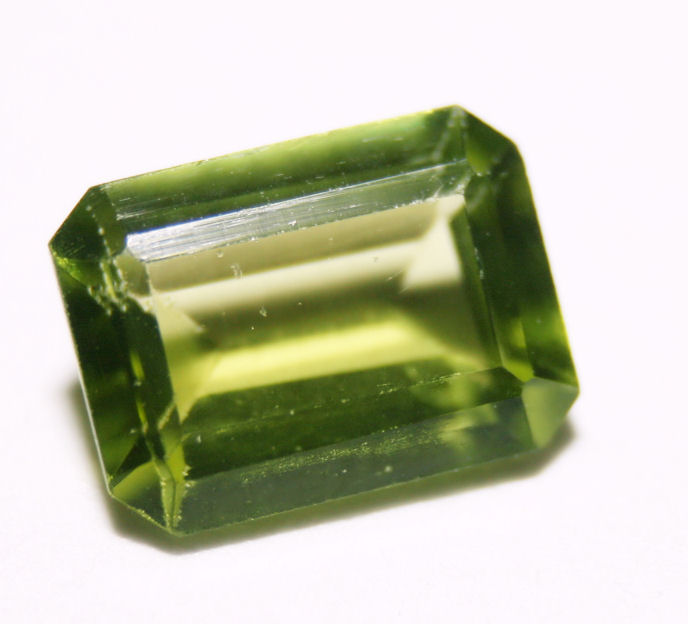
I don’t honestly know if this is interesting or not. It seems plausible that there would be semiprecious stones and crystals in some places, which is quite appealing. Olivine looks quite nice:

By Rob Lavinsky, iRocks.com – CC-BY-SA-3.0, CC BY-SA 3.0, https://commons.wikimedia.org/w/index.php?curid=10448817

This is actually a gemstone, when it’s known as peridot, and can be cut as such:

However, these kinds of olivine are close to being pure magnesium silicate and I don’t know if that applies to lunar olivine.

The existence of crystals gives me to wonder if there are any objects whose formation resembles living things, such as dendritic patterns in rocks or something like desert rose gypsum. It seems unlikely though, since there’s no water to act as a solvent and the place is very uneventful. It’s also likely that if olivine became easily available, since it’s so common on the surface, that it would cease to be a precious stone and if it can be used as fuel it would more or less have to drop in price.

There are no carbonates or sulphates on Cynthia, and also no hydrated minerals. However, there is a little ice in polar craters, which counts as a mineral there more than it does here in a way. These are craters in permanent shadow, and the same is true on Mercury. There is a general problem with raw materials due to the importance of water in concentrating useful mineral deposits here on Earth. Although the metals are often there in some shape or form, they don’t seem to be in the usual readily-extractable ores found here, and this of course reduces the incentive for going back.

Thus far I’ve mentioned the maria, highlands and craters, but there are other selenographical features. For example, although the maria are not real seas, they are smoother than the highlands, darker and have “shores” like the real oceans and seas here have. This means in particular that they have bays and tend to flood craters, the former being craters on the border of maria. One famous example of this is the Sinus Iridum – the “Bay Of Rainbows” – at the northwest of Mare Imbrium. The maria themselves also have features, including craters which are more recent than their formation and other craters which have become submerged under lava when the maria formed, sometimes called “ghost craters”. Lunar domes are present, previously thought to be “blisters” which had not ruptured to form craters in the days before their formation was attributed to meteorite impact, but they are in fact shield volcanoes with central non-meteoritic craters. The most concentrated collection of these is the Marius Hills, which range between two and five hectometres above the surface of the mare in Oceanus Procellarum. Of course, just saying they’re in Oceanus Procellarum is a bit like saying a geographical feature on this planet is “in the Pacific Ocean”, but unsurprisingly they’re near a crater named after the astronomer Marius, who may have discovered the Galilean satellites of Jupiter although their name suggests he didn’t. Among the hills is a forty metre wide pit apparently opening into a lava tube or rille. Lava tubes are basically long, sinuous lunar caves which form when lava solidifies on the outside but continues to flow out of the hollow tube thus formed. Their roofs can later fall in, forming a channel referred to as a valley or rille. Rilles can also form when parallel faults allow the ground between them to fall, in which case they will be roughly straight.

There are also ridges on maria, formed from the contraction of cooling magma, and these are also found on Mars and other moons and planets. They’re officially known as dorsa. Catenæ are also common elsewhere and consist of chains (hence the name) of craters, formed when tidal forces cause meteors to break up before impact. My impression is that catenæ are not as common on Cynthia as on some other bodies in this solar system, but that may be my imagination.

And there are mountains of course, although here a problem arises. On Earth, the height of a mountain is easily expressed as above sea level, though this can be misleading as it makes Everest seem to be the highest, which it may not be because Earth is not perfectly spherical. On Cynthia, a fairly arbitrary decision has to be made which has been given different values at different times, involving deviation from a presumed diameter of a sphere. Height of the peaks above the surrounding surface is easy to measure because they cast shadows and since the angle of the Sun and the distance are both known, it can be straightforwardly estimated. Mountains can be isolated or parts of ranges. The tallest mountain is Huygens, at 5.5 kilometres. This is a little surprising, as one might expect a body with lower gravity to be able to form higher mountains, which would then be fairly immune to erosion due to the practically absent atmosphere. The highest possible elevation of granite on the surface would be something like eighty kilometres, so this is very much in need of an explanation in my mind, and I would guess it has something to do with there not being the same kind of mountain-forming processes on Cynthia as there are here. That said, Mars lacks them too and yet has a mountain over twenty kilometres high. Isolated peaks unlike anything found on Earth occur in the centre of craters.

So to conclude, is this interesting or not? Mere proximity enables us to observe features likely to be found everywhere, even on planets and moons gigaparsecs from here, but as a body Cynthia does have distinctive features too. The maria being confined to the visible side, the presence of mascons to a greater extent than in other known worlds and the presence of transient lunar phenomena are all interesting. The greyness and familiarity make her seem dull, but there’s more to her than might at first be supposed. If she were a continent, her surface area would be second largest, somewhat larger than Afrika, and maybe in a way that’s a profitable way to think of her. She’s like a seventh continent which happens to be in orbit around the rest, more drastically different from them than Antarctica is to the other five, or perhaps a feature of Earth like the bottom of the oceans, and she is interesting. If you could drive there, she’d only orbit the rest of us nine times, and Concorde could travel that distance in eight days, so she really isn’t that far away, and definitely worth going back to. But I can relate to the dullness.

The Anti-Universe

A prominent mythological theme is that of time being cyclical. For instance, in Hinduism there is a detailed chronology which repeats endlessly. Bearing in mind that the numbers used in mythological contexts are often mainly there to indicate enormity or tininess, there is the kalpa, which lasts 4 320 million years and is equivalent to a day in Brahma’s life. There are three hundred and sixty of these days in a Brahman year, and a hundred Brahman years in a Brahman lifetime, after which the cycle repeats. Within a Brahman Day, human history also repeats a cycle known as the Yuga Cycle, which consists of four ages, Satya, Treta, Dvapara and Kali. The names refer to the proportion of virtue and vice characterising each age, so Satya is perfect, life is long, everyone is kind to each other, wise, healthy and so on, satya meaning “truth” or “sincerity”, Treta is “third” in the sense of being three quarters virtue and one quarter vice, Dvapara is two quarters of each and Kali, unsurprisingly the current age, is the age of evil and destruction. Humans start off as giants and end as dwarfs. Then the cycle repeats. Thus there are cycles within cycles in Hindu cosmology.

The Maya also have a cyclical chronology, including the Long Count, in a cycle lasting 63 million years. Probably the most important cycle in Mesoamerican calendars is the fifty-two year one, during which the two different calendars cycle in and out of sync with each other. The Aztecs used to give away all their possessions at the end of that period in the expectation that the world might come to an end.

The Jewish tradition has a few similar features as well. Firstly, it appears to use the ages of people to indicate their health and the decline of virtue. The patriarchs named in the Book of Genesis tend to have shorter and shorter lives leading up to the Flood, which ends the lives of the last few generations before it, including the 969-year old Methuselah. Giants are also mentioned in the form of the Nephilim, although they are seen as evil. I wonder if this reflects the inversion of good and evil which took place when Zoroastrianism began, where previously lauded deities were demonised. There is also a cycle in the practice of the Jubilee, consisting of a forty-nine year Golden Jubilee and a shorter seven year Jubilee, and obviously there are the seven-day weeks, which we still have in the West.

The Hindu series of Yugas also reflects the Greek tradition of Golden, Silver, Bronze and Iron Ages, which was ultimately adopted into modern archæology in modified form as the Three-Age System of Stone, Bronze and Iron. The crucial difference between the Hindu and Greek age system and our own ideas of history is that they both believed in steady decline whereas we tend to be more mixed. We tend to believe in progress, although our ideas of what constitutes that do vary quite a lot. In a way, it makes more sense to suppose that everything will get worse, although since history is meant to be cyclical it can also be expected to get better, because of the operation of entropy. Things age, wear out, run down, burn out and so on, and this is the regular experience for everyone, no matter when they’re living in history, and it makes sense that the world might be going in the same direction. On the longest timescale of course it is, because the Sun will burn out, followed by all other stars and so on.

Twentieth century cosmology included a similar theory, that of the oscillating Universe. It was considered possible that the quantity of mass in the Universe was sufficient that once it got past a certain age, gravity acting between all the masses in existence would start to pull everything back together again until it collapsed into the same hot, dense state which started the Universe in the first place. There then emerge a couple of issues. Would the Universe then bounce back and be reborn, only to do it again in an endless cycle? If each cycle is an exact repetition, does it even mean anything to say it’s a different Universe, or is it just the same Universe with time passing in a loop?

This is not currently a popular idea because it turns out that there isn’t enough mass in the Universe to cause it to collapse against the Dark Energy which is pushing everything apart, so ultimately the objects in the Universe are expected to become increasingly isolated until there is only one galaxy visible in each region of the Universe where space is expanding relatively more slowly than the speed of light. This has a significant consequence. A species living in a galaxy at that time would be unaware that things had ever been different. There would be no evidence available to suggest that it was because we can currently see the galaxies receding, and therefore we can know that things will be like that one day, but they would have no way to discover that they hadn’t always been like this. This raises the question of what we might have lost. We reconstruct the history of the Universe based on the data available to us, and we’re aware that we’re surrounded by galaxies which, on the very large scale, are receding from each other, so we can imagine the film rewinding and all the stars and galaxies, or what will become them, starting off in the same place. But at that time, how do we know there wasn’t evidence of something we can no longer recover which is crucial to our own understanding of the Universe?

Physics has been in a bit of a strange state in recent decades. Because the levels of energy required cannot be achieved using current technology, the likes of the Large Hadron Collider are not powerful enough to provide more than a glimpse of the fundamental nature of physical reality. Consequently, physicists are having to engage in guesswork without much feedback, and this applies also to their conception of the entire Universe. I’ve long been very suspicious about the very existence of non-baryonic dark matter. Dark matter was originally proposed as a way to explain why galaxies rotate as if they have much more gravity than their visible matter, i.e. stars, is exerting. In fact, if gravity operates over a long range in the same way as it does over short distances, such as within this solar system or between binary stars, something like nine-tenths of the mass is invisible. To some extent this can be explained by ordinary matter such as dust, planets or very dim stars, and there are also known subatomic particles such as the neutrinos which are very common but virtually undetectable. The issue I have with non-baryonic dark matter, and I’ve been into this before on here, is that it seems to be a specially invented kind of matter to fill the gap in the model which, however, is practically undetectable. There’s another possible solution. What makes this worse is that dark matter is now being used to argue for flaws in the general theory of relativity, when it seems very clear that the problem is actually that physicists have proposed the existence of a kind of substance which is basically magic.

If you go back to the first moment of the Universe, there is a similar issue. Just after the grand unification epoch, a sextillionth (long scale) of a second after the Big Bang, an event is supposed to have taken place which increased each of the three extensive dimensions of the Universe by a factor of the order of one hundred quintillion in a millionth of a yoctosecond. If you don’t recognise these words, the reason is that these are unusually large and small quantities, so their values aren’t that important. Some physicists think this is fishy, because again something seems to have been simply invented to account for what happened in those circumstances without there being other reasons for supposing it to be so. They therefore decided to see what would happen if they used established principles to recreate the early Universe, and in particular they focussed on CPT symmetry

CPT symmetry is Charge, Parity and Temporal symmetry, and can be explained thus, starting with time. Imagine a video of two billiard balls hitting and bouncing off each other out of context. It would be difficult to tell whether that video was being played forwards or backwards. This works well on a small scale, perhaps with two neutrons colliding at about the speed of sound at an angle to each other, or a laser beam reflecting off a mirror. Charge symmetry means that if you observe two equally positively and negatively charged objects interacting, you could swap the charges and still observe the same thing, or for that matter two objects with the same charge could have the opposite charges and still do the same thing. Finally, parity symmetry is the fact that you can’t tell whether what you’re seeing is the right way up or upside down, or reflected. All of these things don’t work in the complicated situations we tend to observe because of pesky things like gravity and accidentally burning things out by sticking batteries in the wrong way round or miswiring plugs, but in sufficiently simple situations all of these things are symmetrical.

But there is a problem. The Universe as a whole doesn’t seem to obey these laws of symmetry. For instance, almost everything we come across seems to be made of matter even though there doesn’t seem to be any reason why there should be more matter than antimatter or the other way round, and time tends to go forwards rather than backwards on the whole. One attempt to explain why matter seems to dominate the Universe is that for some reason in the early Universe more matter was created than antimatter, and since matter meeting antimatter annihilates both, matter is all that’s left. Of course antimatter does crop up from time to time, for instance in bananas and thunderstorms, but it doesn’t last long because it pretty soon comes across an antiparticle in the form of, say, an electron, and the two wipe each other off the map in a burst of energy.

These physicists proposed a solution which does respect this symmetry and allows time to move both forwards and backwards. They propose that the Big Bang created not one but two universes, one where time runs forwards and mainly made of matter and the other where time goes backwards and is mainly made of antimatter, and also either of these universes is geometrically speaking a reflection of the other, such as all the left-handed people in one being right-handed in the other. This explains away the supposèd excess of matter. There’s actually just as much antimatter as matter, but it swapped over at the Big Bang. Before the Big Bang, time was running backwards and the Universe was collapsing.

In a manner rather similar to the thought that an oscillating Universe could be practically the same as time running in a circle because each cycle might be identical and there’s no outside to see it from, the reversed, mirror image antimatter Universe is simply this one running backwards with, again, nothing on the outside to observe it with, and therefore for all intents and purposes there just is this one Universe running forwards after the Big Bang, because it’s indistinguishable from the antimatter one running backwards. On the other hand, the time dimension involved is the same as this one, and therefore it could just be seen as the distant past, which answers the question of what there was before the Big Bang: there was another universe, or rather there was this universe. It also means everything has already happened.

But a further question arises in my head too, and this is by no means what these physicists are claiming. As mentioned above, one model of the Universe is that it repeats itself in a cycle. What we may have here is theoretical support for the idea of a Universe collapsing in on itself before expanding again. That’s the bit we can see or deduce given currently available evidence. However, in the future, certain evidence will be lost because there will only be one visible galaxy observable, and the idea of space expanding will be impossible to support even though it is. What if one of the bits of evidence we’ve already lost is of time looping? Or, what if time just does loop anyway? What if time runs forwards until the Universe reaches a maximum size and then runs backwards again as it contracts? There is an issue with this. There isn’t enough mass in the Universe for it to collapse given the strength of dark energy pushing it apart, but of course elsewhere in the Multiverse there could be looping universes due to different physical constants such as the strength of dark energy or the increased quantity of matter in them, because in fact as has been mentioned before there are possible worlds where this does take place. Another question then arises: how does time work between universes? Are these looping universes doing so now in endless cycles, or are they repeating the same stretch of time? Does time even work that way in the Multiverse, or is it like in Narnia, where time runs at different speeds relative to our world?

It may seem like I’ve become highly speculative. In my defence, I’d say this. I have taken pains to ignore my intuition in the past because I believed it was misleading. However, there appears to be an intuition among many cultures that time does run in a cycle, and the numbers these cultures produce are oddly similar. The Mayan calendar’s longest time period is the Alautun, which lasts 63 081 429 years, close to the number of years it’s been since the Chicxulub Impact, which coincidentally was nearby and wiped out the non-avian dinosaurs. The Indian kalpa is 4 320 million years in length, which is again quite close to the age of this planet. Earth is 4 543 million years old and the Cretaceous ended 66 million years ago, so these figures are 4.6% out in the case of the Maya and 5% for the kalpa. Of course it may be coincidence, and the idea of time being cyclical may simply be based on something like the cycle of the day and night or the seasons through the year, but since I believe intuitive truths are available in Torah and the rest of the Tanakh, I don’t necessarily have a problem with other sources. Parallels have of course been made between ancient philosophies and today’s physics before, for example by Fritjof Capra in his ‘The Tao [sic] Of Physics’. Although much of what he says has been rubbished by physicists since, there is a statue of Dancing Shiva in the lobby at CERN and one quote from Capra is widely accepted:

“Science does not need mysticism and mysticism does not need science. But man needs both.”

UFOs

I don’t always give myself much time to think up ideas for these posts because I’m trying to produce one a day. Today it looked for a moment that it was Flying Saucer Week, but in fact that was in March, but it’s probably worth writing about them anyway, so here it is.

It’s trivially true that Unidentified Flying Objects exist, since a UFO is nothing other than an object in the sky whose nature is unknown to an observer. More specifically, if one person doesn’t know what something is, someone else might. Presumably the stricter definition, based on the original use of the term, would be of an aerial object whose identity was unknown to any observer. As a philosopher, I have to inject a note of doubt here since I see knowledge as belief which it’s rationally impossible to doubt, making absolutely everything which one believes to be in the sky a UFO, but that’s not a useful definition. Google Ngrams, a search engine for historical textual references on paper as well as, presumably, online text in more recent decades, shows the word UFO to have been used first in the late 1930s, to have climbed rapidly in incidence from 1950, peaking in 1978 (around the time of ‘Close Encounters’ but is that cause or effect?), then again in 2000 (‘X-Files’? Same question) and finally in 2012, which I suppose could’ve been connected to the 2012 phenomenon. As for ‘flying saucer’, they start in 1940 or so (whenever the term was invented, by a pilot), peaking in 1955 and then again in 2012. The curves are rather similar. I could do this all day, but finally, the term “little green men” begins in Georgian times, takes off in the 1930s and climbs slowly but steadily up to the present day. This illustrates the fact that “little green men” used to mean leprachauns, then got transferred over to presumed humanoid aliens.

Historically, the perception of UFOs predates the invention of either term by millennia. They’re referred to in ancient sacred texts, by Roman philosophers and others, including astronomers, and the “airship flap” of the 1890s, but reports of their observation peaked in 1957, which is of course when the Soviet Union sent Sputnik 1 into space. It is not in fact the case, as is often asserted, that they are never seen by trained observers such as astronomers and military people, although they are unsurprisingly less often seen.

Before you jump to the conclusion that I believe our planet is regularly visited by visible alien spacecraft, I want to emphasise that I absolutely do not. There are multitudinous problems with this idea. Firstly, if UFOs were alien spacecraft, the question arises of how a technology capable of sending spacecraft across interstellar space with intelligent life on board wouldn’t also have technology which enabled them to avoid being detected. Secondly, the beings associated with UFOs are humanoid, which practically guarantees that they wouldn’t be alien, although there’s another possibility there which I used to consider as a child but have since rejected. Thirdly, there wouldn’t be a government cover-up of UFOs because there’s no reason to suppose that aliens would respect human hierarchies or governments, so if anyone knows about them, “anyone” would, not just people in the higher echelons. This is predicated on my belief that hierarchical societies can’t last long enough without destroying themselves to achieve interstellar travel, but it’s possible that they would respect our system I suppose.

I’ve talked about the idea of humanoid aliens before. There are three possibilities here. There could be few or no humanoid aliens because of the manifold vagaries of evolution, there could be many due to convergent evolution, or humanoid aliens could be manufactured or genetically engineered as ambassadors to the human species. If there are few rather than no humanoid aliens, those could also be deployed as ambassadors. However, since it isn’t even clear there are any other life forms at all in the Universe, I think it’s safe to say that UFOs with “aliens” of that kind on board are not spaceships from elsewhere. Consequently, back when I did believe in UFOs of this kind, and Barney and Betty Hill’s experience is an example of remarkable evidence for them although still not enough to make me believe any more, I thought they were time machines. A famous representation of this idea is found in the 1980 Play For Tomorrow ‘The Flipside of Dominick Hyde’, whose main character travels back to 1980 and becomes his own ancestor, as one does. However, Dominick Hyde is from the fairly near future. My own version of this hypothesis was that they were from many millennia into the future, because they were significantly physically different from us.

I’m not sure exactly where to fit this bit in, so I’ll put it here. It’s been noted that UFOs tend to take one of three forms: “cigars”, “saucers” and spheres. A four-dimensional hyperspheroid analogous to the shape of an oblate spheroid (a squashed ball with long axes of symmetry in one dimension and a short one in the other, like a slim discus) would intersect with our own three-dimensional space in these three ways. Imagine a discus being sliced in various ways. It could look like a sausage shape, a circle or an oval, and a four-dimensional analogue could manifest the same way in our space. Then again, glimpsing an object of an approximately discoid shape would also be mistaken for those three shapes, so there may be no need to jump into hyperspace for this one.

Avro Canada VZ-9 Avrocar

This is a VTOL aircraft called an Avrocar, introduced in 1958 as part of a secret Cold War aircraft programme. It uses the Coandă Effect, which is the tendency for a jet to remain attached to a convex surface. This is undoubtedly a real aircraft which is also undoubtedly saucer shaped. It is almost literally a “flying saucer”, and this is where I think an explanation for UFOs of the more convincing kind is. I’m afraid this is going to be a bit of a conspiracy hypothesis on my part.

Back in the late 1970s, I saw a “flying banana”. Actually, not a flying banana, which is a heavy helicopter with rotors at front and back, but a Mil V-12, which looks like this:

I don’t understand how I can have seen this helicopter, because it’s a Soviet aircraft and the Cold War was seriously on at the time. Nonetheless I did, and it flew over my house in Kent. I remember the red, white, blue and silver colour scheme and it took me a long time, several years ago, to track this down, but this is undoubtedly what I saw. However, I drastically overestimated the distance and thought it was three miles long, and genuinely believed it to be an alien spacecraft for quite some time. I still don’t know what it was doing there, but presumably the British government knew about it because there are no reports of it attacking anything or being attacked, and it seems unlikely that that could’ve been hushed up. It happens to be the largest helicopter ever built, but it is not three miles long. As far as I know there are no similar NATO helicopters in the sense of the colour scheme, although there are transverse rotor ‘copters aplenty.

I have built up a hypothesis around this single data point which I think accounts for many UFOs. I believe UFOs are sometimes secret military aircraft. Governments are at peace with the idea that a lot of people think they’re alien spacecraft and make a big fuss about there being a cover-up, because the people concerned are, not wishing to insult anyone, “useful idiots”, as the phrase has it. That is, people supporting a cause without realising the full implications intended for that cause. The LGB Alliance comes to mind here, for example. Incidentally, although this phrase is attributed to Lenin, he doesn’t seem to have said it. Anyway, reports of UFOs by untrained observers when they are in fact secret military aircraft combined with public perception of the people concerned as delusional would be a convenient way of hiding such a programme. I’m not saying that’s definitely what happens, but as far as we know there’s only one species able to discover this kind of technology, it’s a fact that NATO used flying saucer-like craft in the 1950s and it is at least a more plausible explanation than the idea that they’re alien spacecraft. I am, however, not particularly attached to this idea. I think probably most of the time people see Venus and misidentify it.

One of my favourite little details about British post-war history is that British Rail once designed a flying saucer. The way this happened is rather convoluted and the craft involved would’ve been pretty environmentally unfriendly. A diagram is shown above, appearing in their patent application, GB1310990, made in March 1973. Here’s an extract of their text:

A space vehicle includes a platform under which is provided a thermonuclear fusion zone to which liquid fuel is supplied under pressure to be ignited by beams from lasers. The platform mounts electromagnets, possibly superconducting magnets, to deflect charged particles produced by the fusion reaction; some particles are deflected so as to be received on insulated electrodes for generation of electric power. Excess thermal energy produced in the reaction is removed by cooling tubes to a radiating surface. The lasers may be energized by an homopolar generator. The latter may also be used as a reference for stabilizing the vehicle by varying the electrostatic voltages on sections of the electrodes to apply a correcting couple to the vehicle. By controlling voltages on sections and also the fields from magnets, the thrust on the vehicle can be directed to control the attitude and direction of the craft. A passener cabin is included.

This seems to involve the expulsion of large amounts of ions. Apparently, and I’m speaking from memory here, there was a department within British Rail which was given free rein to come up with projects like this, and it seems that this evolved out of an idea for a train station platform which could raise itself to ease access to carriages by passengers. It employs two pieces of technology which have yet to be cracked properly. One is fusion power, which is always thirty years away from being realised, and has been since the War, a bit like a human mission to Mars really. The other is superconducting magnets, which exist and are even used in MRI scanners, suitably cooled, but superconductivity at room temperature may never be achieved although there has been some progress in recent decades. It was designed by someone called Charles Osmond Frederick. The patent lapsed in 1976 and is quite famous, and also taps into the optimism following the Space Race, and really the question is not how far out of touch with reality this is, but why something like it didn’t happen. I don’t think technology could have advanced fast enough for it to have happened in the twentieth century, but maybe if the will was there it could have. Fusion reactors, though, have various problems. One is that the radiation inside them is so intense that it would make the casing dangerously radioactive and also brittle, meaning that although there may not be radioactive waste from the fuel itself they would still produce it and be remarkably unsustainable. It’s possible to trigger a fusion reaction but only recently has more energy been gained from it than had to be put in to create it. The alternatives are pellets and magnetically confined plasma, the problem with the latter being turbulence in the plasma making it hard to contain. It also uses tritium, which is rare – one hydrogen atom in 32 million is tritium. This tritium is also lost into the casing and the water in the coolant, or most other coolants. Tritium is radioactive. As for superconductivity, this can be done using liquid helium but with both of these technologies lots of massive matter is involved, so it seems unlikely that the flying saucer could take off.

The picture at the top of this post shows the Futuro Pod, a mainly fibreglass structure which was mass-produced in the late ’60s and early ’70s. It probably counts as a “tiny house”. There are about four dozen of them, designed by the Finnish architect Matti Suuronen as a mountain cabin, and were killed off by the Oil Crisis as they’re made of plastic. Today they’re very expensive. They aren’t even particularly suitable as permanent accommodation but are more like log cabins or bothies, so it can be presumed from “real” flying saucers that the people on them are either very small, and they are after all little green people, or on a day trip, perhaps from a mother ship, in which case they’d probably have to travel much faster than light. Having said that, a Futuro is eight metres across and four metres high, which is a lot more space for a being of half human stature, so maybe.

Finally, there’s the obvious religious aspect of the whole thing. If someone lacks the option to believe in some of the old-time religion due to either rationalising it away or not being exposed to it in the first place, it does make sense to project spiritual beliefs onto the sky, so these craft and their occupants could be seen as angels or deities, or even perhaps demons. I personally find it a little difficult to dispell this idea and I’m theistic, so it’s understandable that belief in UFOs would fill the vacuum. But I’ve discussed this in depth elsewhere so I shan’t bother with it now.

“What Is The Universe Expanding Into?”

Steve, I wrote this with you in mind.

Yahoo Answers is, as I mentioned previously, about to die, although it’s a death by a thousand cuts. In the past I’ve used this blog to put more thoroughly thought-out answers to frequently-asked questions on the site, so I’ve probably addressed this before, but right now I have a different and perhaps less dogmatic take on this question than I usually adopt. Before I go on, I should probably insert the standard diagram people put in nowadays when talking about the Big Bang:

Strictly speaking, this diagram is inaccurate because it shows a two-dimensional projection of a three-dimensional model of a four-dimensional set of circumstances. Take the barred spiral galaxy at top right. If the X-axis is supposed to be time, we should be concluding that the left hand arm of that galaxy happens first, then the end of the right hand arm and the nucleus, and finally the middle of the right hand arm. Also, space is two-dimensional in this picture when for most practical large-scale purposes it really has three dimensions. In other words, this isn’t so much a diagram as an illustration intended to communicate the history of the Universe since the Big Bang. You can’t take it too seriously. It has an artistic, creative aspect.

One possibly inaccurate, because it isn’t really intended to be that accurate, feature of this diagram is the way it shows space. It’s a black rectangle into which the Universe is expanding. There is an outside to this Universe, and at that point you’d be forgiven for asking, if the Universe is everything, what’s the blackness outside it supposed to be? Why is that not also the Universe? The Jains, of all people, had an answer to this. They believed that the Universe as we know it was suffused with a substance which made movement possible, but was surrounded by infinite space from which this was absent. Nowadays, maybe we could do something similar with the idea of dark energy, the apparent force which causes the Universe’s expansion to accelerate. The above picture has a literal “bell end”. It flares out rather than widening steadily or perhaps slowing down from left to right. This is the influence of dark energy, as it represents accelerating expansion. I suppose it’s possible to think of the Universe as infinite space with at least one region where dark energy is active. However, this is neither how I think of it nor, as far as I know, the way scientists do.

Before I go on, I want to make a point about the nature of science at this scale. In certain circumstances, rational thought is “bigger” than science. Maths is one example of that. There’s plenty of pure mathematics which seems to have no practical application and even applied maths doesn’t need to be tested by observation if it’s proper pure maths. For instance, it’s a mathematical truth that any roughly spherical planet covered by an atmosphere must have at least two points on its surface where there’s no wind at any moment, although these points may move. However, our oceans needn’t have any points where there’s no current because there’s land on this planet. Likewise, a doughnut-shaped planet needn’t have any such locations, nor need any planet with at least two mountains high enough to stick up into the stratosphere. There’s no need to observe any planets to prove this because it’s a mathematical fact. I’m not entirely sure about this, but I suspect that cosmology may also have aspects of this: it may not be possible to approach the nature of the Universe entirely scientifically because there’s by definition only one example of the Universe and it can’t be compared to others. This is a particular view of the nature of the Universe which either includes the Multiverse as part of the Universe or in some way demonstrates that this Universe is all there is. There are a number of conceivable ways in which there could be other universes, but some of the arguments for it not only rely on logic and maths but also require that they cannot be observed even in principle. For this reason, without disrespecting the field, there’s a way in which cosmology cannot be scientific. James Muirden once said:

The Universe is a dangerous place – a sort of abstract wilderness embracing the worlds of physics, astronomy, metaphysics, biology and theology. These all subscribe to the super-world of cosmology, to which students of these various sciences can contribute. Strictly speaking there is no such person as a ‘cosmologist,’ for the simple reason that nobody can be physicist, astronomer, metaphysicist, biologist and theologian at the same time.

James Muriden, ‘The Handbook Of Astronomy’ 1964.

It isn’t clear though whether something which is outside the realm of science will always remain there, and in this view, it may be that there’s not in principle something imponderable about cosmology if the mind pondering it is sufficiently powerful, but simply that the span of disciplines is too broad for anyone to grasp. There certainly seem to be cosmologists nowadays, but maybe they’re cosmologians.

Although I don’t want to dwell on that, I do want to point out that it isn’t immediately obvious what space and time are. The nature of space in particular seems to depend on observation. It’s possible to doubt the existence of space but not the passage of time, since as far as we know we are disembodied viewpoints imagining the world but we can only do that imagining if time passes. This is in spite of the fact that spacetime is unified, so it isn’t clear how we’re immediately confronted with time but not space. Maybe there are more advanced minds in the Universe who experience both with the same immediacy. But there are, in any case, at least two different ways of thinking of space and this is what I usually based my answer on.

Space can be thought of as a thing or a relationship. That is, it could be understood as a container, as it were, in which objects are located, but also an object in itself. The Universe clearly is an object, but that doesn’t mean it’s made of space and studded with galaxies like spotted dick. There is a famous “balloon” analogy applied to space, which views the galaxies as spots on the surface which move apart from each other as the balloon inflates. This makes it sound like there’s a hyperspace into which the Universe is expanding, but this may not be the case.

In maths and physics, the concept of space is often used to make arcane ideas simpler. For instance, up, down, top and bottom quarks seem to refer to direction and location, but of course they don’t. They’re just called that to indicate that they are related to each other more closely than they are to other quarks. Likewise, we might talk about the temperature rising and falling, but that doesn’t mean there’s a spatial dimension called temperature. This can even be taken into the realm of space itself. We impose the idea of several dimensions on the idea of direction and temporal precedence, but there are reasons to suppose that this is mere convenience.

Suppose space is an actual thing. What would happen if there was a tear in it? It would surely mean that one could go into that tear, wouldn’t it? But how could that happen if there was no space there, since it’s torn? Does it mean anything to say that you can take a one metre sphere out of space? What happens when you move “into” it? How would it be different from a point? This suggests that there’s a flaw in thinking of space as the fabric of the Universe.

Consequently, space can be thought of as a combination of direction and location. Location can be described, more or less, using three numbers, although since there are higher dimensions this doesn’t work perfectly. It is, however, true, that relative to one’s current position a list of numbers is sufficient to describe where something else is. This tells you how far away something else is and in what direction. However, there is no absolute position. The Universe has no centre, or its centre is everywhere. This would also be true if space is infinite but it isn’t. However, as I’ve just said, space cannot have an outside, so how can this be?

The answer is that there is a maximum distance between two points, after which the direction between them reverses. This follows from the fact that the parallel postulate is incorrect: parallel lines do in fact meet at an enormous distance in most circumstances, and nearer than that in special circumstances to do with extremely high gravity. These are just properties of that group of qualities we refer to as space or spacetime, in a similar sense to addition working the same way either way round and subtraction not. When it’s said that space is expanding, all that means is that the maximum possible distance between two locations is increasing. That doesn’t imply that any actual object is expanding. A further clue to this being so is that although it’s impossible to travel faster than light, sufficiently distant objects do recede from each other at superluminal speeds. This would be impossible if space was an object unless the mass of such an object could only be expressed by a number on the complex number plane, but the distance between nearby locations increases at less than the speed of light, at a specific distance at the speed of light and at a greater distance greater than the speed of light. This is impossible for a single object because it would have to have real mass in small quantities, zero mass at the volume of the observable Universe and imaginary mass at greater than that volume. I have to say that’s an interesting set of properties and I’m not sure if it really is impossible.

The point is that in this view the Universe has no outside or, in terms of hyperspace, no interior. It clearly does have a three-dimensional interior, but not an interior in terms of a larger set of large dimensions. This account is slightly complicated by the fact that as well as time there are tiny further dimensions, but it usually makes more sense to measure the length of a pencil line than its area.

That’s an expanded version of my usual answer to the question “what is the Universe expanding into?” but it could be wrong. The reason it might be wrong is fascinating, and therefore probably not valid, but here it is anyway: ‘Brane Theory.

You might think at first that Brane Theory is just “Brain Theory” spelt wrong. That would be funny, but sadly it’s not so. Brane Theory is an extension of string theory and although I’m not afraid of maths, I can’t understand it fully. I’ve already mentioned the issue of extra dimensions which are, however, tiny. Brane theory uses this idea to explain why gravity is so much weaker than the other forces, if indeed it is a force. It isn’t immediately clear to observation, but there seem to be three major forces in the Universe plus gravity: electromagnetism, the strong force and the weak force. Of these, electromagnetism is obvious except that it may not be realised that light is part of electromagnetism. The strong force prevents atoms other than hydrogen from exploding as soon as they form, since their nuclei are made up of positively charged particles which repel each other. The weak force is a bit more obscure, and might be better described as the weak interaction because it doesn’t involve attraction or repulsion. It amounts to a tiny force field which occurs when radioactive decay involves atoms emitting beta particles, which are fast electrons. When a nucleus releases an electron, because it’s negatively charged and there are no negatively charged particles in the nucleus, a neutron becomes a proton, or the nucleus emits a positron and a proton becomes a neutron. In the former case it means the element moves one place up the periodic table. But nothing is pushing or pulling, which makes it confusing. The strong and weak nuclear forces are very small scale in their range, only operating within atomic nuclei, and for some reason the strong nuclear force is 128 times weaker at double the distance. Electromagnetism is more straightforward, probably because we experience it ourselves directly and obviously in the form of light, current, magnets, compasses, lightning and so on, and it diminishes like gravity, following the inverse square law. That is, for example, a light source emitting light all around it such as the Sun will do so in a sphere and because a sphere twice the size has four times the volume, it will be a quarter as bright from twice as far away. Gravity may not even be a force at all, but the distortion of spacetime by mass, and is anomalously weak. A magnet can pick up a piece of iron against gravity even if the magnet only has a mass of one gramme, yet Earth’s mass is nearly six quintillion (long scale) times the mass of the magnet. That’s ridiculously weak.

Brane theory, at least sometimes, attempts to solve the problem of gravity being as weak as it is by using extra dimensions. Instead of exerting a force in three-dimensional space, gravity may be doing so in hyperspace, which means that instead of weakening due to the geometry of a sphere, it does so due to the geometry of a higher, multidimensional cousin of a sphere, but the other forces are confined to three-dimensional space, in a thin membrane, hence the name “Brane Theory”, which is of course expanding in hyperspace. It’s also theorised that just after the Big Bang, in the part of the above diagram labelled “inflation”, this Universe collided with another one, causing this inflation.

So in other words, perhaps it isn’t a silly question to ask what the Universe is expanding into. This still doesn’t require space to be a thing, but makes the galaxies and stars into a thin, three-dimensional skin on a four-dimensional or multidimensional bubble. The answer is therefore possibly that the Universe is expanding in hyperspace, which is also not a thing but a way of describing distances and directions which need more than three numbers relative to where you are.

A few bits and pieces I want to clear up. This might all be thrown up in the air by the recent discovery of the way muons precess, because that suggests that the standard model of particle physics is wrong. And finally, I may have got this wrong myself. That is, what I just said might turn out to be nothing like what Brane Theory actually is. But note this: it’s maths and I’m not afraid of it. Lots of people are afraid of maths, and think they’re no good at it. I may well also be no good at maths, but I’m not afraid of it. This is a tangential point but very important, and probably has more bearing on everyday life that Calabi-Yau manifolds and stuff have anyway.