Several of the planets, or former planets, in this Solar System have a kind of iconic symbolism to them. Saturn is the “classic” planet with the ring round it. If you want a symbol of a planet, it serves well, mainly because otherwise a symbolic planet would just be a circle with no particular significance. Mars and Venus benefit from being next to Earth, Venus being the “planet of love” and Mars the “planet of war”, which is why we get invaded from Mars a lot in old sci-fi. Saturn, Uranus, Neptune and Pluto have all also been seen as the “outer limits”: as new discoveries were made, each of them was demoted from this position. In ‘Last And First Men’, Olaf Stapledon has the human race move to Neptune to escape the Sun’s increasing radiation about an æon from today, and although he acknowledged the existence of several planets beyond Neptune, he was writing just before Pluto was discovered and hence his Neptune occupies that rôle right then. Saturn worked very well in this niche because of its prominent rings, forming a kind of pale around it which reinforce the idea of limits. But for many of us alive in the last two-thirds of the twentieth Christian century, Pluto fills that slot.
Pluto has a remarkable astrological history which makes me wonder about the nature of that approach as opposed to the science of astronomy. Astrologers have been known to call Pluto “Lowell-Pluto” to distinguish it from the other astrological Plutos, Pagan-Pluto, Wemyss-Pluto and Thierens-Pluto, each named after their respective astrological advocates. The first of these is associated with Scorpio, like the Pluto we’re most familiar with, and was designated in 1911, nineteen years before Pluto was discovered. Wemyss-Pluto is far out, with a sidereal period several times that of Pluto as we know it, of 1 566 years, and rules over Cancer rather than Scorpio, and Thierens-Pluto is a renamed Osiris, a hypothetical planet paired with I*s*i*s (not sure what search algorithms do with that sequence of characters sans stars), and is one of four trans-Neptunian planets. All of these are known as hypothetical planets in astrology, and some have been given ephemerides (tables of their movements and conjunctions etc.). I won’t cover all these in enormous depth, but just want to observe that it’s interesting that astrologers “discovered” Pluto under that name long before it officially received it. Traditionally Scorpio was ruled over by “Negative Mars”, which makes sense because of the red giant Antares – “anti-Mars” – in that constellation. Negative Mars is nocturnal, feminine and negative as opposed to the Martial attributes of diurnality, masculinity and positivity. In astrology, there is a negative planet for each positive one, also referred to as feminine planets, although as I understand it this idea is not currently used.
Astrologically, Pluto is a disrupting and disturbing influence in keeping with the original idea that there had to be a massive planet beyond Neptune which was perturbing the orbits of planets further in, and also Pluto is a bit of an oddball, considered as a planet, because it isn’t a gas giant, unlike the four planets beyond the asteroid belt. Besides that, its orbit brings it closer to the Sun than Neptune for a dozenth of its year. Being associated with the underworld, partly because of its name, it also has associations with crime and “degeneracy”, and also obsessions. The era of its discovery is also considered significant. There have been attempts to write an extra piece for Holst’s ‘The Planet Suite’, composed before its discovery, which to my uneducated ear sounds appropriately atonal and modern, perhaps like Charles Ives or Messiaen.
Pluto, then, is Ultima Thule. Ultima Thule is the most distant location for the Greco-Roman world and it isn’t clear if it’s a real place. The Orkneys, among other islands, have been suggested as its real world equivalent. The original name was Thule, but it became metaphorically associated with the most distant possible place, hence “ultima”, meaning “last” or “final”. The back of beyond, in other words. The name Ultima Thule was also applied to a very distant trans-Neptunian object, 486958 Arrokoth, visited by the New Horizons probe after Pluto. It’s also given a name to the sixty-ninth element, thulium, I’m guessing because it’s the rarest of all the stable rare-earth elements, or was considered to be so at the time of its discovery. Thule was also used in Nazi ideology as the name for a far northern original homeland of the Aryan folk, and due to that association the name is no longer used for the object encountered above, Arrokoth, which was named officially by a Pamunkhey tribal elder in a ceremony in November 2019.
The “Ultima Thule” idea clearly has great power, and for a long time Pluto was a modern version of this notion. For instance, in ‘Not The Royal Wedding’, one of the ‘Not The Nine O’Clock News’ books, Brezhnev’s share of the royal wedding cake was described as the size of “a microbe’s frisbee seen through the wrong end of a telescope well beyond Pluto”, i.e. something very small indeed, and also distant. This is of course just one of countless examples of “Pluto as metaphor” used between 1930 and 2006, in which it has the attributes of being very cold, dark and distant. In fact this doesn’t quite work as well as might be thought, but before I go into that it’s fair to observe that one reason Pluto is such a potent symbol is that very little was known about it for a very long time, allowing all sorts of thoughts to be projected onto it from a great distance, with little accountability in a way, because it seemed unlikely that anyone would ever find out much about it.
I can’t help thinking that if the International Astronomical Union had decided to demote Pluto earlier, it would’ve been less likely that New Horizons would ever have been sent there. It was launched only seven months before the decision, and plans must have been underway for many years before that, so the mere act of changing Pluto’s status right then probably wouldn’t’ve been enough to do it, but had that happened long before, or if Pluto had never been considered a planet, I don’t believe the mission would’ve taken place. It’s fine to send a spacecraft to some Kuiper Belt objects, and also interesting and useful, but I don’t think it would’ve been good publicity for NASA to do that if it had never been regarded as a planet. The sheer distance probably makes it seem like an excessive mission to the minds of many non-astronomical folk, and it might therefore be associated with the idea that it was a waste of money. Nevertheless, we got a mission and I’m very happy personally that we did.
The surface temperature of Pluto is -226 to -240°C. Although this is colder than Uranus, that rather than Pluto is now deemed the coldest planet in the Solar System. NASA gives a temperature of -233°C. There’s no denying it’s cold. Only three elements would be gaseous at that point: hydrogen, helium and neon, although on a hot “day” fluorine would be close to achieving that. However, it’s still above the ambient temperature of almost all the Universe, which is -270°C, and of course well above absolute zero. There’s a remarkable story by Larry Niven of an astronaut who has frozen on Pluto but whose nervous system becomes superconducting during the day when the temperature gets high enough and is therefore still conscious, waiting perhaps centuries to be rescued, unable to move, which sounds like a recipe for madness or Hell, rather appropriately for a planet named after the kind of the underworld. Not a fiery Hell though.
It’s often said that the Sun is just a star from that distance. That is true, because it’s forty times as far as Earth from it, meaning that it wouldn’t show a visible disc to the naked eye, but on the other hand the Sun would still be hundreds of times brighter than Cynthia at its brightest, and would illuminate the dwarf planet about as strongly as the light we experience just after sunset. The surface wouldn’t look poorly-lit to us there. There would also be the light from Charon, a relatively extremely large and close moon, which is locked into the same position in the sky at all times, and is therefore invisible from the other side, and of course the other moons.
The coldness of Pluto has sometimes been represented in paintings of its surface in the form of the likes of snow and icicles. Whereas this communicates, mildly, the conditions there, it seems unlikely that it ever actually snows there at all. On Neptune’s moon Triton, the nitrogen atmosphere snows in the eighty-two year long winter. A point needs to be made here about Pluto’s climate and the influences on it. Pluto is not strongly illuminated by the Sun, but has a very eccentric orbit and a considerable axial tilt. Because of the weak radiation at that distance, the tilt, which would normally strongly influence the weather and seasons, such as they are, is less significant than the highly elliptical orbit. The axis tilts between 102° and 126°, which can also be thought of as being 54° and 88° but rotating in the reverse direction to most of the planets, and this means it has overlapping polar and tropical zones rather than polar, temperate and tropical ones. It sounds a bit weird to talk about Pluto having a tropical climate, and this is only relative as of course the maximum temperature at the equator at midsummer during its closest approach to the Sun is still enormously colder than the midwinter temperature at our own South Pole, which is true in fact of every planet from Jupiter outward though not necessarily their moons, but on Pluto water is effectively a kind of rock anyway so it’s not like we’re talking about rain and snow. Also, water ice is not the main constituent of the surface but frozen nitrogen with some methane and carbon monoxide. It’s easy to think of the carbon monoxide as a poisonous gas, but again, since its freezing point is -205°C, once again it’s something of a technicality that it happens to be toxic to us life forms living thousands of millions of kilometres away on a world so hot that we have oceans of molten rock, comparatively speaking.
Pluto’s day lasts getting on for a week. 6.4 days is a more accurate figure. The star that is the Sun would therefore be below the horizon in some places for more than three days at a time, and because of the highly tilted axis it would be in the sky for over a century, followed by more than a century of night. And it would in fact look very different when it wasn’t there because the night would be dark like ours, though perhaps lit by an extremely large and close moon in the sky, permanently hanging in the same position.
What, then, would it be like to live there? There is actually a more pressing question here: what would be the point of living there? Why would anyone bother? It took New Horizons nine and a half years to reach it and it takes five hours to send a signal at the speed of light over that distance, so people are not really going to be having real time conversations with anyone on Earth, or for that matter Neptune. There seems to be no practical reason at all to go there. Jupiter is a rich source of hydrogen and helium, Mars is relatively nearby and might once, or maybe even still, has life on it, but living on Pluto wouldn’t be much different from living in a space habitat that far out with the added difficulty of making it hospitable rather an building a friendly environment from scratch. There’s also a serious lack of useful resources within easy reach, and the surface gravity is extremely low at only a fifteenth of hours, meaning that unless something was done to maintain muscle mass, bone density, cardiac health and the like, living there would be a life sentence. You’d never be able to return to Earth, assuming you’d come from here in the first place. I think probably the main motive would be to do something extreme, a little like walking to a pole. It’s a Ranulph Fiennes-type thing to do. I can imagine the rest of the human population of the Solar System rolling their eyes at people choosing to live on Pluto and wondering what the heck the point of it all was.
This is not to say that the place has no merits. Its orbit is sufficiently large that the Centauri system would actually just about visibly shift position in the sky through the year, although only people who lived to 120 would be able to experience that and it’s hardly noticeable. There may be at least two active volcanoes there, Piccard and Wright near the south pole. There may also be a very deep internal ocean of water, which could conceivably have life in it. The whole world is smaller than our moon at 2376 km diameter, giving it a surface area about the same as Russia and a little larger than Antarctica. The micronation of Aerica claims part of Pluto as its territory, which seems to be another “Ultima Thule” thing, and the Empire also claims a made-up planet called Verden.
In some ways, the world is quite rich in resources, if by “resources” you mean the likes of water and oxygen. You’d never go short of those. However, if you wanted metal or many other minerals essential to life, you might get a bit stuck unless you took them with you and kept them in a closed cycle. Nitrogen is fine, but there’s the usual issue with phosphorus and possibly even sulphur. If the ocean exists and there is any cycling between the mantle and crust, there might be some heavier elements in the form of salts where water ice outcrops exist. There are nitrogen glaciers fed by the thin atmosphere precipitating out in the “winter”, whatever that is, which tend to smooth out craters. Unlike elsewhere in the Solar System, this ice would be soft and gelatinous. There do appear to be winds of some kinds because there are streaks of red material. It isn’t clear what that red material is, because it isn’t tholin. You could even get something like fossil fuels from the place because there’s methane ice on the surface.
What I have in mind, then, is a kind of horizontally-oriented rotating wheel oriented somewhere either in sunlight lasting a century or so, or in a region where the day-night cycle is about six days. It would need to rotate to keep the inhabitants healthy. It could be warmed by burning methane or hydrogen, and there would be no concern regarding sources of water, oxygen or nitrogen, but other materials, including metals, would be sparse and this suggests that the base would need to be made out of some kind of synthetic material, which I would call plastic except that this makes it sound like it’s weak and flexible whereas I have something much tougher in mind. There would be relatively little risk from ionising radiation because there’s nowhere for it to come from.
But as to whether there would be any point, apart from proving it’s possible, I do not know.
Back in 1987 CE, I finally got round to joining Leicestershire public library. In a way this was entirely superfluous as I was also a member of Leicester University library (and still am, because that’s how it works, although I lost my card a long time ago and last used it in the late 1990s), but the kind of books were different. I used it to get a quick overview of subjects I needed to study in more depth as part of my degree, and also for novels and art books. One of the first books I took out, after Hugh Cook’s ‘The Shift’ which incidentally I highly recommend, was Brian Stableford’s and David Langford’s offering ‘A History Of The Third Millennium’, which is an unfiction book whose image I shall now try to retrieve from the dark recesses of the web:
(actually that’s just Wikipedia). The illustration of the nautilus shell you see on that cover is in fact one of several options, including the acorns which I’ve seen on mine and the library copy, and is a hologram rather than a two-dimensional photograph. There was also a paperback version which I used to own:
The big, hardback version (whereof there was also a large-format paperback I think) scored over the small paperback in the lavish, full-colour illustrations and of course the hologram on the front cover. I don’t know if anyone reading this remembers UB40’s 1982 album UB44:
This was the earlier, limited edition, bearing a hologram, replaced soon after by this:
I actually quite like the second cover as well.
So the thing is, if you were living in Britain in the ’80s, you might have got the impression that the future would have lots of holograms in it. Oddly, the only holograms we seem to see regularly are on back cards. I do not know why this is. It seems to me that they’re still pretty groovy (geddit?) and that they ought to be all over the place, but they aren’t. They do have their drawbacks. For instance, this form of hologram doesn’t display real colours but shows a spectrum of them across the image. There are ways around this but not with printed still images. Nonetheless, representational holograms at least were a fad which went out of fashion and I don’t know why. They were probably replaced by Magic Eye images, also known as random dot stereograms:
I’ve made a few of these, on a Jupiter Ace. They’re quite easy. Another possible visual replacement is the Mandelbrot Set, in a sense.
Just as holograms have gone out of fashion, but seemed like the future at the time, some of Langford’s and Stableford’s book also, unsurprisingly, proved to be highly inaccurate and projected the trends of the time unrealistically, as it turned out, into the future, but other aspects were bang on. There’s also something about the illustrations not being CGI which forges a connection between the reader now, when we are very accustomed to it, and the fact that some of them, although obviously manipulated in an analogue way, had to be based on real models at some point, which gives them a vividness lacking in computer graphics. I almost feel sad to say this because I was very into CGI as a teenager and my main motivation for interest in computers was their possibilities in that direction, but the idea has a kind of soullessness to it which is quite saddening. It isn’t about whether they’re convincing but the need to feel an anchor in the physical world. There’s also artistry in how the images must’ve been created when they are fake. It’s a little like the ingenuity of helical scanning on video cassettes to make it possible at all.
The most glaring anachronism is that the world depicted has the Soviet Union and the Warsaw Pact persisting for centuries, although it also sees Stalinism as dwindling to nothing very quickly. It was published around the time Gorbachev came to power and after a short period it became obvious that he was going to take the USSR in a very different direction. However, it also predicted that entrepreneurial capitalism would come to an end and that planned economies would become the norm, and this is really what’s happening, particularly in the wake of Covid. What we have now, quite possibly, is a situation where small businesses go to the wall and are replaced by corporations. For instance, a small takeaway could close down due to lack of footfall but its facilities would be bought up by a fast food franchise, siphoning off the income to where it does no good for anyone significant and effectively taking it out of the economy, at least locally. In the book, this process is envisaged as being driven by technological change, where manufacturing becomes more specialised and the division of labour becomes more sophisticated, and this does happen to some extent and may be responsible for the impression I get, at least as an outsider, that individual jobs are often incomprehensible to the people holding them. However, governments are also seen as having to exercise more control over the owners of large enterprises, which I don’t see happening, and I’m also not sure what the writers mean when they say “owners” because of the nature of shares. One thing which does seem realistic to me is the purchase of small nations by multinationals. I can absolutely see this happening and wouldn’t expect it to be confined to small nations either. The description of the real interests of multinationals also seems entirely accurate. They are described as constituting great cartels with no interest in competition, but more in avoiding taxation, protecting their markets and maintaining stability. On the other hand, governments are seen as in opposition to them because they try to avoid taxation, but this is the opposite of the real situation, which is that they prefer to tax the poor and leave the rich to enjoy their stolen money, and perhaps find new ways to take money off the poor. It all seems a bit idealistic really, but still.
An interesting chapter covers a series of epidemics, not really pandemics, which broke out from 2007 to 2060. The first leads to the overthrow of apartheid because it incapacitates all ethnicities in South Africa but because the Whites are in the minority this enables the others to mount an uprising against them. South Africa then disintegrates into a number of small self-governing republics. There is a theme of deniability here and it’s explicitly stated that none of the epidemics are necessarily genetically engineered although many of them were convenient. Several of them seem to be aimed at particular ethnic groups, and it has been mentioned that this might be possible although I suspect it wouldn’t work very well because of the mixture of genes we all have. One seems to be instigated by the US against Latinx immigrants, and not only succeeds but spreads into Mexico, Central and South America and kills many millions, beginning from Los Angeles. This one is rather poignant. It happens in 2015, is limited to a year and is quickly contained in the US by a vaccination program which only takes three weeks. This is amazingly different from the real situation with Covid-19. The attribution, though plausibly deniable, that the viruses involved in all of these are genetically modified is an interesting parallel to the real world conspiracy theory that Covid was genetically modified by the Chinese. In fact, the book also depicts a Chinese virus from Wenzhou (温州) causing sudden hepatitis which kills 38 million. In fact it would be possible to identify genetic modification because entire genes would be spliced in, meaning that long, continuous stretches of genetic code would differ from the wild strains, and at the time of writing genetic fingerprinting was being developed at my alma mater, so in a sense the authors missed a trick. It is in fact the case that we are likely to be plagued by a series of pandemics due to deforestation over the next few decades, and it’s notable that the predictions of death toll are far smaller than the real numbers of casualties we’re currently experiencing. A new variety of AIDS is predicted for 2032, whose long incubation period helps it spread, and it also causes sterility and arose in Poland. The US “triplet plagues” are three simultaneous viruses, one causing paralysis and neuropathy, a second causing leukæmia and a third solid cancers. These kill ten million within a year. By 2060, the viral plagues have ceased, apparently because they hurt the perpetrating groups as much as the intended victims. This particular chapter is interesting to compare and contrast with the reality of Covid and the probable reality of future plagues, although there’s no need for any conscious instigation for this to happen. Also, they were right about the overthrow of Apartheid although not about the cause or the timing – it’s a quarter of a century later here. Another thing they got right, sadly, was that pandemics would be better managed in the developed world than the global South.
The chapters on energy use are interesting. They seem to be based on accurate projections of fossil fuel and nuclear power use although the likes of COP didn’t exist at the time. Coal and oil use peak in 2025 and 2000 respectively, but the cost of fuels relative to inflation rises thrice as high for the latter. It’s a little hard to understand how a fuel used for transport and manufacture is able to rise in price that fast independently of the prices of other goods, but there might be an explanation somewhere in the text. The reason for the rises in price is that increasingly marginal sources are used, particularly for oil, such as oil shales and sands. It can be assumed that fracking is going on given the perspective we have. Coal also becomes more expensive because of deeper mines having to be dug. Imports of oil also get harder due to countries wanting to hang on to their own supplies. This leads to biofuels, mainly ethanol, being developed in countries without these resources. Fission power is if anything less popular than in reality, mainly due to Green parties,which achieve a modicum of power. There is a meltdown in Vologda in 2004, which is probably close enough to other European countries to be significant, and the issue of enforced internationalism is also mentioned, this case being an example of pollution leading to neighbouring countries being concerned about each others’ activities.
The US President Garrity, 2024-32, introduces restrictions on commercial plastic use and fossil fuel automobiles and conspicuous consumption ends. This is unpopular and blamed for a recession, but fuel shortages have already led to a recession by this point which is sufficiently severe that the additional measures make little difference. In fact I wonder if 2024-8 will prove to be Trump’s second term, in which case none of this will happen, and I’m also sure nothing this pronounced was agreed at COP-26. The expense of manufacture and energy leads to the maintenance rather than disposal of equipment, which encourages manual labour again. This again is the opposite of what has happened so far. Built-in obsolescence is a major issue, although there is the Right To Repair movement, and if this succeeds this could lead to the possibility of maintenance and repair becoming more popular by the end of this decade. This chapter also notes that uranium mining suffers from the same unsustainability problem as fossil fuels, but doesn’t mention thorium reactors.
Stableford and Langford blame the energy austerity measures imposed on consumers in the mid-century on profligate use of energy from the mid-twentieth century onward, and we would probably all agree with this. Energy use for individual consumers is rationed and large-scale energy use concentrates on public utilities. Property taxes are based on heating inefficiency, smart meters monitor consumption and issue on the spot fines and long distance ‘phone calls are cut off after a certain period. All of this is intrusively surveilled. Although I can imagine such things becoming necessary, I can’t see them being implemented. Nor can I see steps being taken to prevent us entering this predicament, so there are a lot of questions here about what will actually happen when it comes to the crunch. It is, however, clear that governments are able to exploit xenophobia resulting from this kind of situation, so whatever else happens it seems clear that right wing populism will be fuelled, so to speak, by this kind of crisis. On a side note, it predicts the Roomba in this bit.
Three necessities are mentioned for fusion: an accurate simulation in advance of changes in the plasma in order to continue containment; more powerful and efficient magnetic fields; and, a form of shielding which would absorb most of the neutrons and protect the outer casing. All of these things are solved, and they do seem in my rather naïve view to capture all the issues. The simulation problem is addressed as an outgrowth of what we now call the Human Genome Project, which is referred to as “Total Genetic Mapping”, as software was needed to achieve this. I’m sure that’s true but I’m not sure how this would be relevant, which isn’t to say that it isn’t. In the book, the efficiency of the magnetic fields is achieved by the invention of room temperature superconductors. Finally, the alloy which acts as a neutron sink is manufactured in orbit because only in zero G can metals of different densities, such as aluminium and lead, become an alloy without gravity separating them. I see this bit as an attempt to demonstrate the benefits of zero gravity manufacturing conditions but it is also an attempt to address the problem of the casing being so heavily irradiated that it becomes radioactive waste in its own right and also needs to be replaced. Room temperature superconductors do now exist but only under immense pressure, so another problem has been created. Previously the issue of creating magnets powerful enough to contain plasma under sufficient pressure to cause fusion was addressed by using liquid helium to cool the magnets and circuitry almost to absolute zero, which led to a mind-numbing temperature gradient because the plasma itself was at 150 million Kelvin. Now the problem is pressure, but there may be a hint at a solution when you realise that both the plasma and the superconductor need to be under very high pressure. This is too big a subject to talk about in this post really. Incidentally, fusion reactor efficiencies are misquoted in two ways. Firstly, the ratio of energy input to the plasma to its energy output is not the whole story because total energy input is greater, and secondly the conversion of heat to electricity is only fifty percent efficient at best. There’s also energy input to the tritium extraction process and tritium is also scarce, at one hydrogen atom in 32 million. The alternative is to use helium 3, which is abundant in lunar regolith, but we are not anywhere near managing it at the moment anyway. It’s looking like I’m going to have to blog about this subject separately, but this brings home the interesting topicality and relevance of the book to contemporary events, because all the things mentioned are current issues in fusion research.
By the time fusion power becomes practical, the public and government perceive it as having been dangled in front of them for so long that they’re sceptical and people have also readjusted to the new energy régime. Biotech is also getting all the money because it’s more glamorous, so it isn’t until the 2090s that fusion generators come online at all. Once they have, there are further delays. It’s realised that neutrons emitted by fusion can be used to make weapons-grade plutonium, there are squabbles over the sitings of the reactors because it’s felt that some redress is needed for the global South for the previous amassed wealth achieved via fossil fuel use by the North, and given that they are located there, the cost of building an electricity grid sufficient to carry the power out of the countries considerably offsets the benefits. Deuterium plants also have to be located in or near the sea, so it doesn’t help landlocked territories. There are also teething problems, such as damage to the plant from the intense heat and radiation, meaning that the reactors need to be redesigned and rebuilt.
All of this section feels remarkably grounded in reality and practical considerations. There is nothing waffly in this. I can completely buy the idea that should fusion power ever prove practical, this is very much along the lines of what would happen. We can already see Third World nations objecting to what they see as the North pulling up the ladder after themselves by changing the energy goalposts, and this reluctance is basically the same thing. This accords with the general tone of convincing politicking combined with speculative, but not wildly so, conjectures regarding technological and scientific change. This is definitely hard SF.
Unsurprisingly, an issue following on from this is that of anthropogenic, or otherwise, climate change. The emphasis is on global warming and sea level rise although it is mentioned that changes in ocean currents and rainfall patterns lead to unanticipated results such as a general reduction in crop yields accompanied by sporadic increases in some areas due to shifts making land more suitable for particular crops such as cereals. This can be seen in reality today, for instance with the increasingly friendly English climate for grape-based wine production. It’s also uncertain, in the book, how much fluctuations in solar activity contribute to the situation, but again as in reality, they’re generally thought to mitigate the effects of climate change. Ocean acidification hadn’t been identified as a problem at the time and is therefore ignored, as are the risks from clathrate hydrates releasing methane.
The prediction of sea level fluctuation is that it will rise sixteen metres between 2000 and 2120 at a maximum rate of twenty-four centimetres a year and then drop once humanity gets its act together to a stable level two metres above the 2000 level by 2200. Shanghai is the first city to be affected by the rise, starting in 2015 and being obliterated by 2200. Tokyo and Osaka are similarly threatened but this is overtaken by events because in the late twenty-first century Japan is practically destroyed by quakes and the population disperses throughout the globe. Speaking of quakes, attempts to protect Los Angeles and San Francisco are hampered by seismic activity in California. All of this is quite well thought-through, although I have yet to check the elevation of the relevant cities. More widely in the US, attempts to rescue New York City and Los Angeles are the main focus, leading to resentment in the South, particularly Florida and Texas. The bicentennial of the Civil War in the 2060s leads to civil unrest in the Southern States because of the focus on settlements outside the area. This is a little similar to the Hurricane Katrina situation.
Comparing this with real life, Shanghai is indeed very low-lying at 2-4 metres above sea level. China is also disproportionately affected by sea level rise for a continental nation, as is much of East Asia. In Shanghai, there was catastrophic flooding killing seventy-seven people in 2012 and there are attempts to create mangrove swamps to increase resilience. For some reason I don’t understand, sea level is rising faster in East Asia than elsewhere. How is this possible? Clearly there’s something about the oceans I don’t understand. As for New York City, I don’t know what’s been done yet but there are plans to fortify the shoreline in Manhattan. The devastation of New Orleans also occurs but from flooding due to sea level rise rather than the hurricane, and of course this is still on the cards.
Another successful prediction is made concerning public response to climate change. People take it personally and realise it’s about their children and grandchildren. Having said that, it often seems to me that people are remarkably unconcerned in reality about it and I find this puzzling. But we do have Greta Thunberg and Extinction Rebellion.
The destruction of Honshu occurs in 2084-85 and starts with an earthquake followed by the eruption of Mount Fuji and the emergence of a new sea volcano. This leads to a Japanese diaspora and the blurring of cultural and ethnic distinctions. Clearly this is an unpredictable event although the nations of the Pacific Rim are all at risk. In order to tell a story, the authors have to commit themselves to a particular date and location, but there’s a more general principle here. It’s a bit Butterfly Effect, because it’s equally feasible that it could happened to California, which would have different consequences because of it being somewhat integrated with the rest of the States.
There follows a to me rather depressing chapter on genetically modified food, where the reduction in yields caused by climate change is only mitigated to subsistence levels by the engineering of more suitable varieties for the new climatic conditions. This leads to the production of SCP – Single-Cell Proteins – initially as fodder but illicitly eaten by vegans as a meat substitute until it’s legalised for human consumption later on. Complete foods are also created in the form of grains which contain all essential nutrients, off which the inventor lives for a decade but is accused of cheating. This reminds me of Huel and also breatharianism to some extent. Then there’s a description of all the small-scale subsistence farmers who have been forced off their land by megascale monoculture agriculture growing patented crops, which balances the rather technocratic tone of the previous chapter. These are known as the “Lost Billion”, the number of people affected (short scale), no longer able to farm what used to be their land and reduced to the status of refugees. Some of them resort to armed struggle and others join apocalyptic religious cults as a coping mechanism for the destruction of their way of life. Sea farming also expands greatly, something I personally strongly believe in, in the form of algal and blue-green algal farming, which would serve to satisfy many nutritional needs while redressing the phosphorus imbalance. Seaweeds are also grown, particularly by Australia due to its extensive shallow seas, but also along the entire west coast of South America. This is from the 2060s. In my mind, I envisaged just ordinary seaweed but their version of it is genetically modified seaweed, which is also used for biodiesel. It often isn’t realised how much oil there is in algæ, which I presume is to enable them to float near the surface and photosynthesise. As the authors point out, more than two-thirds of sunlight falls on the sea and it is an underexploited resource. Not that it’s ours to exploit necessarily as it would have an impact on the ecosystem there, but it’s a question of minimising that impact elsewhere.
Unsurprisingly, the most predictable thing ever, the internet, is, well, predicted. Amusingly, ebook readers are for some reason only introduced in the 2060s after false starts from 2005 onward. There are also wall screens. I don’t know if domestic wall screens will ever become popular. In theory we could have them now, as larger screens exist in public places for such purposes as advertising and as whiteboard replacements. All anyone need do is buy one and put it in their home, but people don’t do this. Maybe they will one day, and it’s important to remember that this is supposed to be about what happens in the next 979 years. Speaking of which, it also speaks of financial transactions going through a cycle of security and insecurity, which is entirely feasible if quantum computers develop the capacity to hack encryption through fast factorisations.
Then they talk about employment. They see it as eliminating white-collar jobs faster than manual labour because of the need to maintain new technology and the damage done by climate change. Hikikomori are also mentioned, though not by name. It’s described as “TV withdrawal” and as affecting mainly people in poorer countries, who seek to escape from the reality of life into the more idealised version, particularly in advertising, seen on television. There is resistance to home-working and people continue to commute because they see working at home for pay as unnatural. I can see some of this to be sure, and for the real world there’s the issue of economic support for ventures which are used by commuters and people going to work such as fast food stands and sandwich shops, among other things. City centres also stayed expensive. An interesting phenomenon which as far as I know hasn’t happened is an organisation known as Speedwatch, starting in 2004, which begins as a mutual support group for the victims of dangerous drivers and develops into a vigilante group assassinating motorists who exceed the speed limit or otherwise drive dangerously, which although it ends in the perpetrators being imprisoned is argued to make roads safer by introducing a deterrant. Restrictions on private vehicles increase while the leaders are in jail, and in 2021 on being released, they claim to have won. Public transport is boosted. Now this would be sensible, which probably explains why it hasn’t happened. Electric cars are introduced but are underpowered. The Sinclair C5’s successors, planned in reality, are more successful. The time frame is approximately correct, with petrol cars ceasing to be manufactured in 2030, by which time there is in any case more home-working. Airships come back too, for obvious reasons. I really want this to happen but don’t think it will.
That, then, is the first part of the book. The wider sweep of the worldbuilding, which extends far beyond the third millennium, was used as the basis of much of Brian Stableford’s fiction, such as the Emortality Series and his short story ‘And Him Not Busy Being Born’. His earlier novels bear no relation to all of this as far as I can tell. David Langford mainly writes parodies, such as ‘Earthdoom’, which I have read, but also came up with the idea of the brain-breaking fractal image known as “basilisk”, which leads to online images being made seriously illegal. He writes the newssheet ‘Ansible’ and also the Ansible Link column in ‘Interzone’, and has won more Hugos than anyone else ever. The rest of the book is also interesting but tends to branch out beyond what’s relevant today. There is a first contact towards the end, but since humans have been so genetically modified by then, it doesn’t really feel like one. They also remove the natural limit on the human lifespan, so there are no longer such things as disease and old age, and this is an important issue in much of Stableford’s work.
It isn’t so much about accuracy and datedness that this work is interesting as the focus on Realpolitik and the quality of the research put into it. Yes, it’s dated and yes it reflects the time it was written in (these are not the same thing), but it’s also believable and quite frank about the risks we present ourselves with, particularly in the area of climate change and fossil fuel use. I highly recommend it, even now.
Alchemist Hennig Brand looks focused, if maybe a bit drained, in this 1795 painting by Joseph Wright. The painting depicts Brand’s discovery of the chemical element phosphorus.
I have repeatedly, perhaps incessantly, referred to the Fermi Paradox on here, but one thing I have never done is to do a survey of the most often given explanations, plus a few less common ones, so I’m going to do that here.
Before I start, it’s probably worth stating clearly what the paradox is. It goes like this. There are thousands of millions of stars in this galaxy, and innumerable galaxies in the Universe, and many of those stars are suitable for life-bearing planets, yet we never seem to detect or encounter any intelligent aliens. Why is this?
Before I get going, I want to mention the Drake Equation. This is a surprisingly simple equation thought up by the space scientist Frank Drake in 1961 CE. It’s simply a series of factors, all unknown at the time, multiplied together. It looks like this:
To explain the variables and the unknown constant N then, N is the number of civilisations with which communication might be possible in this galaxy. This figure is arrived at by multiplying the following factors:
R* is the rate of star formation in this galaxy.
fp is the fraction of those stars with planets.
ne is the average number of planets which can support life per planetary system.
fl is the fraction of planets on which life appears at some point.
fi is the fraction on which intelligent life develops.
fc is the fraction of intelligent life which develops technology making it detectable from elsewhere in the galaxy.
L is the length of time detectable signs are there.
There is said to be a problem with this equation first of all, which is that it’s susceptible to chaotic influence. The Club Of Rome released a report called ‘Limits To Growth’ in 1972 which predicted that various mineral resources would run out very quickly, but this didn’t come about because at the time it wasn’t appreciated that the results of a mathematical model often depend very sensitively on the exact values of the variables involved, now known as the Butterfly Effect. It’s been suggested that the same issue appies to the Drake Equation, in that most of the variables are not even approximately known, let alone exactly. And there’s another problem, which I’m going to illustrate with something personal. I used to have a list in my head of the ideal partner, and there weren’t many criteria on it. It amounted to similar values, personality traits of particular kinds and common interests. A short list. I stopped taking this approach eventually because I decided it wasn’t ideal for a number of reasons, but I also noticed something quite odd. There was one person who was absolutely ideal in these respects, and was also unavailable, so I began to look elsewhere, and was surprised to find that after many more years there wasn’t even one other person who satisfied those criteria even remotely. Don’t worry about me, by the way – I took a different approach and it worked out fine. The same phenomenon afflicted the a particular army when it attempted to produce a small range of uniforms somewhat suitable for everyone. Given criteria such as arm and leg length, chest and hip circumference and the like, all quite important for the clothes to fit, they found that nobody at all had the same such dimensions, and it was impossible. I’ve mentioned this before of course. Applied to this equation, it’s easily conceivable that working through all the variables, if they were known, could result in N equalling one, namely us humans here on Earth, and that’s it. Some of them are much better known now, or at least fp is: there are a very large number of stars with planets, probably most of them in fact, and the ones which don’t have them would be unsuitable for life anyway because they’re short-lived and life doesn’t have long to develop on them anyway. There also seem to be examples of planetary systems in which multiple worlds are suitable for life, such as TRAPPIST-1, with at least three planets orbiting within the habitable zone. The wording of the Drake Equation is also somewhat inappropriate, as it fails to take into account that moons might also be suitable for life. These increase the value of neconsiderably. fp is effectively close to one, and ne is quite possibly quite high. For instance, in this solar system it could be as high as 8 if moons are included. The presence of life on, or rather in, moons is, incidentally, one possible answer to the Fermi Paradox.
Using the information available at the time, Isaac Asimov worked his way through the equation in his 1979 book ‘Extraterrestrial Civilizations’ and concluded that there were 530 000 such civilisations in the Milky Way. His approach was quite exacting. For instance, he excluded the nine-tenths of stars which are in the galactic core and assumed that the total length of civilisations per planet averaged at ten million years, but was shared between different intelligent species evolving on the same planet. On the other hand, the book was written before it was realised that the Sun would make this planet uninhabitable æons before it would start to become a red giant. I think Asimov’s approach was a little tongue-in-cheek, but there is an issue about whether once intelligence evolves, it will ever disappear again on a planet until it becomes uninhabitable. We may also be in a position where once evolution enters a certain state, the appearance of the kind of intelligence which leads to technology may occur repeatedly. It’s been noted that there are a number of other primate species which now use stone tools, for example, and the nature of intelligence among crows, parrots, elephants and dolphins as well as primates is quite like ours. Given that Asimov’s estimate is exactly correct, which is unlikely, this makes it possible to estimate the average distance between such civilisations. The volume of the Milky Way Galaxy has been estimated at eight billion (long scale) cubic light years. The central nucleus, according to Asimov and others, is unsuitable for life, so assuming that to be spherical, which it isn’t of course, that gives the rest of the Galaxy a volume of around six billion long scale cubic light years. If there are 530 000 civilizations in that volume, that makes one per eleven million cubic light years, so that would make the average distance between them roughly 224 light years with spurious accuracy.
I’m actually going to do headings this time!
Absent Aliens
The most straightforward, and in a way even the most scientific and sceptical explanation, is that Earth is the only place in the Universe with life on it. There are various versions of this, but the simplest is just that life arose on this planet by sheer luck, and is practically impossible. Nowhere else in the Universe is there so much as a bacterium. Since we only seem to have one example of life known to human science, this is the only explanation which doesn’t rely on conjecture. At first sight, it might seem unlikely that there’s no life anywhere else although strictly speaking life would only need to be rare for this to be the explanation. There is in fact a peculiar issue with the origin of life on this planet. Although taking a few simple compounds as would’ve been found in the primitive atmosphere and oceans and exposing them to ultraviolet light and electricity does produce many of the more complex chemicals found in living things, there is an important set of compounds which are completely absent. DNA and RNA are very complex of course, but are made up of fairly simple building blocks of ringed nitrogen-containing compounds called purines and pyrimidines which comprise the rungs of the ladder and encode the genetic information. As far as I know, such compounds have never arisen in laboratory conditions. Clearly living systems can all synthesise them or they wouldn’t exist, but this happens through complex enzymes and already-organised biochemical pathways which rely on genes, made of those very same compounds. It’s a chicken and egg situation, and perhaps this means that the appearance of purines and pyrimidines is the single unlikely missing link on the way to life which has arisen just once in the entire history of the Universe, and therefore that the only place in the Universe where there is life is this planet. However, even if this is a one-off event, it doesn’t necessarily entail that life is found only here because it may still be that it arose somewhere in the Universe and spread widely. A few million years after the Big Bang, the whole Universe was much smaller, denser and warmer, to the extent that all of it was between the freezing and and boiling points of water and matter was dense enough to support life as we know it in space, and the elements from which it’s made were already available. Hence it’s possible that life has been around for almost as long as the Universe, and that it has a common origin, being able to spread as the Universe expanded.
There are even hints that life is present elsewhere in this Solar System. Some people, myself included, interpret the 1976 Viking missions’ ‘Labeled Release Experiment’ as positive in detecting life. This involved taking a sample of Martian soil (I always find it strange when extraterrestrial materials are described as soil. Martian soil is more like a mixture of rusty talcum powder and bleach), exposing it to a radioactively labelled soup of nutrients in water and measuring any carbon dioxide given off for radioactivity. It assumed that water would not be harmful to any organisms living in the soil. Anyway, the experiment was positive, but cast in doubt in view of the fact that the other two were negative. On Venus there have been three separate pieces of evidence for life in the upper atmosphere, not just the claim of phosphine. There is also something in some clouds which absorbs ultraviolet light and a compound called carbonyl sulphide is produced which is difficult to account for in the absence of life. On one of the several moons in the outer Solar System with subterranean water oceans, Saturn’s Enceladus also has geysers in which biochemical compounds have been detected. Other candidates include Titan, Europa, Ganymede and Callisto, and perhaps Jupiter. However, I don’t think this is good evidence for life elsewhere in the Universe. I think it could easily turn out that if there is life in these places, it has spread out from a common origin somewhere in this Solar System and without good data from elsewhere in the Galaxy we might still be alone apart from that.
One argument for life being common is that it began so very early on this planet, very soon after it first formed in fact, which makes it seem almost inevitable given the right conditions. Alternatively, it may have infected this planet from elsewhere, possibly Mars. However, this doesn’t follow because we only have one example of life known to us. There is also a very specific reason why life might be rare or non-existent elsewhere: phosphorus.
Back in the day, Isaac Asimov (yes, him again!) scared the living bejesus out of me in his article ‘Life’s Bottleneck’, highlighting a peculiar and largely ignored major environmental problem. There are all sorts of chemical elements needed for human life of course, but the major ones for all life make a short list: carbon, oxygen, hydrogen, nitrogen, sulphur and phosphorus. Phosphorus is far less abundant than the others and living things are distinctive in that they concentrate phosphorus way more strongly than the other elements compared to their surroundings, on the whole. The way industrial societies tend to deal with human excretion is often through sewers which expel the treated waste into the water and ultimately the sea. This waste is of course quite high in all sorts of elements, but is also sufficiently high in phosphorus that the alchemist Henning Brandt was able to discover it in the seventeenth century from performing transformations on human urine, as in the picture opening this post. The phosphorus which enters the sea only returns to the land very slowly because it’s mainly recycled by continental drift and gets washed off the land by rain anyway. Humankind began to notice in the early nineteenth century that the limiting factor in food production was phosphorus, and proceeded to mine phosphate rock for fertiliser, which has liberated a lot of phosphorus into the environment and leads to algal blooms and the like, which tends to poison the oceans and deprive aquatic environments of oxygen due to increased biochemical oxygen demand. It’s hard to know exactly what anyone can do about this which would make much difference, but a few steps which could be taken are to increase the amount of food from marine sources in one’s diet, which doesn’t mean fish, crustacea and the like because of their unsustainable “mining” but seaweed, and change the way one gets rid of urine, fæces being more a public health hazard which would probably be best dealt with by sanitation services, which does however need to happen, so that is a lobbying and pressure group-type issue. Anthropogenic climate change is of course vastly important, but it’s only one of various vastly important environmental issues, and the phosphorus one in particular is disturbingly ignored. Things are far from fine in that area.
Phosphorus limits biomasse. It’s the limiting factor in it to a greater extent than other elements because they are far more abundant. It might not be going too far to call the kind of life we are “carbon-phosphorus-based” rather than “carbon-based”, because the element has two completely separate but vital rôles in all life as we know it. One of these is that it stores energy and provides a chain for its release from glucose, even in anærobic respiration, in the form of adenosine triphosphate (ATP). This is how the Krebs cycle links with the rest of metabolism. Without ATP, there is simply no life. The other is that it forms the sides of the DNA and RNA molecules along with a sugar, in the form of phosphate. Again, without nucleic acids, there is no life, which harks back to the difficulty in finding a feasible process for purine and pyrimidine synthesis. The discovery that phosphorus was a major limiting factor in biomasse may not simply apply to life on this planet, but throughout the Universe.
Why is this an issue? Wouldn’t we find that other planets in the Universe have about the same amount of phosphorus as there is on Earth or in this Solar System? Well, no, or rather, quite possibly not. Odd-numbered elements are usually rarer than their even numbered neighbours in the periodic table, and phosphorus is element number fifteen. Of the other elements playing a major rôle in life here on Earth, only nitrogen and hydrogen have odd numbers. Hydrogen is a special case because it’s the “default” element. In parallel universes whose strong force is slightly weaker, the only element is hydrogen. Its abundance there is one hundred percent, and most atomic matter in the Universe is in fact hydrogen, because the rule doesn’t apply to it. It’s a given. Nitrogen is still the seventh most abundant element because it’s fairly light and therefore likely to form. Phosphorus is the seventeenth most common everywhere on average, and is only formed when silicon atoms capture neutrons and decay. Only 1‰ of Earth’s crust is phosphorus and 0.007‰ of the matter in this Solar System. Its main mode of formation is in Type II supernovæ.
Supernova 1987A, a Type II supernova in the Large Magellanic Cloud
Type II supernovæ result from the collapse of stars whose mass is between eight and four dozen times the Sun’s. They only “burn” silicon for a very short period of time, during which a few silicon atoms will become phosphorus. Then they explode, scattering their elements across their region of the Galaxy in a shockwave. As time goes by, these supernovæ slowly increase the abundance of various elements, including phosphorus, but the regions of the Galaxy where the element is relatively abundant may be quite small and scattered, at least for now. This means that effectively the Universe, and on a smaller scale our galaxy, may be a phosphorus desert with a few small oases where it is even remotely “abundant”. Asimov said of phosphorus that we can get along without wood by using plastic, without fossil fuels by using nuclear power and without meat by substituting yeast, but because phosphorus is such a fundamental part of our metabolism there is no such substitute.
Now the question might arise of why so much importance is placed on phosphorus here when life seems to be so very adaptable and able to find ways round problems, and this is indeed so, but there are reasons for believing that this cannot happen with this element. It’s locally more abundant in geothermal vents and carbonate-rich lakes, which have fifty thousand times as much oxygen as seawater has, and it can also become concentrated in rockpools due to capturing the runoff from water and concentrating it when it evaporates at low tide, so there are various high-phosphorus places on this planet where life could have begun, which may well not be elsewhere in the Galaxy. Now suppose there are various different processes which could lead to life beginning here which do not involve phosphorus, which seems feasible and in fact it’s considered slightly odd that all life known here seems to have a common origin. The one which needs phosphorus is at a disadvantage compared to the ones which don’t, because it relies on a scarce element and wouldn’t be able to spread so easily to environments where other life for which it was not a limiting factor would be able to thrive. Therefore it very much looks that the kind of life which exists on this planet has the only kind of biochemistry possible here.
This could have major consequences for our own space travel. It might mean, for example, that we can’t settle on planets in distant star systems and thrive without bringing our own massive supply of phosphorus, and this also makes it more difficult for other intelligent carbon-based life forms to colonise the Galaxy, because not only are there vast distances between the stars, as we already know all too well, but even those distances are small compared to the small spheres of phosphorus-rich systems scattered sparsely through the Milky Way. They could be thousands of light years apart. Moreover, although the Universe is very old, it may have taken this long to accumulate enough of the stuff for life to be possible at all, meaning that the idea of elder civilisations out there which appeared æons ago may be completely wrong. This leads to a second variant on the idea that life is rare.
We’re The First
It may be that we don’t know of any aliens because there aren’t any, but there will be one day, either because of us or because they will evolve later. The phosphorus bottleneck is one explanation for this, but it could also be that we got very lucky with evolution. Over most of the time this planet has existed, it’s had life all right, but it was single-celled and those cells weren’t even the more complex ones like amœbæ, and life chugged along just fine, though it didnæ end up producing anything very impressive-looking or even visible to the naked eye. It could very well, for all we know, have continued in that vein until the Sun roasted it out of existence, but it didn’t. In fact this is another explanation entirely which is worth exploring as such: simple life is common, complex life rare.
One way to look at evolution as it’s happened here is as a series of improbable events. Some even say that the advent of oxidative phosphorylation is improbable, and that even anærobic respiration was an improbable step, which would limit life so severely as to effectively rule it out in any meaningful sense. Beyond this, the evolution of cells with separate nuclei containing DNA surrounded by an envelope of cytoplasm with symbiotic bacteria living within it also seems quite unlikely, and we haven’t even got to the simplest animals and plants yet. Maybe on other planets these improbable events have taken longer than they have here, or don’t happen at all, and although there will be intelligent life there one day, that point is hundreds of æons in the future. There are a couple of unexpected things about the Sun. One is that it’s a yellow dwarf rather than a red dwarf, and since those are both apparently suitable for life-bearing planets and liable to last many times longer than the Sun, a random selection of intelligent life in the Universe might be expected to result in finding an organism living on a planet circling a red dwarf 200 000 000 000 years in the future. The other weird thing about the Sun is related to this. If there is something ruling out life on red dwarf planets, such as frequent flares, it’s still more likely that intelligent life would evolve on a planet slightly cooler than the Sun, that is an orange dwarf such as α Centauri B or either of the 61 Cygni binary system, because the star would both last longer as such and have a habitable zone which lasted longer in the same place. Perhaps the reason the Sun is a yellow dwarf is that we are ourselves unusual and have evolved unusually early, so the absence of aliens is in a way connected to the unusualness and apparent unsuitability of this star.
The ‘Red Dwarf’ universe has the second version of absent aliens which in fact amounts to “we’re the first”. There are other intelligences in ‘Red Dwarf’ but they’re all derived from Earth in one way or another, and this is “word of God” because Rob Grant and Doug Naylor have said so themselves. In this version of us being first, we are indeed the first but will go on to seed the Universe with our machines and organisms until it teems with intelligent life. We just happen to be living before that’s happened. I would argue against this for the same reasons as I did here: if that’s the case, aren’t we just incredibly unlucky to have been born before it happened? My answer to this is that it will never happen, but there’s a further probabilistic difficulty in the fact of our existence here and now on this planet 13.8 æons after the Big Bang: the scepticism about our future is about time, but could equally well be applied to space. If I am a random intelligent entity in the Universe and it’s normal for intelligent life forms to expand out and settle the Universe in untold high population numbers, why am I not one of their much greater number? Here’s a possible answer:
Intelligent Life Destroys Itself
This was a popular idea from 2016, when Donald Trump got elected, but has been stated many times, in connection with climate change, the Cold War and hostile nanotech. Maybe there’s something about monkeying around with the world which ends up killing species off. This could be quite low-key. For instance, it’s possible that if we had continued with a mediæval level of technology and population and it had spread around the world, although climate change might not be as severe as a result of our own activities, we might still reduce the fertility of the soil and have plagues and famines wipe us all out in the long run. However, once an industrial revolution has occurred, bigger problems start to emerge, the most prominent and obvious being anthropogenic climate change in our case, but another issue is the use of weapons of mass destruction, or AI, complexity or nanotechnology causing our extinction. The Carrington Event is a famous solar flare in the mid-nineteenth century which led to electrocutions from the only electrical telecoms which existed at the time, telegraphy. If this happened now, and it is likely to recur quite soon statistically, the internet and devices connected to it could be physically destroyed, and we are now very dependent on it. Nanotechnology is another potential threat, with the “grey goo scenario”, where tiny machines reproduce themselves and end up eating up the entire planet. This has been explored and seems to be impossible, because limiting factors like phosphorus for life also exist for such machines in the form of other elements, but one thing which could happen with nanotech which is much cruder is that it simply becomes a ubiquitous particulate hazard for everyone. Complexity probably amounts to unforeseeable apocalyptic scenarios. For instance, climate change could lead to wars over water which would restrict access to metals needed to maintain a physical infrastructure we need to provide food. In a way, as an explanation of the Fermi Paradox the absence of aliens might constitute an important lesson for us, but the details are less important than the consequences, which are that there are no spacefaring or communicating aliens because they always die out soon after becoming capable to doing anything like that.
I actually do think this explanation has some factual basis, although it isn’t quite as drastic as it seems. I think there is a brutal pruning process in technological and social progress which prevents harmful aliens from leaving their star systems, and unfortunately in that process there are myriads of innocent deaths and enormous sufferings, holocausts and the like. The way I think it works is that tool-using species may either smoothly develop in a consistently altruistic way or in a more internally aggressive manner which may or may not be resolved by the time they attain the ability to travel through space. We are now at such a crucial stage, and we may destroy ourselves, solve our social problems and opt not to go into space or solve our social problems and expand into space. There may be a law of nature which means an overtly belligerent attitude is self-defeating and such species, although they may not be essentially aggressive, always destroy themselves rather than travel to other star systems. In other words, I believe in this explanation, but it may not be an explanation of the Fermi Paradox. I think it means that any aliens we encounter who have left their own star systems will automatically be peaceful and coöperative. If this is too tall an order then nope, there are no interstellar civilisations, although there may be aliens who haven’t wiped themselves out yet, and even aliens who occupy an entire star system. This is the opposite answer to the Fermi Paradox to the next, fairly recently devised, one:
The Dark Forest
This is named after the work in which it was apparently first suggested, 黑暗森林, by the Chinese SF writer 刘慈欣, Liu Cixin, in the ‘noughties, although it’s hinted at in the preceding novel, 三体, whose English title is ‘The Three-Body Problem’. Avoiding spoilers, the basic idea is that we never hear from aliens not because there are none, but because they’re hiding from each other. I’ve mentioned this before but it bears repeating here. Aliens are assumed to see each other universally as potential threats and will therefore act to destroy each other whenever they become aware of their existence. In response to this, they all hide themselves and the reason we detect no signals from them is that they assiduously avoid making themselves detectable. Against this dark background, humans are recklessly advertising our presence to all and sundry, positively inviting ETs to come along and destroy us, even if only to avoid attention being unwantedly attracted to themselves by even more powerful minds which would swat them like flies.
It can be argued that this situation reflects the real situation we observe in ecology, where camouflage and mimicry protect organisms from each other and disguises of various kinds are adopted to prevent themselves from being sensed, killed and eaten. I think 刘慈欣 has a rational approach to the issue, and in fact quite a positive message as he believes that we’ve got the idea of humans and aliens the wrong way round. He believes that there is a prevailing view that aliens will be friendly while we are aware of the hostility prevailing between powers in the human world, but that the real situation is that human beings are potentially much more altruistic than we give ourselves credit for, and it’s likely to be the aliens who behave in a vicious manner towards us. Other believers in the Dark Forest answer say that non-believers in it are being anthropomorphic by imagining that aliens would not be hostile, because the biosphere we know of is quite savage. I’d say that this is a projection, and also that to extend the comparison, there are circumstances where organisms positively advertise their presence, for example to seek a mate or as warning colouration. The former is a little hard to fit into this scenario, but the closest analogy would probably be something like exchange of information for the benefit of both cultures, a relationship described ecologically as symbiosis. For instance, assuming the presence of multiple hostile civilisations in the Galaxy, it would seem to make sense for two less powerful cultures to tell each other about the threats. Something like warning colouration is another possibility. A species of aliens might wish to broadcast its potential hazardousness to others in order that it not be bothered, rather like the Mutually Assured Destruction (MAD) scenario, and in fact the Dark Forest is based on game theory, which is influenced by MAD.
The idea of more powerful civilisations disrupting and destroying less powerful ones has a persuasive-seeming precedent in human history, because in general European and European-derived cultures have tended to do that to a horrifying degree on our own planet to other human cultures. This,though, is based on what happens within our own species in highly specific circumstances which rely substantially on the idea of territory and land use, along with a religious and political outlook used to justify those atrocities. It’s this which seems anthropomorphic to me. The Dark Forest seems to be the same situation translated into interstellar space and assumes that the species or entities involved are similar to us in the mode we have employed during history, which is likely to be highly atypical even for us, and we may also be projecting our own assumptions onto ecology when we assert these things. There are plenty of examples of peaceful coöperation between species, such as symbiosis and the very fact that multicellular organisms are themselves alliances of unicellular ones for mutual benefit in the same way as an ant colony is. There’s also the consideration that life on this planet has been around for a very long time now and it would seem to make more sense to nip things in the bud before intelligence of our kind has even evolved, but this hasn’t happened. However, I do maintain a modicum of sympathy and interest in 刘慈欣的 argument because I suspect it’s linked to dialectical materialism, and in order to assess it properly I would have to know more about Maoism, the current status of the Chinese 共产主义, his status with respect to the Chinese government and so forth. I would maintain that China, because it has a stock market, is capitlist, but that doesn’t mean it doesn’t have valid philosophical views built upon its ideology. It’s all a bit complicated, and interestingly something he goes into himself in his novels. Although I don’t agree with the Dark Forest at all, laying it out as a Marxist-influenced argument is interesting and may suggest other solutions to the Fermi Paradox which are freer from the taint of capitalism.
Spending Too Much Time On The Internet
I have felt since the early 1980s that there may be a trade-off between Information Technology and human space exploration. I don’t want to go into too much depth here but I suspect there is an inverse relationship between the two, such that the more IT advances, the less effort is expended on sending people into space and the more human beings explore the Universe, the less happens in the sphere of computing and the like. This is a subject for at least an entire post, and I won’t do more than mention it in passing here. Suffice it to say that when the Drake Equation and Fermi Paradox were first thought of, IT was very primitive compared to how it is now, although the internet itself is quite possibly the most predictable thing which has ever happened (see for example Asimov’s ‘Anniversary’ published in 1959 or Old Burkster’s Almanac in the 1970 ‘Tomorrow’s World’ book, which actually predicted the exact year it would take off (1996), so the link could’ve been made then. In fact, Olaf Stapledon predicted something similar in ‘Star Maker’ in 1937, where he imagined a species of aliens which ended up never leaving their home planet, which is doomed due to losing its atmosphere, because they end up lying in bed all day hooked up to a global information communications system, which also tellingly begins by encouraging cosmopolitanism but soon degenerates into echo chambers.
The “spending too much time on the internet” solution to the Fermi Paradox goes like this. We went through the Space Age and appear to have come out the other side. On this other side, we have an almost universally accessible network of devices for information and communication. If we are able to develop sufficiently convincing virtual worlds, we might all end up in the Matrix and not bother going into space at all. Perhaps this is what always happens to sufficiently advanced technological civilisations. The author of the Dilbert cartoons, Scott Adams, once stated that if anyone ever managed to invent the Holodeck, it would end up being the last thing ever invented because everyone would just end up living in that virtual world and not bothering with anything else. This is different to the idea of the Universe being a simulation because in this situation everyone knows where they are is not “real”, although Gen-Z-ers might argue with a definition of reality which divides meatspace from cyberspace with considerable justification, and willingly participates anyway. If you’re doing that, why bother to explore strange new worlds or seek out new life and civilizations. In fact you could do that anyway because I’m sure a virtual Enterprise would be one of the first things to be created in this virtual world, if it hasn’t been already. It wouldn’t be “real” in the way we understand it, but who are we to say? It would, however, mean we aren’t going to meet any aliens because they’re all on Facebook or something, which we may already have noticed is so.
One problem with this answer is that it assumes aliens are all similar enough that they get to a stage when they not only start to create communal online environments but also then get addicted to them and abandon space exploration. It isn’t clear that they’re similar enough even to have the same mathematics as we have, so why assume this is what happens? It may well happen to humans, but that could have little bearing on what happens anywhere else.
This can be turned round:
The Planetarium Hypothesis
There are several different versions of this and it blends into another version. The most extreme and probably easiest to state version is that we are living in a simulation, which Elon Musk claims playfully and perhaps not very seriously to believe. The argument that this is so in his case is based on the expectation that technological intelligences would very commonly get to the point where they could simulate the Universe, and within those simulations, more technological intelligences would do the same and so on, meaning that the number of virtual worlds compared to the real one is very large and therefore that we are much more likely to be living in one of those than the unadulterated physical Universe. Hence this is not the real world, and for simplicity’s sake, or perhaps as an experiment, we’re sitting in a simulation which, unlike base reality, is devoid of aliens. The alternative, according to Musk, is that in the near future we’re likely to become extinct, because there would then be no intelligent civilisations capable of simulating the Universe and therefore that we are living in base reality, but not for very long because there is about to be a massive calamity which will wipe us all out. I don’t find this argument to be at all satisfactory. Like the previous argument, it assumes that history will proceed in the same manner for everyone and that we all end up producing simulations. It also assumes simulations are possible when there are at least two good reasons for supposing they aren’t. One of these is the three-body problem. Three bodies whose attraction to each other is significant will behave chaotically in almost all cases and there are no ways of predicting their movement with a finite number of mathematical operations. There are exceptions to this. A few entirely predictable stable situations exist, most of which are too rare to occur in the observable Universe although there is one which may well exist somewhere in a star system in a galaxy far away. However, that’s the three-body problem. The Universe we experience has many more bodies than that in it. The number octillion has been mentioned in connection with this. For the Universe as we know it to be simulated, even the bits we’ve visited with space probes, an infinitely complex computer would be needed. Another problem is that of consciousness. Simulating consciousness doesn’t seem to be the same thing as actually being conscious, yet we know ourselves to be conscious. We could be mistaken about our substrate – maybe it’s transistors or qubits rather than brain cells – but for that to be so, panpsychism also has to be true, which as far as I’m concerned is fine but most people don’t accept that view of the nature of consciousness. There may be a functionalist solution though. A further objection is based on Musk’s own thought about the multiplicity of simulations. If a powerful computer can run a simulation of the Universe in which other computers can also run simulations of the Universe and so on, the largest number of simulations running would also be the most rubbish ones, at the bottom of the pile, because that’s the point at which the “tree” has its final twigs, and that means we’re more likely to be in a rubbish simulation, but we aren’t, and that simulation would also be too simple to allow any further simulations to be run. Minecraft exists, therefore we are not living in a simulation!
One point in favour of the Planetarium Hypothesis is that it’s highly sceptical and makes very few assumptions compared to some other solutions, and in that respect it’s similar to Absent Aliens. There are also less extreme versions of this which take the word “planetarium” almost literally. We have never bodily travelled more than 234 kilometres into trans lunar space, which happened with the ill-fated command module of the Apollo XIII mission in 1970. Therefore, for all we know the rest of the Universe could be faked for our benefit, although this assumes that the likes of the Pioneer and Voyager probes are just sitting somewhere being fed loads of false data or something. There’s a decision to be made in this explanation as to where one cuts things off and decides everything else is fabricated, and it begins inside one’s own head. This thought has been used at least twice by major SF writers. In the 1950s, Asimov (again!) wrote a story where the first astronauts to go behind Cynthia (“the Moon”) found it was painted on a board and propped up by wooden struts. Later on, Larry Niven, who had written himself into a bit of a corner with his Known Space series because he had to try to maintain continuity, playfully came up with the idea that none of it had happened and it was just being simulated in VR on Cynthia.
It’s been suggested that the almost perfect match between the apparent size of Cynthia and that of the Sun is a kind of Easter Egg, that is, a clue that we’re living in a simulation. It doesn’t seem necessary for the existence of intelligent life here that that match should be so perfect, and there seems to be no explanation for it other than chance. And it is peculiar. It will only hold true for the approximate period during which oxygen-breathing terrestrial animals can thrive here because the distance between Cynthia and Earth is increasing by a few centimetres every year. It would be interesting to run the figures about this, to see for example how big and/or distant a moon would have to be if we were orbiting within the habitable zone of 61 Cygni B or something, because there might be a clue there.
I have to admit it’s tempting to believe that the empyrean, as it were, is hidden from us by some kind of holographic Dyson sphere, i.e. that the planetary Solar System and Kuiper Belt are surrounded by a fake display of the rest of the Universe, just because it’s an appealing idea, and there are even reasons for supposing this to be the case. However, that would mean that Pioneers 10 and 11 along with Voyagers 1 and 2 either hadn’t hit the solid sphere of the sky, as it were, yet, or that they had but are themselves in a simulation of interstellar space. It was recently suggested that the Solar System may be enclosed in a vast magnetic tunnel as it moves around the Galaxy, but it seems to be several hundred light years wide and a thousand light years long, so if that’s the edge of the simulation it seems a bit pointless. Another appealing idea associated with this is that all that stuff about Venus being a hot, steamy jungle planet and Mars having canals and Martians living on it could be entirely true and we’re just having all that concealed from us and, again, fake data being fed to space probes. Of course, if human astronauts actually did go out there this would be harder to maintain, unless one begins to suppose that they’re all abducted and brainwashed or something.
The answer this kind of blends into is the
Zoo Hypothesis
This used to be my favourite answer when I was younger, and I just basically assumed it was true, but it lacks the parsimony of absent aliens or the Planetarium Hypothesis. If you’re familiar with ‘Star Trek’, you’re probably aware of the Prime Directive, also known as Starfleet General Order 1:
“No starship may interfere with the normal development of any alien life or society.“
We don’t know how extensive or organised any technologically advanced species or other intelligence which might exist outside our Solar System is, or anything about their ethics or politics. However, the admittedly anthropomorphic analogy with how things are here with uncontacted people on our planet, we do have at least a rudimentary ethic to protect them. We note that they are self-sufficient, unfamiliar with how things work in global society, highly vulnerable and at risk of extinction. Often the reason their lives do end up disrupted is due to governments or multinationals wanting to get hold of resources which happen to be located where they are. This is never going to be the case for Earth in terms of mineral resources, as even phosphorus is found elsewhere in sufficient quantities, if that turns out to be important, and there isn’t going to be any kind of invasion to get hold of metals or whatever from here. What we may have is culture and biodiversity. Speaking of biodiversity, there are reserves and national parks in many countries on this planet, so maybe we’re in one of those. It isn’t clear whether to an alien we would be more like an uncontacted indigenous culture or endangered wildlife, depending on how different our intelligence and minds are, but there are measures in place here for the protection of both. Moreover, when the difference is large enough, it’s possible for human technology to maintain an environment in captivity which may create a persistent illusion of the habitat an animal is found in before human interference, and we could be in such an environment.
I’m going to present my train of thought, as was, on this issue, starting with the premises of the Fermi Paradox. The Galaxy is more than twice as old as this Solar System, so it’s fair to assume that intelligent life evolved many æons ago, even before the Sun formed. This is also more than ample time for the Milky Way to become thoroughly known to the technological cultures that exist within it, and it can also be assumed that any species able to leave its star system must have achieved some kind of utopia in order to be able to use the energy and resources efficiently enough to do so. Therefore the probable situation across the Galaxy is that a peaceful and benign community exists which will protect the less advanced civilisations found within it. This applies to Earth. We are observed by aliens and there is a non-interference ethic which prevents us from being contacted because of the disruption that has been seen or modelled to occur in the past if it happens too early in the history of a species. This policy has been in place for thousands of millions of years. When we reach a certain stage in technological and perhaps social development (I actually think these always occur hand in hand), we will be contacted and, perhaps after a probationary period, invited to join the “Galactic Club”. There is well-worn standard procedure for doing this. It can also be supposed that because this society is so ancient and long-established that it works as perfectly as any society could, so the procedures can no longer be improved upon. I should probably also mention that back then, as now, I thought in terms of technological cultures rather than species. Individual races come and go in this scenario just like individual humans in society, but the culture is permanent, or at least very durable. This is the condition of the Galaxy.
Although my use of the word “culture” calls Iain M Banks’s fiction to mind, I began to use it before they were first published. The word is just very apt to describe this kind of situation. I used to be very confident that this was how things were, and it is more or less the Zoo Hypothesis. Where it falls down, I think, is in having a quasi-religious tone to it. It could be argued that this is akin to our own ancient tendency to project our wishes and stories onto the sky, and I do think this is significant. However, there are different ways to respond to that thought. One is that we unconsciously know how things are and therefore made various attempts to express that fact given the current state of knowledge throughout our history. Alternatively, the reverse could be true: we have a tendency towards magical thinking which results in religion, and this leads us towards imagining how to have things this way in the face of what we perceive to be powerful evidence against the supernatural. Some fundamentalist Christians accept the existence of aliens but see them as demonic. It’s very difficult to examine oneself closely and neutrally enough to come to a firm conclusion as to what belief in the Zoo Hypothesis is motivated by, and therefore to assess it scientifically or rationally. There are certainly inductive inferences operating within the argument, but perhaps not deductive ones. “Accusing” it of having a religion-like flavour is not the same as refuting it, and part of the decision as to whether to accept or reject it relates to how one feels generally about religion.
That said, there are some ways of arguing rationally against it. It only takes one small group within the Galaxy, perhaps the closer star systems in this case, to behave differently for First Contact to occur. Since I’ve concluded also that mature interstellar cultures must be anarchist, there would be no law enforcers to prevent this from happening. However, anarchist societies are not necessarily chaotic and may have customs which prevent such things from happening. For instance, queues are not generally legally enforceable but people rarely jump them due to social disapproval or the simple act of people providing the service one is queueing for ignoring violators, and there are apparently places where there are no laws regarding traffic priority at junctions, but people behave harmoniously according to custom. It hasn’t escaped my attention that I’m talking about Douglas Adams’s “teasers” here. As far as we can tell, though, this hasn’t happened. Or has it?
UFOs Are Alien Spacecraft
Like most people, I reject this out of hand but there’s a point to stating in detail examples of what people who believe this generally think. There is some variation in the details, but I think it works roughly as follows.
For quite some time now, perhaps since prehistory, this planet has been regularly visited by spacecraft ultimately originating outside this Solar System, containing intelligent aliens. These aliens sometimes abduct humans and other animals to do experiments on them. The governments of the world are aware of the situation but keep it secret from the public to avoid panic or because they’ve made some kind of deal with the aliens.
This view has a number of variants and is the basis of several religions. One such view is that ancient astronauts are responsible for world religions and have interfered in our history, perhaps even interbreeding with our ancestors or genetically engineering them for the appropriate kind of intelligence. Incidentally, this is known as “uplift”. Another view, of course, is that the human world is run by alien reptilian humanoids or shapeshifters for their own nefarious purposes and not for human benefit. There are also notions such as aliens wanting to get elements or substances from this planet which are rare elsewhere in the Universe, such as human enzymes or for some reason gold.
I stopped believing that UFOs were alien spacecraft when I was about ten, I think. There are a number of very good reasons to suppose this is not the case. The initial trigger that ended my belief was that the occupants of the craft were said to be humanoid in possibly all cases, which I saw as completely incompatible with them being aliens. For a while, I believed they were time machines and the beings on board were highly evolved humans from the future. Although I no longer believe this either, I still think it’s more plausible than the alien idea. I had a bit of a blip in my disbelief when I heard about the star chart aboard the spacecraft in the Hills’ abduction, which closely maps nearby star systems from a certain angle, but now think that this could be made to conform to the pattern drawn by projecting the stars in various different ways until a rough fit was achieved, which is in fact what happened with this.
There are various problems with the flying saucer hypothesis. One is the fact that people report humanoid occupants, although there are possible explanations for this. The entities could be manufactured or genetically engineered to look like us or convergent evolution might ensure that tool-using species are humanoid. Another is more serious: UFOs are visible. People report detecting them in various ways, such as on RADAR screens or more often visually. Even with our own relatively limited technology, we are able to make things almost invisible and undetectable on RADAR, but we are expected to believe that aliens can’t do this even though they can cross interstellar distances with ease. The alternative is that they want to be seen, but this is an unsustainable intermediate position because it doesn’t make sense for just a few craft to be seen occasionally. It can be confidently asserted that if they wanted to be invisible, they would be, so it then becomes necessary to explain why they don’t want to be. It’s fine as such if they don’t, but it would also mean the idea that they only associate with the “leaders” of the human race goes by the by. Also, the very idea that they would respect governmental power structures makes no sense. There’s no reason to suppose aliens would have government or that they would pay more attention to the people who happen to think they’re at the top of the pyramid. Of course, I’m personally convinced that they’re all anarchist, but there are other circumstances in which aliens might wish to subvert the hierarchy or just end up doing it anyway. Apart from anything else, they are after all aliens. They may not have the capacity to understand the nuances of human governmental systems, or they may arrive here not having learnt how it works. Or, they may wish to disrupt human society for nefarious purposes by inducing the panic world governments are supposèdly trying to avoid by keeping them secret. The nub is that if aliens were visiting us, they’d be able to hide from everyone, and if they didn’t hide from everyone they’d hide from no-one.
I do believe in UFOs of course. There very clearly are aerial objects which remain unidentified by any human observer. These are often things like Venus, birds, drones, weather balloons and so on, but I do also think there is another, very small set of other objects. These are secret military aircraft which happen to get spotted by people from time to time but whose existence isn’t openly admitted by the authorities. The one time I saw a UFO I couldn’t explain, that’s what it turned out to be, so maybe I’m biassed because of that.
I also believe that aliens would be benevolent for the reasons I set out under the Zoo Hypothesis.
Simply not believing that UFOs are alien spacecraft is not the same as believing we aren’t being visited or observed though. Maybe they are here. Maybe we are the aliens without knowing. I’m getting ahead of myself though. Here’s another similar idea to UFOs being alien spacecraft:
They’re Here But We Haven’t Noticed
This one is something of a mental health hazard because it very much stimulates paranoia, and again there are several versions of this. The closest one to the previous explanation is that there are indeed alien spacecraft, or perhaps nanoprobes, visiting or monitoring this planet but we can’t detect them, or haven’t done so. It does make sense that if they wanted to remain hidden, they would succeed in doing so, given their level of technology. One suggested means of eploring the Galaxy is to launch swarms of minute spacecraft in order to save energy and avoid collision with dust and other bodies between the stars simply by being smaller. It would also be relatively easy to secrete a reasonably large completely visible probe somewhere in the Solar System or in orbit around Earth without attracting much attention. Another somewhat disturbing further option exists. Right now, we can do 3-D printing and have some ability at genetic engineering. We aren’t that far off inventing a replicator, should that prove possible at all, bearing in mind that things often seem easier before they’ve been done. But for a technology far in advance of our own, it should be possible not only to produce a completely convincing living human, but even one whose memories are false and doesn’t even realise they’re the product of an alien machine. In other words, we could ourselves be aliens without even knowing. This kind of prospect is very similar to the kind of beliefs many children have and also has some resemblance to Capgras Syndrome. Whereas all of these things are possible, they are almost by definition non-scientific as they have no way of being falsified. Perfect camouflage is just that. No test can be performed to verify or refute that it happens. Therefore, whereas all of these things seem entirely feasible, they aren’t actually particularly meaningful as a simpler explanation for what we observe is that there are no alien spacecraft or “pod people”.
They’re Too Alien
Many answers to the Fermi Paradox seem quite anthropomorphic in one way or another. For instance, both the Zoo Hypothesis and the Dark Forest attribute perceived human-like behaviour, in opposite directions, to these unknown and possibly non-existent beings. But what if the reality is that aliens are in some way intelligent but also truly alien? What if they’re just fields of singing potatoes? They’re very intelligent, to be sure, but all of that cleverness is channelled into art so sophisticated and arcane that it can’t be grasped by humans, and also they sit there and do nothing else. They might send up a shoot or two with eyes on the end every now and again and look at the stars and planets in their night skies, but it doesn’t grab their interest. Of course, the singing spud scenario is borrowed from Grant and Naylor, but it’s one of many possibilities, some unimaginable and all unanticipated. We are one example of a tool-using species. Another one may be dolphins, and it doesn’t look like they’re going to develop our kind of technology at any point, not only because they live in the sea and don’t have anything like hands, but also because they’re just not interested, and that’s just on this planet and quite closely related to us. Or they could be a spacefaring species like some humans aspire to be but just have no concern about meeting any aliens or getting in touch with them. We might not even recognise each other as alive. For instance, what if they were a rarefied plasma drifting between the stars?
Different Or No Maths
I went into this one the other day here. Most of us humans don’t distinguish between subitising, which is the ability to judge how many items there are at a glance and which we are usually able to do about five, and the kind of activity which counts as arithmetic and mathematics. I won’t wade in here but there doesn’t seem to be any good reason why we would have evolved an aptitude to do mathematics given our lifestyle, or for that matter for any other species to do so given its niche, but we’ve done so anyway and this has somehow proven to be useful in rocket science and the like. Maybe it’s this which is missing from other intelligent life forms’ faculties, so they do fine building some kind of civilisation where everyone isn’t just a number, but they never leave their home world because they never develop anything able to do that.
Right, so this has turned out really long, so at this point I’m going to stop and publish. Part II in a bit, possibly tomorrow.
This is going to come from a weird direction at first, but bear with me.
The Fermi Paradox is well-known nowadays, and amounts to the question: where are all the aliens? The most obvious solution to this is that there just aren’t any, and there are other possibilities such as the idea that it’s just too difficult to get across interstellar space, that there’s no reason good enough to do so and so on. However, there are also “minority” explanations for the Paradox which are less well-known, such as the idea that science reaches the point where testability of hypotheses becomes impractical or impossible or that, far from the scenario of planets being endlessly pelted by asteroids and comets, preventing life from becoming complex, there actually aren’t enough mass extinctions to stimulate evolution to the point where there’s intelligent life. One of these is that intelligence of our kind might be unlikely to evolve, and that we’ve just stumbled across it. It does in fact seem very strange to me that we evolved on the savannah to gather plants and hunt herbivorous mammals and the like and yet somehow this enables us to do things like discover neutrinos and play chess, so I have some sympathy with this. There’s a more specific version of this. What if the reason we never detect or see any aliens is that they can’t do mathematics? If they can’t do maths, they can’t, for example, do rocket science, although presumably they’d get way beyond that in their journey to the stars anyway, but even that basic thing is beyond them. But why might that be? If we couldn’t do maths, would we be able to do other things? How would it have made the world different?
It’s notable that hunter-gatherer societies, which is what we used to be, tend not to care much about counting. They may only be able to count to four or have three numerical concepts, comprising one, two and more than two. This is presumably because it isn’t that important to their survival or even flourishing, but this raises the question of why we have the ability to conceive of infinity, zero, negative numbers, decimal fractions, imaginary numbers and so forth. We have discovered and invented many things since everyone was a hunter-gatherer, so why should maths be any different? After all, other species are often capable of counting, apparently up to about five, and they can usually tell the difference between something being there and it not being there if they can perceive it in the first place, which is the difference between zero and one. However, counting is not the same as another skill, probably found much more widely, known as subitizing.
Subitizing is one of several faculties which I considered capitalising on when I was home edding in the ’90s CE and ‘noughties. It’s the ability to judge at a glance how many objects of a particular kind there are in one’s visual field. It also applies to touch and perhaps other sensory modalities, although some don’t lend themselves to it. It isn’t the same as counting. Subitizing does take longer the more objects there are, for most people. However, for a few the ability to subitise (I really want to spell it with an S!) extends far beyond this:
Subitising is substantially faster than counting. It takes between forty and a hundred milliseconds longer for most people to recognise each additional object compared to the longer period of time it takes to count them. My impression is that the maximum number of subitisable objects for most adults is five. That’s generally my limit but there are a few exceptions with special categories of objects (and I don’t want to talk about this) where my subitisation goes up to around four hundred. But I wouldn’t be able to subitise how many peas there are in a typical serving on a dinner plate and in most respects I am completely normal with regard to the ability.
Subitising is impossible for some people with injured parietal lobes, which are the ones just behind the crown of the head, and they also lack the ability to perceive more than one item at a time. Positron Emission Tomography (PET) scans show that different parts of the brain are used to subitise than to count. The fact that subitising seems to get to five suggests that a quinary counting system would be easier to use than decimal, and perhaps be less disabling for people with dyscalculia.
The existence of this condition suggests that there is some kind of in-built faculty in most people than enables them to do maths fairly well. The rest of us do something mysterious with numbers, in that we learn to use them properly, associate particular notations with them and can develop our ability to do arithmetic to grasp more arcane concepts such as irrational and transcendental numbers, countable and uncountable infinities and hypercomplex numbers, and of course a load of other things I have no idea about because I’m not a mathematician or particularly good at maths. But I am average at maths. I have an O-level in it, for instance. Other species we know of may not be able to do O-level maths, and not just because there aren’t many exam centres for O-levels any more. However, they often do appear to have at least an approximate number system and also to conceive of when there is more or less of something, which serves the same purpose much of the time. The ability to distinguish between numbers in this way is referred to as numerosity rather than numeracy. On the whole, or at least speaking for myself, with the exception of my peculiar subitisation, I would say people seamlessly link nomerosity and numeracy. Very young children seem to have one without the other.
It’s been established that some corvids have a number sense up to five. This was experimentally found in ravens. I say “some corvids” because choughs and jackdaws probably haven’t been investigated, for example. This isn’t surprising because corvids along with parrots have cognition notably similar to that of humans. Other primates have unsurprisingly been found to be able to subitise and their perception, like perception generally, corresponds to a linear relationship with the stimuli at small quantities and a logarithmic one at higher ones, which is challenging to divorce from counting but can be done.
It’s been considered odd that mathematics is in any way useful. Why should the Universe be amenable to being considered in this way? There are cases of people with doctorates in the sciences who can do algebra but not arithmetic, so the inability to perform in one branch of mathematics doesn’t rule them all out. It’s also the case that logarithms, calculus and trigonometry are to some extent built into our abilities, possibly without there even being particular cognitive modules able to perform them. Logarithms turn up in how we believe varying strengths of stimuli. For instance, before the Christian Era, and therefore around two millennia before Napier, the Greeks classified stars into six brightness categories, which to human vision simply looks like a scale of one to six but once formalised turns out to be a logarithmic scale such that a star of first magnitude is a hundred times brighter than one of the sixth. Although this has been made more precise, the actual perception remains. Likewise with sound volume, the decibel scale is logarithmic, with each three decibel increase being roughly equivalent to a doubling in loudness, but this is not just a kludge but connected to how we actually perceive loudness. A third example is with the perception of weight. We will be more aware of the difference in weight of one kilogramme (that’s actually mass of course) if it’s double the previous weight than if it’s only a dozenth of it, and this is to do with loads on muscles and angles of carrying as much as direct perception, suggesting that this logarithmic nature of perception is not to do with what we’ve got built into our brains or sense organs. Regarding calculus, aiming and catching objects, particularly the latter, seems to involve some kind of instinctive or learnt perception of infinitesimals and limits (I don’t know calculus so this is vague), and depth perception, although it also involves other cues such as mist and focus, is a form of trigonometry involving calculating the distance between your eyes and comparing it to the shift in position against a background. These are unconscious, intuitive ways of using various forms of maths, used, for example, by predators chasing prey, but they are apparently impossible to harness for more general purposes. It reminds me of how in the past a graphics card in a computer can do all sorts of fancy calculations which were, however, not available for use directly in something like a spreadsheet, although more recently that has changed somewhat. The same kind of calculations would be involved as with depth perception in some cases.
There are no units, other anatomical features or physiological functions which are dedicated to doing this kind of maths which can be separated from their other functions, and these abilities are trainable but not transferable. Nevertheless they exist. If a particularly vivid or precise form of visual or perhaps other sensory “imaging” process is available, this could be put to such a purpose. For instance, one might imagine standing in front of a series of sheets of glass with numbered grids on them enabling one to judge the angles of ones eyes and the distances involved, which would enable one to come up with a table of trigonometrical functions. I don’t know if anyone has the ability to do this. It does sound very much like it’s latent in the psyche though, particularly in view of the special abilities which some people have acquired after brain injuries. This means it’s very difficult to work out what we are mathematically capable of.
Nevertheless, it’s instructive to imagine a society without maths, and with no history of maths, although also important to specify exactly what that means. It doesn’t exactly seem to imply one where people can’t count, but maybe it does. When we count, we put things in a sequence and it’s possible that this combination of sequencing and increasing quantity would be the bit that was impossible. For instance, we might be able to recognise up to five objects and even have words for those arrangements, but not recognise many significant relations between those concepts. In fact, taking the ‘Rain Man’ example, maybe we could even subitise into the thousands without recognising any connection. It seems far-fetched that this would be so, but maybe there’s something staggeringly obvious and significant about our own lives which we are equally incapable of grasping but which aliens would be able to perceive immediately.
Whereas there are many dyscalculic people in the world, this situation is not similar to that. It isn’t a question of a few people who are unable to use maths effectively, but an entire species which is highly intelligent and yet can’t. I can imagine a situation where crops are sown at a particular time of year, which might be identified by the appearance of particular flowers or animal migration, or perhaps weather or floods if sufficiently reliable, harvested when some other event takes place and then placed in a grain store of a particular size, which if you know is full beyond a certain level would provide for everyone in the village for that winter. Our bodies don’t need to count to lay down fat stores so we can use them up when food is short, so why would a society need to? Nor do the flowers or migrating animals know the date and month when these things happen. We would be thrown back on subitisation and judging quantities non-numerically.
We might or might not have clocks and calendars. We could be aware of sequences, just not numbers in the usual sense. Our current calendar resorts to numbering from September onward, but in Roman times the numbers began with Quintilis and Sextilis, now known as July and August, and the Anglo-Saxon calendar used to call months things like “wulf monaþ” – “wolf month”. Likewise we can think of the day as consisting of morning twilight, sunrise, noon, sunset, evening twilight and night. Not being able to grasp counting is not the same as being unable to have a calendar. However, the years couldn’t have numbers, although they might have cycles like Chinese animal years or some of the cycles used in Mesoamerican calendars. Therefore there could be a calendar and even something like history, but there would be no dates. “Last June” and “next July” are possibilities, and perhaps even “the June before last” and “the August after next”, and perhaps more than that, but historical dates would end up as something like “during Queen Anne’s reign” or “just before the Norman Conquest”. It would be possible to date things according to memorable or significant events or the lives of particular people, especially relatives, but there would be no numbered years. Nor could there be an institution such as a sabbath or a jubilee, or anniversaries or birthdays.
One of the things which makes it hard to imagine such a society is that although we’ve had examples of hunter-gatherer cultures which don’t have much use for numbers, it isn’t clear how impaired a society would be if it wasn’t hunter-gatherer, or what other abilities people might have to compensate. For instance, agriculture seems possible, as does the invention of the wheel and the plough, but not accounting or money. Nothing seems to stand in the way of writing either, even an alphabetic script, although perhaps not alphabetical order. It feels like nothing could be standard though, or standards would be based on comparisons with something obvious and reliable, so for instance a room would have to be higher than the tallest person likely to stand in it and have an appropriately-sized door, but it seems like there could be no concept of, for example, a two-storey or three bedroom dwelling. There’s no problem with travelling on horseback or on a horse-drawn vehicle, but distances would not be easily measured. “Over the horizon” might be one, or “a day’s travel on horseback”, where that article, “a”, is however never associated with the number one. It would be more like “if you set out from here at dawn and walk until sunset you will probably find yourself near place X”. Nonetheless, people could easily become aware that the world was round because of the existence of the horizon. It’s all rather imponderable.
It seems likely that there would be a lot of surplus and over-engineering. Although a grain store might be able to hold an entire winter’s food, there would be no precise way to judge when it would be full. You wouldn’t be able to say that it held a thousand sacks of corn. Not creating a possible surplus could lead to famine, where after the winter was past a parent might be aware that Ruth and Simon had died, but not that two of their children had and that their previous household of six was now down to four. A numerate observer of such a society would probably feel like banging her head against a wall in frustration fairly soon after starting her visit. It doesn’t rule out meticulous planning though. There’s no reason why these people wouldn’t recognise squares and cubes, and therefore lay out a city in the Roman or American way, with grids of streets, but there would be no house numbers and the streets would have to have individual names. It’s also feasible to build straight roads between settlements like the Romans, although surveying would be near-impossible so far as I can tell. In the market, where there is as I said no money, it would be easy to be short-changed in terms of quantity, as there would be no weights, measures or units of capacity.
Could such a society develop beyond a geocentric world view owing to not being able to measure in the same way as we do? There’s no problem with recognising that the world is round, and presumably making the equation with other heavenly bodies visible as discs in the sky that Earth is a sphere among other spheres like them, and retrograde motion might tip thinkers off that we are not stationary with respect to the Sun, so maybe there is a way, but the laws of motion could never be derived from observation, which means no Newtonian physics and, later on, no Einstein. Projectiles hurled from catapults or longbows in battle could have their distances estimated. Maybe balloons are possible too, but motorised vehicles could run out of fuel unexpectedly unless it was possible to inspect the level of petrol, say. There would be no precision engineering.
All this said, there is another rather peculiar possibility. What if they had maths but it was different? What if, although they couldn’t grasp the concept of counting integers or arithmetic operators, they could grasp other branches of maths more easily than we could? Could they perhaps have the likes of group, graph and knot theory, topology and some kind of geometry and develop these early and easily out of some necessity the absence of arithmetic might force upon them, or just anyway due to different kinds of abilities, and ultimately, in some arcane university, someone discovers the concept of adding 2+2, recognises its link to group theory and yet it remains an obscure and ineffable branch of advanced mathematics which no ordinary person wouldn’t be able to understand without years of intense education? Is it possible to be like that?
Now turn this round. These people are never going to be able to achieve space travel, so they’re stuck on their planet. They might be able to fire rockets beyond the stratosphere and take photos with a heavily armoured camera (a lot of them would explode or shoot out sideways) or venture forth tens of kilometres above the surface in order to draw maps of their continents, but there’s no Yuri Gagarin or Neil Armstrong in this world. But what if they hitched a ride over to us in this parallel universe on the same planet with some dimension-hopping squid family? What would they make of us with our ubiquitous numeracy? What would we make of them with that thing that they have which we can’t even imagine, that they can’t believe anyone could manage without? It may not be in the area of mathematics at all. Alternatively, perhaps they would have mathematics, but it would be of a completely different kind. Does that even make sense though?
One interesting feature of the cognition of species which are closely related to ours, such as chimpanzees, is that they sometimes outperform us in some areas. For instance, when chimpanzees who can count using Western Hindu-Arabic numerals are briefly shown digits from 1 to 9 in random positions on a touchscreen, they will remember what order they were in after they disappear. Most members of our species probably wouldn’t be able to do that. The capacity of our short-term memory is usually about six “chunks”, which is surprisingly different from our usual capacity to subitise. Hence it seems that we’ve been on the path of being able to perform arithmetic, if not actually there already, since the mid-Miocene, and this scenario of us not having that capacity would diverge from our time line in such a way that chimpanzees at least would also lack this ability. We seem to have a poorer short term memory, and it’s been suggested that this is because of the development of a capacity for language.
The resemblance of some widespread mammalian skills to calculus, logarithms and trigonometry without the conscious articulation of these abilities until a long way into human history also suggests another way mathematical skills could have evolved. Praying mantises have good depth perception and can therefore be assumed to use something like trig to do what they do. Is there a way to start with these three skills along with subitising and arrive at mathematics without using arithmetic? Maybe we could’ve seen ancient Egyptian papyri dealing with integration and differentiation with no numerical notation. Is that a nonsensical idea? It isn’t clear what the nature of doing what could equally well be done in this other mathematical ways is. We may not be able to generalise from the special case of aiming a projectile or catching a ball to these precisely expressed methods.
Dyscalculia has already been mentioned here. This may accompany dyslexia and exists on a continuum. Although some of it might be misdiagnosed and be due to issues with how maths has been learnt, or rather not learnt, it also exists in its own right as a kind of neurodiversity. ‘Rain Man’ in fact depicts someone who may have dyscalculia as well as numerical savantry:
Incidentally, I’m aware that there may be issues with this film’s depiction of Raymond as in the autistic landscape but these clips do serve as useful illustrations of the relevant features of the human psyche. Dyscalculia may involve difficulty in understanding place value and zero, which could be related to the sequencing issue in dyslexia. However, one can easily have difficulties in sequencing without this having any bearing on one’s mathematical ability, as with dyspraxia. A procedure such as long division can be beyond them, as incidentally it is me although I’m not dyscalculic. However, what I’m describing here is not dyscalculia as that is associated with a deficit in subitising and, like that when it’s isolated, is associated with part of the parietal lobe. I’m trying to envisage a situation where subitising is intact. Hence the following list may not be that useful, but here it is anyway. Dyscalculia can involve not being able to read an analogue clock, not being able to tell the difference between left and right, limited spatial reasoning, the absence of mental images, difficulty in dancing and a poor sense of direction, among various other things. There are two main theories concerning the cause. One is that the approximate number system found in humans and many other species is visualised as a number line, so people without mental images might be expected not to be able to do arithmetic. In that case, maybe there are other species whereof some can subitise better than others. The other theory is that there’s a deficit in being able to associate number with notation or symbols. Although all this is interesting and important to bear in mind, it doesn’t seem to be directly related to the idea of an entire sentient species which has no ability to do arithmetic or mathematics. It would be interesting to investigate the abilities of elephants, parrots and cetaceans to do maths, and it should also be borne in mind that the inability to perform arithmetic is not the same as the ability to reason mathematically, which is at times entirely different.
The fact that the seeds of mathematical reasoning as a separate ability have been present in the brains of our ancestors since the Miocene doesn’t mean it gave a selective advantage at that time, or that if it did, further developments were not as adaptive in a pre-agricultural society. There is some merit in being able to count tribal members or work out what time of year a fruit is likely to be available or at its best even in a Palæolithic society, or to be able to give each person a bag for collecting food or a spear for hunting, because if there are two dozen people in the group, it might be a waste of time and energy to make too many spears or bags. One thing this illustrates, though, is the order in which evolution occurs, which can be quite counter-intuitive. A trait has to appear and be manifested phenotypically before it confers an advantage. The mutations themselves are quite random, and most of the time confer no advantage, but they can sometimes result in one, so the fact that our ancestors developed mathematical abilities doesn’t imply that it has immediate benefits for survival and propagation of that trait. However, when such a trait is in the situation of not conferring an immediate benefit, it can turn out to be energetically expensive for the organism and be selected against. On the other hand, a trait can often only emerge in certain organisms and can confer indirect benefits because it can show how the individual is so “fit” that they can afford to have something like a fancy pair of antlers or beautiful plumage which serves no purpose as such except to advertise that fact. Applying this to prowess in maths conjures up a rather weird scene of ancient hominids being attracted to nerdishness!
There is, however, also group selection. This has been unpopular compared to the Dawkins-style approach that it’s all about the genes surviving and nothing else. Dawkins in his early years always came across to me as Thatcherite, in the sense that there was almost “no such thing as the species” in the same way as Thatcher claimed “there is no such thing as society”. In an even more atomised sociological view, Dawkins believed that even our individual genes were out for themselves. Group selection is the idea that natural selection takes place among groups rather than individuals. An uncontroversial example is found among social insects because they are all siblings or parents, so in their case individual and group selection amount to the same thing, and even Darwin believed in it to some extent. It also changes the nature of ethics because for Dawkins and others of his ilk, altruism is rarely or never anything more than enlightened self-interest. But there is division of labour in today’s society, and it seems to make sense that tribes might need some people who were good at maths. Again, this leads to an incongruous-seeming situation where every hunter-gatherer tribe has an accountant! However, it is credible to me that there could be someone in a tribe keeping track of bartered items, if barter was ever that widespread, which has been questioned. In fact, some of the earliest examples of writing are accountancy-related, so maybe it isn’t that far-fetched although it seems that agriculture and fairly large settlements would lend themselve more to that than possibly nomadic folk. This in turn raises the possibility that writing itself was stimulated by mathematical ability, although this doesn’t seem to be its only origin.
To conclude then, it’s conceivable that the reason we haven’t noticed any aliens is not because they’re absent but because they’re no good at rocket science. Maybe they just can’t do maths. This is not quite the same as not being able to count, or at least tell how many items there are, and in fact subitising could be at what would be savantry levels for us in such a species, but they continue not being able to add up. But also, maybe there are species with different maths, or which find what we find easy difficult and what is hard for us intuitive. There are a few other intriguing possibilities here, such as the idea that science might just “run out” before it provides us with the means necessary to visit other star systems easily, but for now I’m going to stick with this, and also note that in a way, our ability to do any maths at all and its usefulness in the world is in fact really more than a bit weird.
‘Rocket To The Renaissance’, written by Arthur C Clarke in about 1960 and expanded upon in his epilogue to ‘First On The Moon’, a book by Apollo astronauts, sets out many of his thoughts regarding the positive impact of human space travel on the human race. Since it was written in the mid-twentieth century by a White Englishman, though apparently a queer one, it unsurprisingly has its colonial biasses, though not fatally so. He focusses initially on White expansion across the globe, although he does also mention the views of non-White thinkers such as 胡適. That said, his point stands, and is paralleled by Arnold Toynbee, who once said:
Affiliated civilisations . . . produce their most striking early manifestations in places outside the area occupied by the “parent” civilisation, and even more when separated by sea.
I honestly can’t read this without thinking of the genocides committed by European powers, but there is a way of defusing this to some extent. There was a time when humans only lived in Afrika and slowly radiated out from that continent into the rest of the world, a process only completed in the twentieth century CE when we reached the South Pole, and not including the bottom of the ocean, which is of course most of the planet’s surface. Something I haven’t been able to track down is that there is supposed to be a genetic marker for the people who have spread furthest from East Afrika, which I presume means it’s found in Patagonia, Polynesia and Australia, although I suspect it actually refers to Aryans because there is indeed such a concentration in the so-called “Celtic Fringe”. Even this expansion may be problematic. It’s not clear what happened when Afrikan Homo sapiens left that continent and encountered other species of humans. Our genes are mixed with theirs, but they’re extinct and we don’t know how either of those things happened. It seems depressingly probable that we are all the descendants of children conceived by rape, within our own species, and this may have been the norm as we would understand it today, between or within our species. It seems more likely, though, that we simply outcompeted our relatives on the whole, and maybe the small portion of DNA from Neanderthals and Denisovans reflects their relatively smaller populations.
Leaving all this aside, the imperial winners of this million-year long onslaught on the planet benefitted culturally and technologically from it. 胡適 said:
Contact with foreign civilisations brings new standards of value.
And:
It is only through contact and comparison that the relative value or worthlessness of the various cultural elements can be clearly and critically seen and understood. What is sacred among one people may be ridiculous in another; and what is despised or rejected by one cultural group, may in a different environment become the cornerstone for a great edifice of strange grandeur and beauty.
Since I don’t want this to descend into some kind of patronising Orientalism, I’ll come back to Arnold Toynbee and his law of Challenge and Response. When difficult conditions are encountered, a minority of creative people respond by coming up with far-reaching solutions which transform their society. For instance, the Sumerians responded to the swamps in their area by irrigation and ended up kind of inventing civilisation as such, and the Church, having promulgated a belief system which caused the collapse of civilisation, went on to organise Christendom and invent Europe. We can of course still see the consequences of Sumer today all around us, but as I’ve mentioned before the very human geography of these isles reflects its location through the “diagonal” arrangement of cultural and economic differences we see locally due to the radial spread of change from the Fertile Crescent.
Even human expansion from East Afrika is problematic. There are clear signs that whatever it was we did led to enormous forest fires and the extinction of charismatic megafauna such as the nine metre long lizards who used to predate in Australia and the giant tortoises and birds of oceanic islands, not to mention the possibility that we helped wipe out the mammoths and woolly rhinos. Animals today tend to be nocturnal, smaller and to run away from humans because of what we’ve done in the prehistoric past. Nonetheless, there is an environment which is not problematic in this way. Actually, I should turn this round. The environments which are problematic from the viewpoint of being easily damaged and containing other sentient beings are largely confined to the thin film of air on this tiny blue speck we call Earth.
In his ‘Spaceships Of The Mind’, Nigel Calder pointed out that if we want to develop heavy industry, there’s always an environmental cost on this planet. On the other hand, if we were to do it in space, that problem goes away completely. Nothing we can do in space is ever going to make even the slightest scratch on the Cosmos in the forseeable future. Of course, it’s worth injecting a note of caution here because that attitude led to damage to our own planet, and locally even in space, that may not be true. Nonetheless, I do believe that one response to the energy crisis is orbiting solar power stations which beam their power back to remote receiving facilities on Earth which can then relay electricity globally, obviating the need for any fossil fuels or terrestrial nuclear power stations, or for that matter wind turbines or Earthbound solar arrays.
Space exploration has already yielded very positive results. These include the discovery of the possibility of nuclear winter, the Gaia Hypothesis, the Overview Effect and technological fallout. I’ll just briefly go into three of these.
Nuclear winter. When Mariner 9 reached Mars in 1971, there were problems imaging the surface due to a global dust storm. This was studied and it was noted that the fine particles in the atmosphere were blocking solar radiation and cooling the surface. The Soviet Mars 2 probe arrived at about the same time, sent a lander into the dust and it was destroyed. Carl Sagan then sent a telegram to the Soviet team asking them to consider the global implications of this event. This led to a 1982 paper which modelled the effect of nuclear firestorms and the consequential carbon particles in our own atmosphere which appeared to show that there would be a drastic cooling effect on this planet if that happened: the nuclear winter. Even now, with more sophisticated models, scientists recommend that global nuclear arsenals should be kept below the level where this is a significant risk during a nuclear exchange, and it’s also possible that it was a factor in ending the Cold War.
The Gaia Hypothesis. This is the belief that Earth is a homoeostatic system governed by its life. It’s still a hypothesis because many scientists still reject it or see it as only weakly supported, and it also coëxists with the Medea Hypothesis, that multicellular life will inevitably destroy itself. The roots of the hypothesis lie in Spaceship Earth and the observation that the other planets in the inner solar system, which didn’t appear to have life on them, were much less like Earth than might be expected. Up until the 1960s, life was more or less regarded as a dead cert on Mars because of the changes in appearance caused by the dust storms, which at the time were interpreted as seasonal changes in vegetation, and of course it had become popular to suppose there were canals there. On Venus, many people expected to find a swampy tropical world or a planet-wide water ocean teeming with life. When this didn’t happen, some scientists started to wonder if life had actually influenced this planet to keep it habitable rather than there already having been a hospitable environment for life which maintained itself. Viewing our whole Earth as alive is a way to engender compassion for all life, and is of course an example of hylozoism.
The Overview Effect. This is substantially related to the inspiration for the Gaia Hypothesis. When astronauts have seen Earth hanging in space, they have tended to gather a powerful impression of the fragility of life and the unity of the planet which has constituted a life-changing experience. The Apollo astronaut Edgar Mitchell set up the Institute of Noetic Sciences in response to his personal reaction, which was part of the human potential movement, and there are plans to make views of Earth from space available via virtual reality.
These are just three examples of how space exploration changes human consciousness for the better, and two out of three of them only happened because there were people in space, beyond low Earth orbit. Considering that even today only a tiny proportion of our species has ever been in space, and an even tinier proportion have left cis lunar space, this is an enormous influence relative to their number. It’s evident that the more astronauts and perhaps people living permanently off Earth there are, the more positive the effect on the human race would be.
But instead, we’ve gone the other way.
The biggest recent notable change in technology from a cultural perspective is of course information technology, mainly the internet and easy access to it via relatively cheap devices. This has led to the creation of cyberspace (I was there at the birth) and a generally inward-looking culture. I would contend that up until 1972, the human race had a spatial growing point, and that this had feedback into the rest of our cultures. And yes, it absolutely was the preserve of the rich and powerful countries, and yes, Whitey was on the “Moon”:
A rat done bit my sister Nell. (with Whitey on the moon) Her face and arms began to swell. (and Whitey’s on the moon)I can’t pay no doctor bill. (but Whitey’s on the moon) Ten years from now I’ll be payin’ still. (while Whitey’s on the moon)The man jus’ upped my rent las’ night. (’cause Whitey’s on the moon) No hot water, no toilets, no lights. (but Whitey’s on the moon)I wonder why he’s uppi’ me? (’cause Whitey’s on the moon?) I was already payin’ ‘im fifty a week. (with Whitey on the moon) Taxes takin’ my whole damn check, Junkies makin’ me a nervous wreck, The price of food is goin’ up, An’ as if all that shit wasn’t enough
A rat done bit my sister Nell. (with Whitey on the moon) Her face an’ arm began to swell. (but Whitey’s on the moon)Was all that money I made las’ year (for Whitey on the moon?) How come there ain’t no money here? (Hm! Whitey’s on the moon) Y’know I jus’ ’bout had my fill (of Whitey on the moon) I think I’ll sen’ these doctor bills, Airmail special (to Whitey on the moon)
Gil Scot-Heron
The question here is of course of which America got the moon landing, and possibly which humankind. However, is there a reason to suppose that if enough people were to go into space it wouldn’t alter their consciousness enough for them to become, for instance, anti-racist and to recognise that we really are all in it together? To a Brit reading this, the reference to doctor’s bills brings the NHS to mind, and that kind of large-scale government-sponsored undertaking is pretty similar to NASA in many ways.
Apollo was also, of course, a propaganda coup, demonstrating what the so-called Free World could do that the “Communist” countries couldn’t. However, it wasn’t done via private enterprise or competition. It is at most an illustration of what a mixed economy can achieve, not capitalism. On the other hand, it could also be seen as an example of competition between the two power blocks dominating the world at the time, but is that capitalism?
As it stands, space probes even today have relatively low specifications, possibly due to long development times. In 1996, Pathfinder landed on Mars powered by an 8085 CPU running at 0.1 MHz. The Voyager probes run on a COSMAC 1802. There was eventually a problem with the Space Shuttle program because the craft used 8086 processors which became hard to find and had to be scavenged from antique PCs. The space program is startlingly primitive in this respect. As far as I know, there has only ever been one microcomputer based on the 1802 processor, the COMX 35, which came out in 1983. The Intel 8085 came out in March 1976, was a slightly upgraded version of the 8080, and was almost immediately eclipsed by the legendary Zilog Z80 which was released a month later. It had a longer life in control applications, which is presumably how it ended up in a Mars rover. The Shuttle program ended in 2011, which was thirty-three years after the 8086, a pretty conservative design in any case compared to the 68000 and Z8000, was mass-produced. Given all that primitive IT technology, the achievements of space probes are astonishing, and serve to illustrate the inefficiency of popular software used on modern devices on this planet. We have our priorities wrong.
I needn’t say much about the effect of social media on society. We all know it’s there, and it’s basically an ingrowing toenail, albeit one which has ingrown so far it’s started to pierce our brains. But we could’ve had a rocket to the renaissance, and instead we got Facebook and Trump. History has gone horribly wrong.
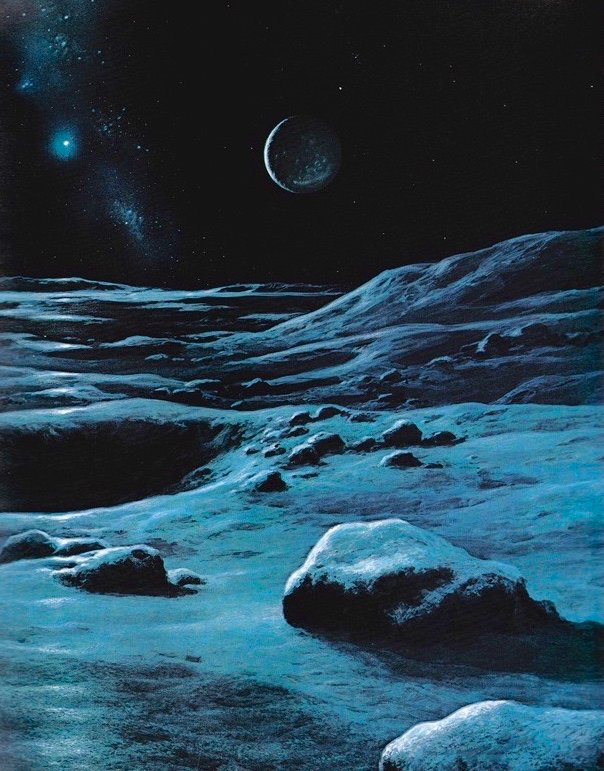


 A Box Of Chocolates