H2G2 casts a long shadow. Any radio science fiction comedy is bound to draw comparisons with it, and even more so if it’s on Radio 4. To some extent, the same problem exists on BBC television, where SF comedy is likely to be compared to ‘Red Dwarf’. This happened with the rather obscure ‘Hyperdrive’ with Miranda Hart, Nick Frost and Kevin Eldon, which ran for only two series. It wasn’t wonderful to be sure, but it was absolutely not a rip-off of ‘Red Dwarf’. It was ‘The Navy Lark’ in space. That series, of which I was never a fan but you know, it was okay, was probably unknown or forgotten by 2005 but is so much more similar to ‘Hyperdrive’ than ‘Red Dwarf’, and if people had known about that and resisted the urge to draw comparisons with the most prominent space comedy, I’m sure it would’ve been perceived much more positively.
There have been quite a few Radio 4 SF comedies since 1980, and H2G2 is rather like the Beatles in that it defined a genre and cannot be successfully imitated without being seen as derivative. What, then, do you do if you want to write a series of this kind? It has to be completely different from Douglas Adams’s work, and probably use a different kind of humour, and this is very restrictive. However, restriction is a wonderful spur to creativity and originality if you can dislodge your focus sufficiently on what you’re trying not to write. I would say Tony Bagley’s ‘Married’ has successfully escaped from Mr Different Adams’s fierce gravitational pull and managed to write something pretty fresh. I mean, he did it over twenty years ago now but it’s still good.
The premise of ‘Married’ (SPOILERS) is that steadfastly single and misanthropist architect Robin Lightfoot wakes up one morning to find himself in a parallel universe where he’s married with children and works at a greetings card company, and absolutely hates his new life. Meanwhile, his counterpart in the parallel universe has entered this one and proceeds to trash his life, since he too is misanthropic but considerably more actively antisocial and abusive. The series becomes increasingly surreal and science-fictiony as it proceeds until the existence of the entire Multiverse is threatened and the fabric of reality breaks down. Robin finds a solution in the final episode, but it isn’t clear if the Multiverse is saved.
Robin is played by Hugh Bonneville, cast somewhat against type. Arthur Smith is another central character, who plays himself, and Julian Clary makes a guest appearance. Many people who exist in this universe also exist in the other, but often have different life histories. It gently breaks the fourth wall a number of times. The only person with an initial grasp on the situation is his son, who reads a lot of graphic novels and is therefore savvy about parallel universes. In a sublime piece of technobabble, he explains to Robin that there are two types of parallel universe, Inverted Gravimetric and Temporal Neomorphic. It’s never at all clear what these are but they sound marvellous.
Although the drama centres, initially at least, on the interaction between the characters, the background is also intriguing. Much of it is based on the humour of rôle reversal. Tony Blair is leader of the Conservative Party. Environmentalists are campaigning for the legalisation of genetically-modified organisms and the use of organophosphate pesticides. Most people believe Francis Bacon wrote the plays usually attributed to Shakespeare. Jimmi Hendrix is a middle-of-the-road radio disc jockey. ‘The Guardian’ is a tabloid and has a porn page but ‘The Sun’ is a quality newspaper. There were eighteen years of Labour rule up to 1997, when the Liberal Democrats achieved power, led by Richard Branson, who is now Prime Minister. Alcohol is a Class A drug but you can buy Cannabis over the counter in Boots. There is no Sunday trading. Surrey is a deprived area but the northeast of England is affluent.
The humour is not confined to reversals. Fashion is how it was in the early 1970s, with kipper ties and flares. Richard Whiteley did something nebulous but awesome in the “Fuel Crisis of ’89” which has made him a universally-loved national hero and there are statues in his honour. Margaret Thatcher died in 1978. The death penalty is not only still in place but fast-tracked without appeal to avoid causing prolonged suffering to the perpetrator. Edward VIII didn’t abdicate and was replaced by Richard IV and then John II, who leaves his wife and comes out as gay, marrying his lover Adrian. He is of course played by Julian Clary. Janis Joplin is still alive. There’s no Marks & Spencers but instead there’s a Marks, Bruce & Willis. There’s a Channel 6. Radio 4 is called Radio 1 and there’s also a Radio 4 Live. The Today programme doesn’t exist. Nicholas Parsons presents a radio panel game called ‘The Transport Quiz’, which seems to be a reference to Mornington Crescent and ‘Just A Minute’. Kingsley and then Martin Amis read the Shipping Forecast. The Titanic wasn’t hit by an iceberg but was torpedoed in 1940. There are numerous other examples, all mainly for the sake of humour. They don’t particularly feel like they go that deep but they are fun.
I’m stuck with my usual quandary here of not knowing how well-known this is. I first came across it when its final episode was broadcast some time in the ‘noughties, and remarkably, if you know the ending, I seem to remember being in the bath at the time. This makes me wonder about false memories. I didn’t catch up with the whole series until about 2007.
Most of all, I wonder about the model of the Multiverse being used in the series. The real answer is “whatever makes the listeners laugh” of course, but those two terms, “inverted gravimetric” and “temporal neomorphic” have a real ring to them. Swapping the first words of each gets you “temporal gravimetric” and “inverted neomorphic”. The former is a real phrase, often used to refer to the measurement of subterranean water and its fluctuation. Temporal gravimetry is the measure of mass changes through time, so it is an actual thing but nothing to do with parallel universes. Inverted gravimetry is no closer. Neomorphism is to do with metamorphic change in rocks and is also a variety of gene mutation where a newly formed gene becomes manifest immediately rather than being masked or inactive.
These parallel universes are more like the “mirror Universe” of ‘Star Trek’ than the bog-standard “choose a pivotal point in history and change it” approach of alternate timelines. Like the Mirror Universe, the same people tend to exist in various universes, so they can’t be based on events which prevent people from existing or cause people to come into existence. They’re interdependent. Ultimately this becomes apparent in other ways, and it raises the question of whether the only kind of parallel universe is one which deviates in connection with events occurring within it. David Lewis’s idea of modal realism is easily confused with the idea of alternate timelines and quantum-related universe variations, but could in fact be an entirely different beast. We talk as if things could be other than they are. We say “if I were you, I wouldn’t do that” for example, but in fact that isn’t true because someone cannot be someone else and they just would act in that way. There is also the issue of paradoxes of material implication. Material implication is usually understood to mean “if P then Q”, but in fact it means “not both P and not-Q”, which lacks the kind of “direction” implication normally implies, and it means that there are peculiar situations where, to quote Wikipedia, it would be true to say that if the Nazis had won the Second World War, everyone would be happy, because if something is false, it being true can imply everything, and if sonething is true, anything can imply it. The idea behind material implication is to make it impossible to move from true premises to false conclusions, meaning that truth implying falsehood is always false.
But a different history may not be the only way in which a world can be different. An alternate universe might be just one which is located elsewhere but exists in the same way as this one does, with nothing else in common except what must be so for it to exist meaningfully as a universe. This could mean being observed in some way, or at least having its existence deducible from something observable. Maybe this kind of multiverse is like a cluster of mushrooms whose stalks sprout from their Big Bangs and become mature as caps, but multidimensionally.
Robin describes the multiverse as like a loo roll. Each universe is a single sheet of paper, separated from its neighbours but also coiled up tightly, so that you could enter another universe on either side by travelling a long way and finding a portal, which is the paper between the perforations limiting the sheets, or, much more easily, you could move towards and away from the centre and enter a neighbour much more easily, since the other universes in those directions are but a whisker away, as thin as a single sheet of toilet paper or even less. Just as accidents can occur where you accidentally poke your finger through the paper, or the roll gets wet and water wets adjacent sheets and their contents might bleed through (assume it’s monogrammed toilet paper) like ink soaking through successive sheets, so can there be bleeding through or accidental penetrations into other universes, but because they’re “rolled up”, it’s easier to enter a universe five universes away or a different number, than it is to enter any of the neighbours in other directions. Isaac Asimov explored this idea in his ‘Cosmic Corkscrew’, a completely lost and unpublished story written in 1931 where a man discovers it’s possible to move forward or backward in time by a set interval because time is like the coils of a slinky, and on travelling forward a single loop of the coil, say a week, he finds the world has ended, and is unable to convince anyone on returning to his present and ends up in a mental hospital. There is of course absolutely no scientific evidence for this but it isn’t ruled out. There’s just no reason for supposing it to be the case. It does work quite well as a model though – it’s coherent. It’s easy to imagine each universe consisting of time and space, and then there being extra dimensions which link them together in different ways, so there are not only portals to adjacent universes separated by gigaparsecs but also extra dimensions in which other universes it would otherwise take countless æons to reach are only a hairsbreadth away, if only we could find our multidimensional equivalent of an inconvenient finger poke or splash of water.
Maybe. But what does “maybe” mean here? Using possible world semantics, “maybe” means “true in some possible worlds”. In other words it’s a bold statement that there are universes where this has been done, that there are bridges between universes which have either arisen spontaneously, through accidents or have been made on purpose. It can become very difficult to talk clearly about parallel universes because language like “possibly”, “probably”, “perhaps” and so forth then become references to places where this is actually so. “Probably” means “true in most possible worlds” for example, but if there are an infinite number of them, how can the majority of worlds contain such a situation? The ones in which the state of affairs doesn’t hold could also be infinite, so how is that a majority?
There are two very implausible things which never seem to get ruled out in spite of the difficulty in accepting how they are reasonable things to expect. One of them is travel backwards in time, and the other is parallel universes. In spite of the “cat among the pigeons” effect them being true would have on science, it remains unfeasible to rule either of them out.
Most of what happens is fairly predictable, and they say that in an infinite Universe, which this probably isn’t, everything is not only possible but inevitable. That is, everything that is possible must exist. This is not, however, so. For instance, at first glance it seems possible that the whole of space could be filled with diamonds one millimetre in diameter separated from eight other diamonds of the same side by one metre. Certainly this seems to be a stable arrangement, particularly if they’re all slowly orbiting each other, and the gravitational forces balance each other, but we can easily establish by observation that this is not so. Therefore there is an infinite set of things which are entirely possible but don’t exist, at least in this universe. Likewise, there could be quite a few things which we only believe are possible because we don’t know what rules them out, and it might be imagined that in fact there is really only one true way that things can be. However, this is not so.
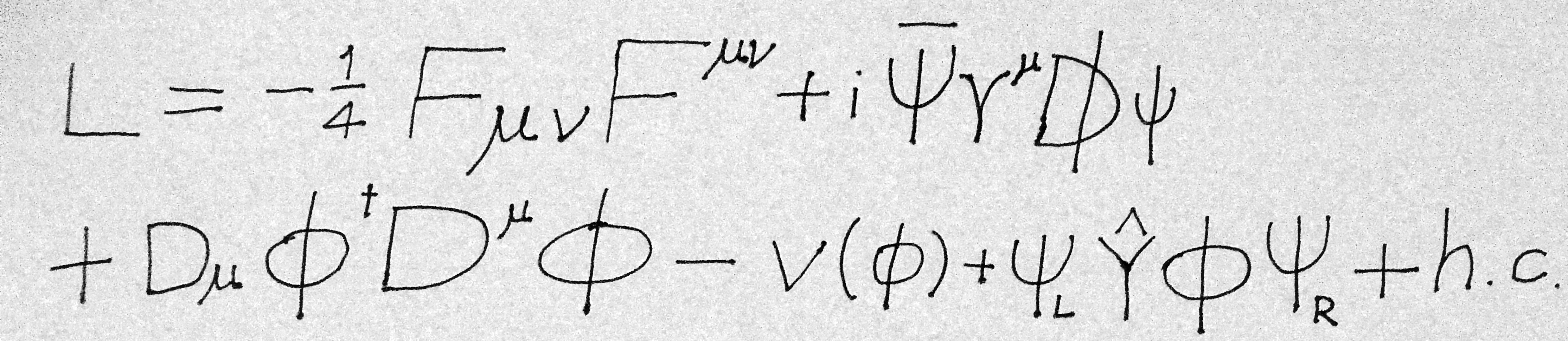
Now there is this:
I’m not going to pretend that I can remember what any of the symbols in this equation mean, and without that information this is just an impressive-looking piece of technobabble. It’s also abbreviated and I may have written some of it down wrongly. Expanded, it would fill a sheet of A4. But this is in fact almost that famous Holy Grail, of a formula which written down fully explains everything physical in the Universe. What’s missing is gravitation, because gravity may not be a force at all, unlike the four used in the sequent above. But right now, that may as well say “abracadabra” to me because it means nothing to me.
There seems, however, to be a problem with the idea that that thing up there along with a similar account of gravity really would be a theory of everything. I mentioned previously (somewhere on here, can’t find it right now) that fine tuning is wanting of an explanation. As far as anyone can tell, there is no link between the relative strengths of the different forces, including gravitation, which make heavier atomic matter and through it chemistry, biochemistry, life as we know it and human beings possible, that means it has to be the case that things are the way they are, and consequently we live in a multiverse almost entirely consisting of very simple and boring universes incompatible with chemistry. There seems to be no cause for these proportions, and consequently there are a number of things which nearly are, but aren’t in this universe. I’ve mentioned these before, but not in as much detail.
Be warned, because I’m about to talk about nuclear physics, and I’m going to do so from a position of considerable ignorance, but not total ignorance.
It should go without saying that a convenient way of looking at atoms is that they consist of orbitals associated with electrons which have various shapes, such as a four-leaved clover or a dumb bell, balanced by a nucleus at the centre which “wants” to have the same positive charge as the total negative charge of the electrons. Hence helium has two positively charged particles, protons, and two negatively charged ones in its orbital, electrons. Hence chemistry. Atomic nuclei, with the exception of the most common isotope of hydrogen, also contain a similar number of neutrons, which are uncharged. The heavier the atom is, the more neutrons are needed proportionately to balance the protons in order that it remain as stable as possible. Hence with carbon and oxygen, with six and eight protons respectively, there’s a stable isotope with the same number of neutrons. By the time uranium is reached, there are no stable forms but the most stable has ninety-two protons and a gross plus two – 146 – neutrons. Even that isn’t enough. The issue is that like charges repel, so atomic nuclei struggle to stay in one piece since they consist of clusters of positive and neutral charges.
There are various factors and forces involved in atomic nuclei, not all of which I can easily call to mind, but two ways of understanding how they work are the shell model and the liquid drop model. No two otherwise identical particles in close proximity can have the same energy level. In atoms this manifests in the form of electrons having “shells” – they have different energy levels into which they slot, so there are for example two possible electrons at the lowest state and eight in the second, and then it gets complicated. This arrangement also applies to protons and neutrons in atomic nuclei, which can also be thought of as a kind of condensed version of the electron shells which make chemistry possible. The liquid drop model sees atomic nuclei as akin to droplets floating in space, and as such they have cohesive and adhesive forces and surface tension. Just as a drop of water has a skin round it which is difficult to penetrate and tends to hold the water together, so have atomic nuclei, and just as the interior of a drop of water consists of water molecules which stick together, so do atomic nuclei. Drops can coalesce and separate, and so can atomic nuclei.
The mass of an atomic nucleus is never an exact sum of the masses of its protons and neutrons because in order for it to hold together, some of their mass has to become energy. Exactly how much can be calculated by considering the nucleus in terms of the forces mentioned above, along with some others. This is known as the “empirical mass formula” and takes account of the nuclear volume, the surface area of the nucleus, the repulsion between the protons, the fact that nucleons need to be paired according to their spin (which I hadn’t mentioned before for simplicity’s sake), and the fact that they cannot occupy exactly the same energy level, which is known as the asymmetry term. All of these taken together, and there is a formula but I won’t bother you with it, explain much of what happens between and inside atoms, but there is a second property known as “magic numbers”. Certain isotopes and elements are more stable than they would be expected to be given this model and the associated formulæ, and consequently others are less so if you take these “magic numbers” to be “normal”. Therefore, the shell model is also needed. Both of them apply to real atomic nuclei and don’t contradict each other. If an atomic nucleus has a magic number of either neutrons or protons, it will be unusually stable. These numbers include 2, 8, 20, 28, 50, 82 and 126. Of these, element 126 has yet to be recognised, but the others are helium, oxygen, nickel, tin and lead, as far as protons are concerned, and as I mentioned before, oxygen-16, which is doubly magic, is particularly stable.
Incidentally, it’s fairly easy to demonstrate that elements have different isotopes, particularly chlorine, which is unusual in having two common stable forms, 35 and 37, of which the former comprises roughly three quarters of stable chlorine atoms and the latter one quarter. Careful measurement of weights of ordinary table salt in its reactions in solution with other substances such as sodium and potassium hydroxide reveal that the proportions involved don’t correspond to whole numbers. This can be demonstrated with ordinary household chemicals if you use large enough amounts and measure them precisely enough. It doesn’t require sophisticated equipment or hard to understand calculations. It could even come into making soap, particularly if the fatty acids have relatively short chains, such as the ones high in coconut or palm oil. The very easiest would be from certain substances in goat’s milk, but that wouldn’t be vegan, but coconut and palm are also ethically questionable.
One of the consequences of these forces and factors is the pattern of stability and instability in the periodic table. There’s at least one stable isotope of each of the first forty-two elements, then technetium appears to throw a spanner in the works. When the periodic table was first compiled, a number of gaps became apparent. Sometimes this was just because the element concerned hadn’t been discovered but wasn’t particularly unusual, as with gallium, although gallium is quite an unusual metal. However, in the case of element 43, it just seemed to be missing, and wasn’t officially discovered until the 1930s. By contrast, gallium had been discovered in 1875 and the actual metal was obtained a year later. It turns out that there is no stable atomic nucleus with forty-three protons, the element now known as technetium, which is universally and usefully radioactive. The same is true of the rare earth metal promethium, whose atomic number is sixty-one, but has stable elements either side of it, and in fact all other rare earth metals have stable isotopes. The heaviest nucleus which has a stable isotope is that of bismuth, whose atomic number is eighty-three. Bismuth and gallium share the unusual property of expanding on freezing, a very rare property crucially also true of water, which is another factor in making life of our kind possible in the Universe. Above bismuth lie polonium, astatine, radon and francium, all of which are exotic in various ways. Polonium is one of the most toxic elements known, completely down to its radioactivity. Astatine, along with tennessine, is a radioactive halogen, like chlorine and iodine. At any given time there are only twenty-five grammes of astatine in this planet’s crust. Radon is fairly abundant and the heaviest known gaseous element. Finally, francium is a radioactive alkali metal, slightly more common than astatine at thirty grammes. Francium and astatine don’t really have meaningful chemistry, partly because they’re so rare and partly because they’re too radioactive to be cool enough to have predictable reactions. It should probably also be mentioned that there’s another series of elements like the rare earths which are all too familiar and are again quite radioactive. These are the actinides, which include uranium and plutonium. One other element is worth mentioning here, although its situation is kind of the reverse of the others’. This is tungsten, which has five stable isotopes plus a further one, tungsten-180, with a half-life of two thousand million æons. The others can also decay but are around a thousand times more stable and have never been observed doing so. Tungsten is also the only third-row transition element which has a biological role, although it is also usually slightly toxic to animal life, so it’s conceivable that life’s existence depends on its near-stability.
The difficulty is in quantifying exactly how much the relative strengths of the strong nuclear force and electromagnetism could change before this arrangement of stability and instability would also change. The shell model would be unaltered by this, but the liquid-drop model would have different parameters if these were different. It’s tempting just to base everything around the inverse square law and the volume of the nucleus, but this wouldn’t take the surface tension factor into account, for instance. However, if the inverse square law were all that was required, the calculations look like this. For there to be a stable isotope of astatine, the strong nuclear force would only need to be relatively powerful enough to hold a nucleus slightly larger than bismuth together. The most stable isotope of bismuth is 209, and the most stable isotope of astatine is 210. If these atomic nuclei are assumed to be spherical, which they aren’t because nucleons don’t tessellate into spheres, and assuming the inverse square law is the only significant factor, a bismuth nucleus could be thought of as consisting of 209 units of volume each corresponding to a nucleon, and an astatine one of 210, which is 0.4% larger. This would actually mean the strong nuclear force would only need to be 0.2% stronger for this to happen, but in fact this figure is inaccurate. To be honest I can’t even work out in which direction. It certainly seems as though there would only need to be a small tweak for there to be stable isotopes of both astatine and francium, and since there are plenty of alkali metal-halogen compounds such as sodium chloride, there nearly is a salt called francium astatide. This would be a white, translucent substance with cubic crystals.
Technetium is more complicated. Both it and promethium have odd atomic numbers at forty-three and sixty-one, and odd-numbered elements are both rarer and less stable than even-numbered ones of similar mass. Even-numbered elements often form from the collision of α particles, or other elements previously formed in that way, and these, being helium atoms, have an atomic number of two, so the more common elements are even. Also, this allows particles to pair off inside the nucleus, again making them stabler. This is only a partial explanation though, because clearly an element like nitrogen or gold has stable isotopes in spite of being odd-numbered. Technetium decays to molybdenum (element forty-two) or ruthenium (element forty-four), both of which are more stable, so the issue is really why it’s less stable than either of those. All elements have radioactive isotopes, but technetium and promethium only have those. Technetium-99 has an odd number of protons but an even number of neutrons, which makes it more stable because of pairing: it has forty-three protons and fifty-six neutrons, making it the most stable isotope of that element. Less stable elements are also supposed to be furthest from the “magic numbers”, which would make the “anti-magic” numbers 5, 6, 14, 24, 25, 39 and 67 (and 103, which would be unstable anyway). Thirty-nine is close to forty-three, but is yttrium, not notably unstable. A light element without stable isotopes could, however, be expected to have a total number of nucleons close to 103 (which technetium-99 has), a total number of protons close to thirty-nine (also true), be odd-numbered (which it is) and have about sixty-seven neutrons, which is somewhat higher than technetium-99’s fifty-six. However, the liquid-drop model only includes approximations for quantum factors, and there’s a more sophisticated method called the Strutinsky Smoothing Method, invented by Vilen Strutinsky, which is more accurate, and can be expressed by this equation:
And yes, I know I haven’t bothered to specify what any of that means, but the point is, there is something out there which does seem to predict that there are no stable isotopes of technetium or promethium. Just considering promethium for a moment, this has an atomic number of sixty-one and its most stable isotope has a mass close to one hundred and forty-six, with eighty-five neutrons. At this point, it’s probably worth digressing slightly into my habit of using duodecimal numbers, because this is a good illustration of why it can be a good idea. Stating this in base twelve, promethium has an atomic number of five dozen and one and its most stable isotope has a gross and two nucleons with seven dozen and one neutrons. This shows much more clearly how these numbers are “unbalanced” than the relative mess of the decimal system can, because the occurrence of sloppy-sounding numbers like these is much rarer in the duodecimal, and focussing on these figures immediately suggests there is something up with them. They aren’t neat enough. The same can be done with technetium-99’s three and a half dozen and one protons, four dozen and eight neutrons and eight dozen and three nucleons, although it’s less glaring. Promethium is in fact the least stable of any of the first seven dozen elements, even less so than the notorious polonium.
The question is, then, could a different strength ratio of the strong and electromagnetic forces cause technetium and/or promethium to have at least one stable or metastable isotope? It occurs to me that both of them are in slightly the “wrong” place with regard to nucleon, neutron and proton numbers, which is apparently down to quantum physics in a way I can’t understand, but the classic “bad” numbers would be thirty-nine and sixty-seven, which are yttrium and holmium. Holmium has the distinction of being the most boring and useless element in the periodic table according to some chemists, and it’s notable that mentioning its name tends not to ring bells in most people’s minds. It’s just kind of “there”. It is a rare earth metal but not a particularly remarkable one, although it can be used to generate the most powerful artificial magnetic fields possible and can also damp down nuclear reactions, which actually sounds like an example of how boring it is. There would be technical differences in the design of nuclear power stations and possibly MRI magnets, but that would be it. It might not be possible to achieve the strength of magnetic fields found in certain circumstances.
Stable promethium is a similar prospect. Most of the uses of promethium depend on its radioactivity, for instance luminous paint and atomic batteries, but again there are alternatives to this, particularly considering that a different rare earth metal would be the radioactive one instead. It would probably have ended up in a phosphor on CRT TV sets and monitors. It would not, however, have the same name.
Yttrium is technically not a rare earth metal but is very similar to them. If it turned out not to be stable, it would not have been detected in the sample of rock from the Swedish village of Ytterby, and at least four different elements would have different names: yttrium, terbium, erbium and ytterbium. Since a relatively high-temperature superconductor was discovered as a result of a typo in the formula, confusing yttrium and ytterbium, this would have significant scientific and technological consequences. It might also have delayed the discovery of rare earth metals themselves. The newly discovered blue pigment Oregon Blue could not exist.
I’ve mentioned the possible Mandela Effect regarding technetium before. If technetium had not been radioactive, it would be called masurium, because of the irreproducible result in the 1920s which appeared to detect it, which in this case would be confirmed. The name “technetium” refers to the fact that it’s a manufactured element. Again, the uses of technetium in the actual world are based on its radioactivity. For instance, it’s used as a radioactive tracer in medicine. Stable technetium would be very different. Here’s a logarithmic graph of the relative abundance of the chemical elements in our planet’s crust:
A couple of things are obvious from this graph. One is that the odd-numbered elements are considerably rarer than their even-numbered neighbours, hence the zig-zag. Another is that there is a sudden plunge in abundance after element forty-two, molybdenum, and a gap where technetium, or masurium, ought to be. This seems to predict that technetium would be about as abundant as silver, although it would probably not occur native like that metal, meaning that it would probably be a minor precious metal like rhodium. It’s also significant that that plunge in abundance would be less severe because there would still be radioactive isotopes of technetium which would break down into ruthenium, an iron-like metal which would therefore also be more common. Technetium has a very high melting point, putting it into the category of metals like tantalum and tungsten, and is a powerful catalyst in the dehydrogenation of isopropanol. It would also be useful in the manufacture of stainless steel. Moreover, since it’s a relatively light element it might have a biological function, which molybdenum has for example. I can imagine it being used as an antidote to isopropanol poisoning. There are a large number of molybdenum-containing enzymes and it may have been essential to the evolution of cells with nuclei, so it’s conceivable that technetium would have a similarly significant rôle. Maybe life has actually struggled with the absence of technetium and would have evolved more quickly if it existed in a stable form, perhaps making complex life more common in the Universe. However, all this is speculation.
Astatine is a case which chemistry examiners are very keen for candidates to consider. The halogens have a regular and particularly predictable set of properties which change as they occur further down on the periodic table. Fluorine is a highly reactive and dangerous yellow gas, the most reactive element of all. Chlorine is still reactive enough to support combustion and is a green gas with a relatively high boiling point. Bromine is a fuming red liquid and iodine a dark purple shiny non-metallic solid. The colour changes are due to the absorption bands of the atoms moving across the spectrum as the electron shells increase in number. Astatine would therefore probably be a relatively inert black solid which looks like anthracite. Every other halogen has a biological rôle, so it’s possible that we’d require astatine instead of iodine for thyroid hormones. Astatine would be an unique halogen because it would be a metalloid. For example, it would be a fairly good conductor of electricity and might be a semiconductor, making it useful in electronics.
There appears to be a similarly predictable trend down the column for alkali metals, and of course cæsium is the most reactive of them all. This suggests that francium is highly reactive, but it has also been suggested that it isn’t, although I don’t know the argument for that. The low melting points of all the alkali metals also means francium could be liquid at room temperature, with a melting point of 8°C, and is about two and a half times as dense as water. Francium has never been observed as an actual lump of metal, or pool for that matter, since it’s radioactive enough to cause itself to vaporise instantly.
Between astatine and francium lies the radioactive and famous gas radon. This has a boiling point higher than any other elemental gas except chlorine, but unlike chlorine it is not very reactive, although relative to noble gases it would be. For instance, radon difluoride is entirely feasible, and in fact it does exist, as does radon trioxide, and there are thought to be higher radon fluorides. If it weren’t radioactive, it’s conceivable that it could collect as pockets of liquid in the ice near the south pole. It would be over four times as dense as water.
Polonium poses an interesting issue. It wouldn’t be poisonous, and it’s also alleged that tobacco contains trace amounts of polonium which make it more carcinogenic than it otherwise would be because of the radioactivity rather than the toxicity. If this is true, a world with stable polonium wouldn’t just differ in terms of Aleksandr Litvinienko not being assassinated that way or Marie Curie not dying of cancer quite as young, but possibly in altering the fates of millions of people, since tobacco would be marginally less carcinogenic, and this could mean various people lived longer and got to influence the world in untold ways. It would also not be called polonium as it wouldn’t’ve been Marie Curie who discovered it, who named it after her native Poland (and this also means Francium would have another name).
The question arises more broadly of whether there would be any other differences. I suspect that a different profile of radioactive elements would influence continental drift. Continental drift occurs because of convection currents in the mantle, heated by radioactive decay. The density of both the mantle and the continents would be slightly different if these stable elements existed, as they would be present in both, and the heating effect would be lower. I think this all adds up to slower continental drift, meaning that the Atlantic Ocean could be narrower, the Mediterranean wider and Australia slightly further south. The differences in world maps reported by those who believe the Mandela Effect is something other than confabulation tend to be in the directions of continental drift, and I find that slightly suspicious. Why would we misremember the locations of land masses consistent with their direction of movement rather than at right angles to them, or in some other way? This is one reason I suspect the Mandela Effect is more than just psychological, eccentric though it makes me. Of course it could also be that a slight difference in the relative strength of electromagnetism and the strong nuclear force would have a chaotic effect and end up producing a universe like this one, full of stars and galaxies, but not the familiar ones, because the early tiny irregularities in the distribution of density in space could be different and later become voids and superclusters which are
While I’m talking about the sky, I want to make one final observation. There are stars whose spectra show they’re high in technetium even though the element is unstable. It’s been suggested that this might be a signal sent by aliens, or at least evidence of alien technology tampering with stellar evolution. It occurs to me that although we generally believe the laws of physics are uniform throughout the Universe, this might mean they aren’t. Maybe there are, after all, planets out there in this universe where these elements are stable, but perhaps also whose laws of physics are incompatible with the survival of the human body, for instance because iodine could be highly radioactive. But the simplest and most boring, and therefore true, explanation is that these stars are high in technetium for some other reason. Nonetheless, there are alternate universes where the elements I mention are stable.
There more or less have to be parallel universes because this Universe is “fine-tuned”. The alternative would seem to be to require a Creator, and although there is a Creator, or rather a Sustainer because God is not within time, nothing in the Universe should be allowed to imply or suggest that there is one as that would be a “God Of The Gaps”.
I should probably explain fine tuning. There are certain constants governing the relative strengths of the four known forces in the Universe which, if they varied even slightly, would make rocky planets and life as we know it impossible. Examples are as follows:
Electromagnetism is a sextillion (long scale) times stronger than gravity. If it were much smaller, the Universe would have collapsed in on itself before the stars could have formed.
When deuterium nuclei fuse to form stable helium-4, the nucleus loses 7% of its mass. If it lost 6%, only hydrogen would exist, and if it lost 8%, all the nuclei in the Universe would’ve fused together within a fraction of a second of the Big Bang and there would be no atomic matter at all. That said, that is quite a large range, determined by the strong nuclear force.
If dark energy was slightly stronger compared to gravity, stars would not be able to form because they’d be ripped apart by the expansion of space. If it was slightly weaker, the Universe would’ve collapsed by now.
If other than three spatial dimensions were extensive (there are others, which are however very small and so don’t influence this), there would be problems with the weakening of gravity at a given distance which would again either cause collapse or make it impossible for stars to form.
There are several other examples, but taking these together is enough to illustrate the issue, because the improbabilities multiply, and some of them even seem to be part of an infinite range of possibilities, usually very boring ones because they either involve the Universe collapsing in on itself almost immediately after the Big Bang or merely consisting of hydrogen atoms thinly spread throughout space. The situation we actually find is fantastically improbable because of this. It’s also been suggested that the specific existence of the element carbon is suspiciously unlikely, and water is also such an unusual compound that it too is unlikely, but the details of these involve once again the strengths of the strong nuclear force in the case of carbon and that of electromagnetism in the case of water. There is presumably a version of water in a parallel universe which is still H2O but is a gas at well below its current freezing point and contracts when it freezes, is not a good solvent and so forth. In fact probably most versions of water are like that. Likewise, and this is I admit a very sloppy calculation because several different forces are involved in holding atomic nuclei together and they don’t obey the inverse square law, the last element to have stable isotopes is bismuth, and if the strong nuclear force was forty percent weaker, stable carbon atoms could not exist and carbon-based life would be impossible.
Because of all this stuff, some theistic religious people believe that there must be a God. However, there’s a problem, or rather several problems, with that argument. Firstly, even if it does entail a creator, it fails to entail a God like the one in the Bible, Qur’an or whatever. Secondly, the Universe which actually exists is almost completely empty and life seems to be a mere detail, possibly on only one planet and even if widespread it would still only have come into existence on the tiny grains in a vast void. In fact, this almost completely empty void may be a clue to the nature of reality. What we’re confronted with when we look into the night sky is unimaginably enormous distances between stars, whose visible examples are unsuitable for life as we know it, organised into galaxies which are also separated by relatively much smaller distances and organised into clusters forming a kind of “foamy” arrangement around enormous voids like bubbles. Only occasionally are the conditions suitable for the concentration of nuclear matter, and even more seldom do rocky globes form. When we consider Earth, we realise how special she is, but that exceptional nature is contingent on the fact that we are here in the first place to do the considering. The anthropic principle says the same is true of the Universe: there are plenty of other universes but they don’t have any life or observers in them. Ergo, there are parallel universes. The alternatives seem to be enforced belief in a Creator with a capital C or a multiverse, and that multiverse would likewise consist almost entirely of empty universes which have either already ceased to exist or contain only widely space hydrogen atoms and perhaps molecules floating in otherwise empty space. Although I’m theist, I choose the latter.
The question then arises of how inevitable anything is. Alternate history usually depends on PODs, Points of Divergence, such as Hitler dying before coming to power or JFK not being assassinated, and from a macroscopic level it seems entirely plausible that Henry Tandey could have decided to shoot Hitler on 28th September 1918 or that Lee Harvey Oswald missed his target on 22nd November 1963. But in fact these PODs are only apparent. Free will is probably illusory, there’s a whole chain of unknown events influencing those moments and for all we know that chain of cause and effect stretches all the way back to the beginning of the Universe. It will undoubtedly be the case that slight variations in physical constants do indeed lead to differences in the universe, but what we imagine is easily possible could turn out to be completely impossible. The question of whether this is true depends on chaos theory and quantum physics.
I’ll take chaos theory first. This is the whole butterfly effect thing. It was found at some point that computer programs written to forecast the weather gave completely different results depending on how many decimal places the data input to them were calculated to. Given the very many decimal places involved before one hits the Planck length, Planck time and so forth, which amounts to the fixed “resolution” of the Universe, which can’t be calculated anyway because so many perfect instruments would be involved that they’d nudge the weather in a particular direction, there seems to be only a weak connection between cause and effect, and for all we know, as David Hume asserted, none at all. If science is supposed to be based only on what can be observed, cause and effect can’t be and therefore it’s problematic including it in science at all, which rather undermines the whole of science. That said, it does still seem that in principle cause and effect often operate deterministically. You can’t usually expect to jump off the roof of a skyscraper and not fall to your very probable death. Maybe the improbabilities are smoothed out by the arbitrary nature of the universe on a small scale. I don’t think chaos theory is a very promising reason to posit that things could have been different.
Quantum mechanics is another matter entirely. There are no hidden variables. That is, if a radioactive atom is observed, there is no way to predict when it will decay into an atom of another element and that isn’t just because we’re unable to observe processes going on at a sufficiently small scale, but because there simply is no causal chain involved at all. All that can be done is to predict that half of a sample of carbon-14, for example, will have decayed in 5 730 years, give or take forty years, and that prediction only approaches fifty percent with the increase of the size of the sample. However, these are acausal processes. There is absolutely no chain of events other than the formation of the atom leading up to its destruction. It just happens.
Hence there are two contrary factors involved in the nature of parallel universes. On the one hand, there is the causal chain stretching back to the Big Bang, and on the other there are acausal events associated with quantum events. The question then arises of whether the Big Bang itself, or its immediate aftermath, was strongly associated with such events. It could be that things have always been different or that all significant events in our own history can be traced back to quantum events after the beginning of the Universe. All that can be said confidently is that if a known chain of events can be traced back to a quantum event, there are parallel universes where this turned out differently.
A fairly trivial example is the issue of the discoveries of technetium/masurium and astatine/alabamine. The actual names of these elements are technetium and astatine. Neither have stable isotopes. The reason their names could have been different is that they weren’t discovered for sure when they were first apparently identified. In 1925, German chemists bombarded a mineral called columbite with an electron beam and appeared to detect a faint X-ray signature of what would be element 43. Later researchers, however, could not replicate this experiment and consequently, although it was named masurium, it was still considered undiscovered. If a greater number of atoms in the sample of this element had not decayed in the attempt to reproduce the result, element 43 would have been confirmed and would have been named masurium. Likewise, with alabamine, scientists at Alabama Polytechnic believed they had discovered the missing halogen which belonged under iodine in the periodic table in 1931, but their method was found to be invalid. The case of alabamine is slightly different, which I’ll go into in a moment. But because of the method of its discovery, there undoubtedly is a parallel universe in which technetium is called “masurium”. That’s a real place.
The case of astatine is slightly different. Astatine is only a couple of nucleons too heavy to be a stable element. Using the same rough and ready calculations as I did with carbon, for there to be a stable isotope of astatine the strong nuclear force would only have to be 0.08% stronger than it is. This may be the wrong figure but the principle is the same: it would only have to be a hairsbreadth stronger than it is “here” in our timeline for stable astatine to exist. In such a situation, polonium would also have a stable isotope and therefore would be less dangerous and would not have been used to poison Aleksandr Litvinenko. This, however, is a minor detail because probably it would just mean francium would’ve been used instead.
The two scenarios are therefore two different ways alternate histories could happen. In one, the Universe has been different since the Big Bang, astatine is a stable element and Litvinenko was poisoned using francium instead of polonium. In the other, its timeline and ours forked in 1925 and is probably practically identical to our own with the exception that technetium is called masurium.
This brings me to the Mandela Effect. Nowadays, most people seem to have reached the conclusion that the Mandela Effect is only accepted by cranks, and I would agree that there’s a lot of noise in the signal, but in the masurium/technetium example we have a real live Mandela Effect which is present in the scientific community that pivots on an acausal principle. This is inside the establishment, although it looks very different to a typical ME. For this reason, I will continue to maintain that parallel timelines are a valid explanation for some MEs. That’s it: that’s all I’m going to say about this for now because I know it’s generally considered crazy and you’re going to think I’ve gone to Nubicuculia if I go on.
There have been attempts to set up quantum lotteries. Although these are successful, as far as I know there are no serious lotteries using this principle. This is a pity, because if there were they’d amount to real forks in history set off by quantum events. As it stands, the only examples I can think of which involve genuine quantum forks other than masurium/technetium are very improbable, although there are guaranteed to be timelines where this happened. For instance, radioactivity was first discovered when Ernest Rutherford left a piece of the mineral pitchblende next to a photographic plate in a drawer and discovered it was blackened. If this hadn’t happened, radioactivity would have taken longer to be discovered. However, the only way in which that could have happened is if the number of atoms decaying was so small that it wasn’t enough to influence the emulsion on the plate, and considering the amount of substance involved, it’s very improbable. That said, somewhere out there such a timeline does exist. There’s presumably a timeline where radioactivity has yet to be discovered, which would leave a lot of mysteries about the Universe, such as how stars work or how old this planet is. There would be no radiotherapy, the Second World War would not have ended in the way it did, there would be no atomic batteries or nuclear power stations, no Cold War and so on. It is a fantastically improbable universe. But it does exist out there somewhere, and is a very different world. Even the people who live in it don’t understand it, because a big piece of the puzzle is missing. However, radioactivity can be discovered at any time. History is teetering on a knife edge in this world.
The question now arises of who we are. If a POD has occurred after our conception in any parallel universe, are we the same people? My ME explanation requires transworld identity, because I believe memories are transferred between universes when the brain is in an unusual state such as a stroke, seizure or coma. Transworld identity is the belief that an object can exist in more than one possible world, including the actual world (and here the world “actual” really just means “this” and “actual world” means “here”). The alternative theory is that counterparts exist in other possible worlds but that they’re not the same thing. David Lewis holds this, for example. It’s feasible that most people would hold that one is the same person if a POD takes place after conception, or perhaps birth, rather than before it. If they believe in the transmigration of souls, they would almost certainly hold that it doesn’t require a POD to take place that late because they would already claim that someone is the same person living a life in another time and place. If they also accepted that karma existed, different circumstances regarding conception might lead to that soul entering a different body and this could mean that the “same” person could be different in many ways in another possible world, being born in the Congo rather than Canada, in the rainforest rather than Vancouver, and so forth. This is someone else’s belief system rather than mine.
Even so, I do have something in common with people who believe in reincarnation: I don’t actually believe personal identity depends on karyotype. Here’s why. If it turns out that someone has a genetic disorder, they and the people close to them would tend to wish that they had never acquired that disorder rather than wishing they were someone else. These are two different things. Therefore, we don’t identify with our genes and our identity doesn’t depend on having been conceived in a particular way. Nor does it depend on the specific substance of our bodies, because if our parents, particularly our pregnant mothers, had eaten a different diet (such as the potatoes on one side of the field rather than the other, not miso instead of yeast extract or something), it wouldn’t make us different people unless it had a major influence on our development, and possibly not even then. What does that leave? There is no soul, so it isn’t that. Nor is it our genes. Nor is it the substance of our bodies. The answer, I think, is that we are socially defined, both passively and actively. In one sense we are the “software” running on the “hardware” of our bodies, although the metaphor of the brain as computer shouldn’t be pushed too far and it’s important to be aware that other parts of our bodies, such as the endocrine system and the nerves in our digestive system, also form a supervenience base for our psyches. It’s difficult to know how close our brains are to computers and how relevant this is to our identities. In another sense, we are externally defined. For instance, we have the legal concept of “next of kin”, which formalises a custom which already exists in social life: we are siblings, offspring, parents and so forth. Therefore, in a parallel universe where a child whose genetic makeup is rather different from this one, has a different temperament and so on, could still be the eldest daughter, have the same name, same birthdate and so forth, and is arguably the same person. In particular, she might not have the leukæmia which killed her in another universe, because at no point was that leukæmia something anyone in the family owned psychologically: it was a disease attacking her, an outsider enemy. I presume this is how many people with cancer approach their illness, but maybe I’m wrong. But that disease could be in her genome.
I don’t know enough detail about how ionising radiation interacts with DNA to be sure about this, and I should probably know more, but I would expect cosmic rays, which are nuclei and protons raining down onto Earth’s surface at near-light speed, to be to some extent the product of nuclear decay and to some degree interact with the molecules in question in such a way as to change the isotope of specific atoms. The existence of radiation in the environment on this planet, whether or not it results from human activity, would certainly be non-deterministic in nature, although the actual presence of that radiation is only technically not so. That is, it’s possible for a scenario as described above with Rutherford’s pitchblende failing to be sufficiently radioactive to influence his photographic plate to occur, but its probability is infinitesimal. Hence there is an element of pure luck involved in mutation which means that it is possible for minor phenotypical differences between members of the same species in parallel worlds to occur, though only to the extent that this doesn’t influence their fitness to survive, although this does also mean there are extinctions which occurred in one world but not another. However, there is another aspect to identity which suggests the “shadow people” I referred to in the title.
It’s widely known that ordinary human body cells each have two pairs of chromosomes which are reduced to one pair in gametes via meiosis:
Overview of Meiosis Date 20 June 2016 Source Own work Author Rdbickel – slightly cropped
It should be noted that the four daughter nuclei in this process are complementary to each other. The one at the top is a perfect counterpart to the one at the bottom and the two in the middle are counterparts of each other. Therefore, for either of the gametes which led to the cell line associated with who we are, there is a complementary alternative. This means there are at least four possible versions of each of us, even assuming the copying process goes without a hitch, which incidentally it never does. For instance, for a White blue-eyed fair-haired child whose mother is White with brown eyes and dark hair and whose father is White with blue eyes and fair hair, there is another potential version who is perfectly complementary, and two more versions who are partly complementary, because different gametes united. These gametes will have existed at some point, and they might even produce a viable child in the case of fraternal twins. These complementary people probably do occasionally exist in the same world. I would estimate that this occurs in one pair of about 500 million fraternal twins. Since in a population of eight thousand million there are around 350 million twins, there’s an even chance that somewhere out there today, this situation exists, and there have probably been about six or seven such pairs in the whole of human history, which by the way emphasises the fact that there are a lot of people around today. But in any case, we all have these shadow people, which brings me to the illustration at the top of the post.
This is a fairly famous gender-swapped version of post-war Prime MInisters of the United Kingdom, which notably has only two men because there have only been two female PMs. The counterparts in question here would usually have different karyotypes. That is, if you are yourself XX, your shadow twin would be XY and therefore usually male. The main situation where they wouldn’t be, incidentally, is complete androgen insensitivity – this is not about trans issues at all right now. However, although we do tend to focus quite strongly on gender as part of identity, there would also be lots of other traits which would differ. We have two children, one of whom resembles one parent quite closely and the other of whom resembles the other. I presume this is because dominant traits from one gamete are more strongly expressed in one than the other. Their shadow twins would be the other way round, which means that they would look very like their siblings, just in a different birth order. Their eyes would also be a different colour. My own shadow twin would still have blue eyes, but also straighter hair. I say that, but the popularly understood traits said to be inherited by single alleles are often not, such as eye colour. There’s also another sex-related issue. Two of the intersex conditions are referred to as Klinefelter’s and Turner Syndrome. The former is XXY and the later just one X chromosome with no counterpart. These two conditions are therefore complementary and a Turner person’s shadow twin would be XXY and vice versa. There’s also chimerism. Some people would be reverse chimeras of their twins, for instance they would be largely cell line A with some of cell line B, but their shadow twin would be largely cell line B with some of cell line A.
It’s also true that every generation of a lineage produces only a quarter of these potential individuals. This means that there are also sixteen possible parents involved, and the number rapidly becomes extremely large. This brings home how unlikely it is that any of us were ever born. Just focussing on the perfect complements, the probability that every person in the world today was their shadow twin is of the order of four to the power of eight thousand million to one. Although this is very improbable, it’s far more likely than the situation I described with the discovery or otherwise of radioactivity.
At this point it becomes clear that there is an issue with the nature of probability. Rutherford’s discovery is genuinely probabilistic and acausal. It could “just happen”, and there’s no need for an explanation. It isn’t so clear that the shadow twin situation could simply happen because there definitely seems to be a deterministic thread running through the whole of meiosis and fertilisation. This raises the question of the nature of probability. Probability is sometimes seen as simply a measure of the frequency of occurrences, so for example half the time a coin comes up heads and half tails, so it has a 50/50 probability of coming up either way. This is an empirical approach, as it’s simply based on observation. The other approach is based on rational degree of belief. For all we know, a coin tossed on a particular occasion might come down heads or it might come down tails, and there is no known reason to prefer one outcome over the other. However, there is in fact a cause, each time, for it landing the way it does, presumably to do with how forcefully it was flipped, the angle, air currents and tiny differences between individual coins which make them slightly unfair. For instance, I believe it’s slightly more likely that a coin will land heads up because I think the tails side is slightly heavier and will tend to weigh the coin down, and I tested this once and found the coin I was tossing was heads up sixty-four times out of a hundred. This helps confirm the hypothesis but doesn’t prove it. Ultimately, there may be two kinds of probability, one deterministic and one not, but the deterministic version of probability could stem from the initial conditions of the Big Bang and therefore not be ultimately so. Incidentally, using possible worlds semantics makes it difficult to use certain terminology. For instance, the world “probably” then comes to mean “in most possible worlds”, in other words something like “usually”. This gets confusing when referring to the theory itself. For instance, I can’t say “most parallel universes have always been separate” because I would then be effectively saying “in most possible worlds, most possible worlds have always been separate”. It could even be that this leads to a contradiction which refutes the theory of parallel universes, and that’s pretty serious because it starts to look like proof for the existence of some kind of First Cause and supports theism or deism to a limited extent.
I am now going to make one of these odd-sounding statements. Namely, “it’s possible that shadow twins exist in other universes”. This could be expanded as saying “there are some possible worlds in which there are some possible worlds where there are shadow twins.” This sounds peculiar, and makes it sound like there are two levels of possible worlds, on whose higher level lies the idea that there are a vast number of arrays of further vast numbers of parallel universes. Using the “rational degree of belief” view of probability, this can be restated as “for all I know, there exist possible worlds where shadow twins exist”. If this is so, it’s possible to imagine the following situation. There is a parallel universe where every representative of a final generation of humans is their shadow twin. In fact there would be several. This uses the criterion of childlessness to select the set of people involved. There’s also the question of whichever cohort includes you. You have a shadow twin, and depending on whether you have descendants you are either in the final generation or one of its recent predecessors.
Getting back to the prime minister picture, these are not photographs of a common type of parallel universe. Not only would the individuals concerned look different besides their gender, and also probably have different personalities, but also these are photographs from a matriarchal society, and quite an odd one at that because the political system of the United Kingdom is otherwise very similar, with Eton, Oxbridge and so forth putting these people in the same positions. In reality, most of the people depicted in the picture would not have become Prime Minister at all because they would have different histories based on their gender. This picture asks us to believe that a woman, Winston Churchill’s shadow twin, would have become PM in 1940, only twenty-two years after Constance Markievicz, which is hard to imagine. Their lives would probably have been much more like those of their sisters, assuming they had any, than their lives in this world. The idea of shadow twins constitutes an interesting thought experiment regarding the nature of gender roles and the patriarchy.
Finally, I’m going to revisit the fringe theory of the Mandela Effect. If there really are shadow twins who are to some extent a sex- or gender-swapped version of oneself in parallel universes, this could sometimes have an interesting consequence which is similar to the idea of a soul of one gender in the body of another as an explanation for gender identity issues. My explanation for hardcore MEs is that individual experiences and memories occasionally get transferred into brains in parallel universes when the brain enters an unusual state. If this happened often enough with a shadow twin, the person concerned could conceivably end up with a different gender identity. However, this suggests that we all go around constantly thinking to ourselves something like “I am a man opening this door” or “I am a woman picking this apple”, when of course we do nothing of the sort. Also, it’s quite an outlandish explanation compared to something much simpler and more easily testable such as chimerism or CAG repeat sequences on the AR gene. Hence I’m going to put that out there, note its similarity to the dubious idea that there are not only souls but also that those souls are gendered, and acknowledge that believing in non-psychological explanations of MEs at all is widely considered dubious. But I do wonder sometimes.



 A Box Of Chocolates