
This one’s a bit navel-gazy because I have something else coming up which needs a lot of attention.
If you have a WordPress blog, you’re presumably aware that it gives you a Mercator projection map of the world with a kind of heat map on it showing which countries get views of your posts. I’ve pondered this map a lot, and it troubles me on one level that it’s Mercator at all for all the usual reasons which I’ll just go into briefly here.
The Mercator Projection aims to produce maps which preserve compass direction and is, I think, about five centuries old. It’s notorious for making the northernmost areas look much larger than the equatorial ones and although it does the same in the Southern Hemisphere this only really affects Antarctica because apart from that continent the land is closer to the equator than in the North. It also has the remarkable effect of being infinite. It has to be cut off at the top and the bottom because it will just continue to stretch the distances so that it never reaches the poles. I sometimes imagine it showing individual snowflakes at the top and bottom. There are also some other choices made about the Mercator Projection as I usually see it here in these isles. It puts London in the middle and the North Pole at the top. Hence it’s responsible, for example, for the phrase “Sub-Saharan Africa”, which I dislike because it makes it sound like the force of gravity acts in a north-south direction and that Afrika south of the Sahara is somehow inferior, literally so in fact. However, all map projections but one distort areas or compass directions. You can project a globe onto a dodecahedron or icosahedron whose faces intersect the surface, which has very little distortion (and may be familiar to GURPS roleplayers), but this messes up directions. The other thing you can do is create a spiral whose spacing is infinitely small and unravel it, producing a one-dimensional strip of the surface which distorts nothing and is infinitely long, but that’s a mathematical curiosity with little practical use on the global scale, and in any case has to sacrifice the whole idea of compass directions.
Map projections are in a sense a question of etiquette, particularly if you’re trying to interact with the whole global population, or at least an evenly-distributed self-selected sample thereof. This is, I hope, what I’m trying to do. If you have a map which unnaturally shrinks certain areas and enlarges others, you are in a sense shrinking and enlarging the inhabitants. There are some other problems with this map too, and with any map which isn’t zoomable as far as I can tell. Micronations and smaller island nations are not really visible on it. There’s a list of countries accompanying the map, which helps, but you can’t see San Marino, Malta or Vatican City on this map, and whereas there are pop-ups as your cursor hovers over it, it’s like playing darts trying to find a small country in the Caribbean or Polynesia, for example. It’s also complicated by the way states claim territories. This is in fact a political map of the world, omitting, for instance, Antarctica because that’s not a country, and that’s fine, and a practical solution to some degree, but choices are always made with these things and they’re always political because everything is political.
When I was about ten, there were 225 countries in the world. There are now 193. At this rate, we should have world unity by 2280, assuming the reduction is linear. I don’t know why this decline has taken place. If you include Vatican City and Palestine, the number rises to 195, and of course that’s a political decision too. In fact, because everything is a political decision, whatever claim you make about even this number is going to tread on people’s toes. It’s all very touchy. For instance, I’ve mentioned Palestine now, which will probably offend some of my Israeli audience. And this is etiquette as well as politics. I remember a conversation I had in the early 1990s where I didn’t know how to refer to the northwestern part of the island of Ireland, and my interlocutor clearly had firm views on the idea that it was incontrovertibly part of the United Kingdom as if it wasn’t even controversial, when to me it really is very controversial indeed. I mention the date because of the Good Friday Agreement. But then maybe it’s important to clear the air sometimes and just be provocative. This relates to the universal polarisation problem which seems to have been worsened by the way people interact online, but was always at least potential if not actual, and was a lot worse in some parts of the globe than others, some of which were rather close to the English Midlands and Home Counties.
Consequently, as I sit here gaily typing away on this keyboard, always at the back of my mind is the awareness that the retinæ whereupon my words will be projected will have originated from zygotes of various genomes, karyotypes and locations onto which social construction will have projected ethnic and national characteristics, and I am bound to mess up from time to time, probably obliviously, and I will quite possibly never even find out what I’ve done wrong. It’s an adage of running a business, which this isn’t of course but still applies, that the majority of potential customers don’t give you feedback when they decide not to go with you. They just drift off never to be seen again. Certainly my own interaction with, say, a blog, answers to this description. But it means that whatever it was that put someone off is harder to discover, particularly if what one causes offence.
The above map is just for 2021 so far. The all-time map, dating back to I think about 2015 or so, still shows a similar picture and of course one of the things both maps incidentally show is that not many people read this blog. This is fine because I’m not really interested in getting a bigger audience, and its function is substantially somewhere to dump my thoughts and, I hope, improve my writing style. It doesn’t have an internally coherent set of topics either, hence the name. From the outside, there’s probably a pattern, but that’s going to arise from my personality, life history and identity. If it had a coherent theme, it might get more readers but that isn’t really my aim here. It is, however, mainly in English, and at a guess I’d say the second language on here is Ancient Greek, and that restricts the readership. It means many people will be reading it in a second language most of the time, and my readership will mainly be first-language English.
The biggest difference between the 2021 map and the all-time map is probably that the latter has more Afrikan countries represented, mainly on the Mediterranean coast. I wonder about this. I did blog quite a bit about North Afrikan concerns in the fairly recent past because of my feeling that North Afrika tends to be erased in the global consciousness to preserve an ethnic distinction between Black and non-Black people, and also due to the dominance of Arabic culture in the Maghreb, which tends to mask what’s going on in smaller communities there such as the Tuareg and Berbers. I haven’t done that so much recently because my own focus has moved somewhat southward in connection with the issues relating to BLM. Either of those things I will be mainly talking about as an outsider, though not entirely. For instance, the issue of what happened to some of my fairly recent ancestors being largely unknown is linked to the Atlantic slave trade and there are a few minor issues, but they’re trivial compared to proper full-scale racism, in which as a White person I am obviously part.
There are something like four dozen sovereign territories where nothing I’ve written on here has been read at all. This could sound a bit imperialist and egoistic – “I want to be heard all over the world” – but the real question is what are the factors, positive or negative, that lead to the distribution I see on this map. Actually, I am going to include the all-time map because this is getting silly:
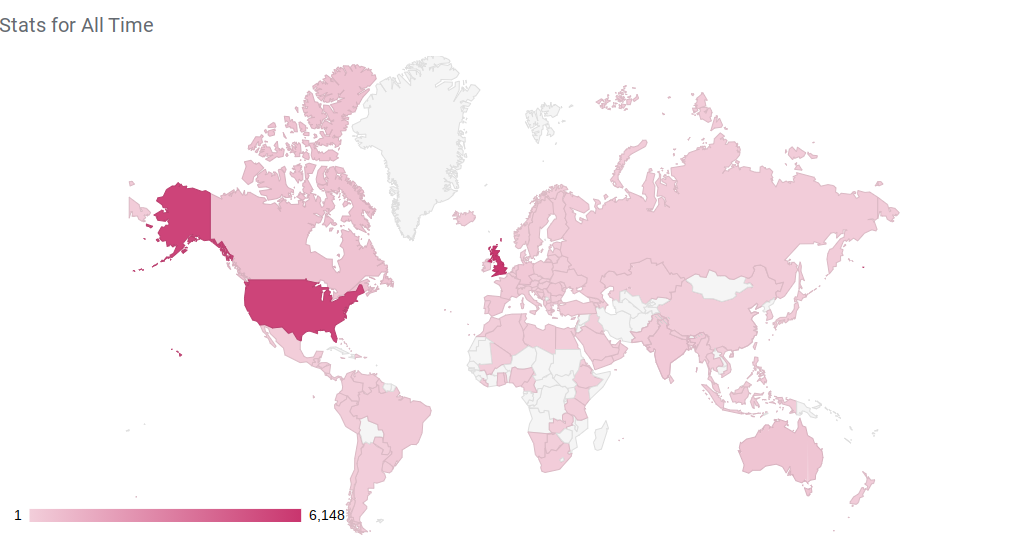
Unsurprisingly, the darkest areas of this map are mainly English-speaking, namely these isles and the United States. In fact, the most readership of all is in this country, demonstrating that the local connection is at least as important as the language I use. The US is a close second, followed by Canada and Australia. The distribution of views is close to log-normal, also known as the 80:20 rule. Here’s a plot of the log-normal distribution:

(and here the limitations of the Chromebook I’m doing this on become apparent because I didn’t plot this myself, just copy-pasted it from a free source).
The darker blue line is the germanest. My blog has been viewed in just over a gross of countries. The thirtieth country on the list is Norway, with three dozen views, which is where a fifth of the number is reached. The notable absences are in southern Afrika, Outer Mongolia, Bolivia, Papua and Kalallit Nunaat (Greenland), and there are also no views from North Korea, Cuba or Suriname. The complete list of countries and territories which haven’t seen my blog is: Papua, North Korea, Kalaallit Nunaat, Outer Mongolia, Bolivia, Madagascar, Lesotho, Eswatini, Western Sahara, Senegal, The Gambia, Svalbard, Jordan, Syria, Iran, Mozambique, Cabo Verde, Zimbabwe, Somalia, Laos, Mauritania, Guinea, Guinea Bissau, Equatorial Guinea, Angola, Congo, Democratic Republic of the Congo, Niger, Malawi, Sudan, South Sudan, Benin, Tchad, the Central African Republic, Afghanistan, Suriname, French Guyana, Turkmenistan, Uzbekistan, Tajikistan, Kyrgyzstan, Bhutan, Cuba, Haïti, Liechtenstein, San Marino, Vatican City, Andorra, and some small island nations in Polynesia, the Caribbean and possibly elsewhere. There are some outliers which I don’t fully understand, notably Romania, which I think resulted from me entitling one post Caveat Procrastinator, and unsurprisingly there are also hits from Romania for Transylvanian English. What these stats fail to capture is how much of a blog post is read. I imagine most of them are just briefly glanced at.
Some of the gaps in the list probably reflect political and development issues. For instance, it isn’t that surprising that central Afrikans don’t read my blog. Bolivia may be an example of this. There’s also the question of censorship, which can be summarised by this map:

The green countries on this map have the least censorship and the fuchsia the most. It’s probably worthwhile combining this with a global internet access map:

(Chromebook limitations are again apparent here). This second map is based on a composite statistic known as the Web Index, which has “no information” in the places where I have tended not to get any views. It attempts to combine ease of access, freedom of information and empowerment, so to some extent it includes the data on the previous map. It’s also notable that a number of the countries involved which are freest on that map also seem to have poor internet access, so it’s more like the governments concerned don’t consider the internet to be sufficiently influential in their countries to bother to do anything about it.
Besides all this though, I’m often concerned about a clash of values between what I write and those of people reading it, and perhaps between their values and my identity, in various ways, such as ethnicity and the fact that I’m quite left wing and vegan. I sometimes feel like there are whole swathes of the planet where I could not exist and might as well be underwater as far as I’m concerned, not because I have any enmity with the people there but because they wouldn’t tolerate various things about me. When I see that someone has read a blog post of mine from there, it gives me pause for thought. In particular, I tend to get quite bothered by clashes in political opinion. I’m aware that I’m to the left of practically everyone. This is my chart according to Political Compass:
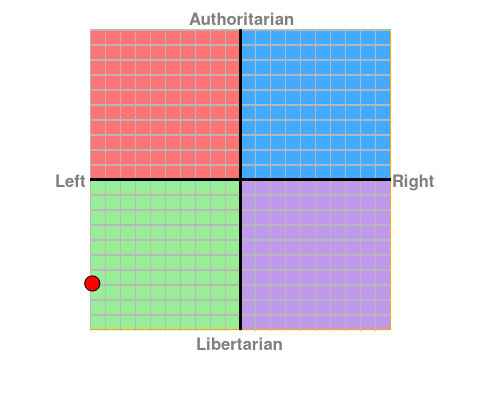
I’m aware of the inadequacies of that site incidentally. But the thing is, I care about people and I’m interested in politics. The mere fact that I’m libertarian socialist does the opposite of stopping me from caring about people, whatever their political views are. Likewise, being a religious theist doesn’t stop me from caring about non-religious people for their own sake, but does the opposite. Same with being vegan. I am all these things because I care about you all, whoever you are who may be reading this.
It’s just very difficult to be polite to everyone, particularly when one knows very little about their country, background and life. Consequently, it’s incumbent upon me to learn as much as I can about the human world, so as to be able to empathise with all of humanity. It’s not achievable, but surely it’s a worthy goal.
 A Box Of Chocolates