I don’t know if you’ve ever seen the short film “Powers Of Ten”. It starts with a photo of a picnic and zooms out to one hundred million light years, then zooms in to a hundred attometres. It can be seen here:
I have a distinct memory of a different film and wonder if it’s been remade. Despite the date on this I think this is the 1968 version. ‘The Voices Of Time’ was published in 1966. The maximum zoom out is to 1024 and the maximum zoom in is to 10-16 metres, neither of which are absolute limits. Nor does the upper bound correspond to the limits of knowledge at the time so far as I can tell, and a metre is not in the middle of that range. The middle would be somewhere like ten kilometres, which is of the order of the width of Chicago, probably somewhat smaller. The idea of it being in the middle is a bit nebulous-sounding. What I mean to ask is, how big are we in terms of powers of ten, or for that matter any other number, in the scheme of things? Are we as much bigger than the smallest possible length as we are smaller than the largest length, or are we off to one side, and if so, which?
The smallest possible length is the Planck Length. This is 1.616255(18)×10−35 metres. Strictly speaking there is no upper limit because it appears that space will continue to expand for ever, and even if it doesn’t it isn’t because there’s a geometrically ordained maximum size, but the diameter of the Universe is said to be 28 gigaparsecs, which is 8.635317 x 1026 metres. Incidentally, the upper figure has spurious accuracy. While we’re “out here”, I may as well work out the volume of the Universe, and I may have this wrong. The Universe is not spherical but hyperspherical, and its volume corresponds to the surface area of a sphere in the same was as that corresponds to the circumference of a circle. The formula for the circumference of a circle is of course 2πr and the surface area of a sphere is 4πr2, so I, perhaps naïvely, would deduce that the formula for the volume of a hypersphere is 16πr3. It’s a bit difficult to work out what the “diameter” of the Universe means because it isn’t spherical, but assuming it means the diameter of the hypersphere which in practical terms constitutes space, this gives it a volume of 4 x 1081 metres. It’s also worth using these figures to calculate the difference between this and the volume of a sphere of the same size, that formula being (4/3)πr3, which would give the Universe a volume of “only” 3.37158 x 1080 metres, which is only a dozenth of the size. This illustrates the significance of the fact that Euclidean geometry doesn’t apply at this scale, and it also means that a sphere exactly half the size of the Universe is twelve times bigger on the inside than it is on the outside. In Whovian terms, it’s dimensionally transcendental. It’s also possible to stick these two big figures together and work out one in terms of the other: how many Planck volumes are there right now? The answer is a figure with a hundred and eighty-seven digits, which permits an upper limit to the useful value of π, although as time goes by it would drift out of kilter so many more places may in fact be necessary. In the unlikely event that you need this figure, go here, which gives it to a million decimal places. I find this quite reassuring because it suggests that memorising the number in question isn’t entirely pointless, or maybe that’s disappointing.
Why is a Planck Length the shortest possible length? The reason for this originates in the “ultraviolet catastrophe”. It’s been known for thousands of years that when an object gets hot, it glows red, then orange, then yellow, then white. However, nobody knew why for most of our history. Given classical physics, why is it that hot objects don’t simply glow white and get brighter as they get hotter? There would, however, be a problem with them doing this. If they just glowed at the entire range of frequencies of light, this would include all frequencies shorter than visible light and this would be infinite if the variation of frequencies could be any figure at all between any two other figures. Obviously a hot object is not infinitely bright, but why?
The answer is that there is a minimum difference between frequencies of the light emitted by a hot object. This means that physical reality has a granularity to it. It has, in terms of computer graphics and video, a frame rate and a resolution, all determined by Planck’s constant, h, and the speed of light, c. Light can only be omitted in discrete quantities. There is not an intermediate energy level below a certain fineness and instead energy leaps between these levels without having any values in between. The minimum quantity is known as a quantum, and the energy of a photon is equivalent to its frequency multiplied by h. It solves a lot of problems. For instance, if electrons in orbitals constantly radiated energy over a continuous range, they would spiral into the nucleus and the atom would collapse. Instead, an electron can only have certain clearly defined energy levels. The Planck Length is given by the formula:
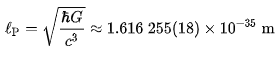
. . . where G is the gravitational constant and ℏ is h divided by 2π. The Planck Time is then the time taken for light to travel this distance.

The thing about the Planck Length in terms of scale is that it’s so much smaller than anything significant which seems to be happening, such as the size of the “smallest” subatomic particles. A zoom into the Planck Length would mainly be very boring because it’s nineteen orders of magnitude smaller than the limit in ‘Powers Of Ten’, which is equivalent to a speck of dust compared to something like ten dozen times the diameter of the orbit of Neptune. However, assuming that the film was made in 1968, certain fundamental particles such as quarks had not been established to exist yet, so nowadays it would be possible to go further. At this scale, it’s conceivable that “quantum foam” exists. Spacetime may be fluctuating in nature at these dimensions like a stormy sea, which also suggests that there is energy present in a pure vacuum. How this might be extracted, and whether it would be desirable to do so, is another question. It’s sometimes thought that the Universe is not at its lowest energy level and if that level were to be reduced to zero, for instance by “mining” the energy of quantum foam, that true vacuum would spread out at the speed of light from where it was formed and destroy everything.
Getting back to the question in hand, the smallest possible scale is the Planck Length of the order of 10-35 metres, and the largest possible scale is the Universe itself, whose current diameter is of the order of 1026 metres. This means we are on the large size. Of the sixty-one orders of magnitude possible at the moment, we’re the thirty-fifth smallest and the twenty-sixth largest. Middle-sized is around the thirtieth from either end, which is around ten microns or somewhere between the size of a white blood cell and a red blood corpuscles. Organisms of this size include protists and single-celled algæ. They are to the Universe as the Planck length is to them. Even so, we are close to being middle-sized in the grand order of things in that a factor of a million is not hugely significant when the number considered is around ten decillion. A hundred thousand times bigger than we is the size of a region of England such as the Midlands, and that’s not terrifyingly and incomprehensibly enormous. Therefore we are, very roughly, in the middle.
A More Literary Bit
I don’t know what pretensions I have to dare describe anything I write as appropriate for the above heading, but there it is. Yesterday I made this YouTube video:
Incidentally, I’m thinking of going back to making YouTube videos, but in future they’re likely to include no speaking and I won’t be showing my face on them, if I bother at all.
I found this rather unsatisfactory. I was going for the impression that the rather overgrown back garden was like a jungle at a smaller scale, but there were a couple of issues. One was that most of this wasn’t truly at ground level, and the other was that there seemed to be precious few animals in that video. I may give it another go at a later date. What I wanted was a lush forest-like appearance teeming with animal life, such as spiders, ants, beetles and flies. Something like this but with animals:
We do, to Sarada’s chagrin, have plenty of horsetails in our garden but they’re not forty metres tall. It’s really a testament to them that they’re still around after 300 million years, and to me it raises the question: when you get smaller, is it like going back in time? After all, on a sufficiently tiny level there are no vertebrates, or rather the vertebrates who do exist are great hulking monsters. There’s a frog who is less than eight millimetres long, and in Britain the minimum size seems to be a few centimetres. Mammals and birds as they’re now constituted can’t be smaller than a certain size because they would be physically incapable of eating enough food to keep their body temperatures at the right level to survive, so getting smaller is a journey into the past in terms of the animals all being “cold-blooded”, except of course that as discussed previously a flying insect isn’t really cold-blooded at all if it has to put much effort into flying. However, also at this scale animals don’t so much need to put effort into flying as into not flying, because for them the air is a fairly thick, buoyant fluid which they don’t so much fly through as swim in.
J G Ballard’s novel ‘The Enormous Space’ tells the story of a man who resolves never to leave his house again. As the days go by, his house expands until even the room he’s in is too vast to traverse. It’s been adapted into a TV play by the BBC:
Because of lockdown (I almost gave that a capital letter), some of us have found our homes becoming our worlds like the character in this piece, but to the various denizens of our dwellings they already are. The longest line section (actually geodesic) which can be drawn in the area I have lived my entire life within is about two thousand kilometres long, from Inverness to Rome, so that’s my world, in a way. Reducing this by a thousand gives an area the size of a small town, so for an ant, say, this is their world. The vegetated area of the garden is about twelve metres long, so magnifying that by a thousand makes it twelve kilometres, like a large forest in terms of England today. But this is mainly a bamboo forest with prodigiously high “trees”, since it’s largely grass. The tallest bamboo species is Dendrocalamus giganteus, which is up to thirty-five metres high, and at a scale of one to a thousand this is equivalent to a fairly well-manicured lawn, which we don’t currently have. To an ant, the moderately tall grass in the back garden is something like ten times the height of the tallest bamboo, making it more like a redwood forest, though of course not woody because of the relatively lower gravity.
This is truly a different world. The gravitational acceleration is less important there because the relative masses are a thousand million times lower. An insect could easily fall out of a skyscraper without being harmed, even though the gravity operating on a two millimetre long organism is in a sense a thousand times as strong. The atmosphere becomes a much more important factor, even the dominant one. Water becomes if anything more dangerous because its surface tension not only allows it to be walked on but also to capture an insect permanently even though they wouldn’t sink, and this opens up a whole ecological niche of predators who can prey on the victims of surface tension such as raft spiders and pond skaters. At the same time there are still the more familiar predators and prey in the form of ladybirds, wolf spiders and aphids.
It’s easy to think of oneself as trapped in one’s home, and since I’m a carer that is particularly a hazard for me. However, not only do I continue to have communication with the outside world, but also I have access to the microcosm. Even without a microscope I can observe the relatively large animals living in the house and garden, and when I get down to the middle-sized animals such as the hundred micron Colpoda, which will be present in the soil here like it is all over the place, and the crinoid-like Vorticella likely to be present in the guttering whose stalks are around the same length, the garden is relatively the size of that good old colloquial unit Wales. How could I want for any more? I can also go the other way, though since I live in England with its grey skies, not quite so far. But on a clear night, like anyone else I can realistically see individual stars thousands of light years away. The whole observable Universe is around me and half of it is accessible, though this presumes I have my own observatory and in practical terms is far less so because I’ve only got a pair of binoculars. But even so, I can see the Orion Nebula, 1 300 light years away, and the Pleiades open star cluster, 440 light years from here, and so on.
In the end, then, although it’s important to get out of the house, to some extent it’s what one makes of it, and the scope for what I might call adventure but is probably better called observation, even just from this one small house and garden in an English Midlands town, is vast. Just because the slightly larger than medium scale at which we happen to live lacks, in the East Midlands anyway, rainforests, elephants, lions and whales, doesn’t mean it doesn’t contain an equally fascinating array of wildlife on another level, and just because we’re confined to Earth doesn’t mean we can’t observe a fascinating wider Galaxy. What more could anyone want? Isn’t it great to be middle-sized?
 A Box Of Chocolates