I attempted to watch the 2021 (CE) ‘Dune’ last night and had high expectations. I was disappointed and gave up after an hour or so. However, I should point out I was of necessity watching it in HD rather than 4K on an 80 cm telly without surround sound, about which I was already trepid due to the fact that it seems to be very much a cinematic experience. The best, or possibly only, way to watch it is probably in an IMAX cinema.
I’ve been putting it off for a while. When it was first released, the Covid issue and other reasons why I’m tied to this house prevented me from going to see it as it was “intended”, but I heard good reports about it. Later on, the rental price was ridiculously high, at something like £15.99, which was also off-putting. I can understand the need to recoup costs in difficult circumstances, so I’m not just going to put that down, as many others have, to greed on the part of the studio. I do wonder if the strategy worked, since it’s now been reduced.
But then I ask myself, if a film relies on spectacle for its impact, is it actually worthwhile anyway? Sometimes I think it is. For instance, there’s an ’80s film I can’t track down about a woman going blind which is visually very lavish because it emphasises what she’s losing. I also understand that another SF film, ‘2001 – A Space Odyssey’, hugely benefits from being seen in its original form in Cinerama. Incidentally, a number of films made in the late ’60s and early ’70s have a “trippy” scene like the one in ‘2001’, such as ‘Charly’ and ‘Willy Wonka And The Chocolate Factory’, with the tunnel scene, which very much chime with the Zeitgeist and exploit the medium of cinema well. I’m not sure how the parents of the children watching ‘Willy Wonka’ would’ve felt about the likelihood that that scene may have packed the auditorium out with a load of long-haired smelly hippies, as they would’ve seen them, but there it is.
I actually feel quite strongly that science fiction cinema should be low-budget and have low production values. ‘Primer’ and ‘The Cube’ both have tiny budgets. ‘The Cube’ mainly involves a single set lit in different ways to make it look like different rooms and cost only $350 000. ‘Primer’ was much lower, at $7000. Even ‘Dark Star’ only cost $60 000, although that was mid-’70s so in 2021 dollars that would be 350,000 (I’m having trouble with the blog editor messing up number formatting here). SF is a number of things, but for me two aspects of it are crucial. One is that it’s a genre where ideas replace protagonists, or perhaps are the protagonists, as with the Big Dumb Object approach seen in ‘Rendezvous With Rama’ and ‘Ringworld’, but often in more abstract ways as in ‘The Ones Who Walk Away From Omelas’. The other is that it has to be fiction whose plot depends non-trivially on the setting. I came up with this criterion specifically to exclude ‘Star Wars’, which I hate and despise, from the genre. The ‘Star Wars’ franchise has many issues, but a significant one is that it attempts to tell sword and sorcery fantasy tales in a space opera setting to demonstrate that certain aspects of the human condition are eternal and universal, and this means that the setting only exists to demonstrate that things are still the same, even though the characters don’t even share ancestry with Homo sapiens. There is nothing wrong in principle with fiction whose plot is independent of the setting or even trivially dependent upon it, although I suspect that the execrable ‘Number One Ladies’ Detective Agency’ is this so there is a risk of poor quality because of that, but it does place it outside the genre.
‘Dune’ was significantly heavily plundered by George Lucas for ‘Star Wars’ although the latter has many other elements which are not linked, such as Buck Rogers and Flash Gordon, and probably Tolkien too. This is unfortunate for a 2021 film though, because it may give the viewer the impression that it’s derivative rather than ‘Star Wars’. It’s very like the tendency for children’s CGI films to be pre-empted by inferior copies being released earlier because they take less time to render than the better quality Pixar films, which happened a lot in the ‘noughties. Without the awareness that Frank Herbert invented a lot of the tropes which ended up in George Lucas’s films, ‘Dune’ looks like a rip-off of that franchise, when it very much is not.
The problem with big budgets in films is that they are often used to make them visually impressive while detracting from the quality of the script and plot. It would be unfair to accuse ‘Dune’ the film of having too many fight scenes because the book also has those, but I remember thinking that the film of ‘Prince Caspian’ was completely ruined by having a ridiculously long battle scene in it, presumably because it needed to compete with ‘Lord Of The Rings’. Herbert did take pains to force his future universe to behave as if it was like our world of a few centuries ago, by outlawing AI and contriving to make melée weapons necessary, so the presence of long, tedious fight scenes and a fair bit of associated machismo is at least in keeping with the tone of the book. This is also balanced by the rôle of soft power and women in the story, although to describe the manipulations of the Bene Gesserit as “soft power” isn’t really accurate. At the same time, there isn’t necessarily anything wrong with a film mainly being a spectacle, and it might even make sense to go further in that direction to keep cinemas alive.
One way in which ‘Dune’ bucks the trend, inherited from the novel itself, is its positive portrayal of Middle Eastern culture and the associations with Islam. Being written in 1965, Herbert’s story long pre-dates the resurgence of Islamophobia in the ‘noughties. That said, it does very much portray religion as primarily an instrument of social control, although there is also the apparent existence of psi abilities. In the film, the latter is clearly present. The author appears to treat Arab culture and Islam respectfully throughout the first novel (I say that because I haven’t read any further). It’s refreshing to see that done in a 2021 Hollywood blockbuster.
I’ve got this far without mentioning the David Lynch version! One of the many problems with that appalling version was that it had an all-White cast when none of the protagonists in the novel were White. This is addressed to some extent in the casting of Villeneuve’s version, although it would be difficult to portray the thorough mixing of ethnicities the novelist assumes to have happened in the many intervening millennia. Evolution has also altered Fremen physiology, so there are biological differences, some of which are genetically engineered, and there are also millennia-long breeding programmes which are supposed to reach their climax in the birth of Jessica’s daughter, but the problem is that she chose to have a son first.
One positive from the previous film is that it at least attempts to portray the space-folding technique used to travel between the stars, although in a very weird and off-putting way. This is completely absent from the new version, which is significant because Spice is economically central to the Imperium as a means of enabling interstellar travel. It would’ve helped to have shown that in order to emphasise the in-universe realities of its central position.
Herbert advocates a right-wing position in his novel, that the basic state of human society is feudal. He was also writing against Asimov’s ‘Foundation’ series, where sociological predictability is central and the emergence of a mutant who can influence society through their new abilities disrupts the plan for preserving civilisation. This was a quasi-socialist position, although Asimov was merely a liberal. Herbert’s reply to Asimov is to portray a society where an individual mutant, or at least a carefully bred sport whose existence depends on an individual decision to go against the plan, makes a huge positive difference to a society. The way Hollywood works is to have heroines and heroes struggle against enormous difficulties and achieve resolution through strength of character, although there is sometimes emphasis on teamwork and family values too. ‘Dune’ lends itself fairly well to this approach. The approach, however, seems to be carefully engineered to bring a situation which reproduces the social conditions of the European Middle Ages. The emphasis on families wielding power can be seen as arising from powerful companies, as it sometimes does today, but on the whole large capitalist enterprises are more democratic than that because of shares and floatation on the stock market. I don’t think it’s really explained how humanity ended up back in the position of having powerful houses, religious organisations and guilds controlling everything when it had become thoroughly capitalist by the twentieth Christian century.
All this, though, may be the reason I didn’t enjoy the film. It’s a bit like ‘The Restaurant At The End Of The Universe’ in a way. You get to the very end of the span of time during which intelligent life exists, and the economic system is still as it ever was, there has never been a utopia and so forth. Likewise, ‘Dune’ is estimated to be set something like 30 000 years in the future, which is a lot closer to the present day, but the basic social order is not criticised so much as taken as a given. I think I would prefer a world to be presented either as a utopia or dystopia. That said, it may be more realistic to recognise the future as neither, and again this chimes with what political conservatives would see as realism. Moreover, this was in the original novel. If it comes across in the film too, that would seem to be a successful adaptation rather than either a failing or a negative aspect of the work.
When it comes down to it, what I think has happened is that I haven’t really seen ‘Dune’ and may not in fact ever do so. In order to see this film, you have to go to the cinema, and possibly to an IMAX to watch it. I didn’t do this, so maybe I haven’t got any valid grounds for criticism. Nonetheless I did rapidly lose interest. My fault probably.
When I started studying human physiology as a separate subject during my training, I was rather surprised by what it seemed to consist of. The textbook had been set by one of our tutors when he was hungover and had made a rather unsuitable choice, so I won’t mention it, but if you happen to want a good textbook on human physiology, Guyton and Hall’s ‘Textbook Of Medical Physiology’ is excellent. Most of the students on my course ended up using that instead of whatever it was we were supposed to use, and got along a lot better for it. But this is an instant digression, and I shall return to my point, or I would if I’d even made it in the first place.
The book in question began by considering diffusion, osmosis and active transport. All of these involve the movement of substances through a medium, often separated by a membrane, and physiology, and therefore the processes of life as we know it, is ultimately mainly about membranes keeping stuff in, out, separated and moving stuff through them. The surprising thing to me was how important electrical charge was in all this. In the equations which describe diffusion and osmosis there is always an electrical charge factor, because positive and negative charges attract each other and try to become neutral. This means that, other things being equal, sodium ions, which are positively charged, might be more reluctant to move across a membrane if there is a positive charge on the other side, perhaps due to potassium or calcium ions, but chloride ions, which are negative, would be encouraged by such a state of affairs. Entropy insists that things run down and will therefore, left to itself, try to equalise charges on both sides, which could have all sorts of consequences, including of course death. Therefore, there is a process called active transport, fuelled as usual by adenosine triphosphate, where complex molecules floating in the membranes act as gatekeepers, allowing some substances through which wouldn’t be able to get through on their own, and changing shape to do so, thereby opening a channel. The membranes themselves, apart from various molecules embedded in them such as the antigens which determine blood groups or interact with hormones, or the aforementioned active transport channels, basically consist of two layers of fat molecules facing each other and electrically repelled by the water molecules on either side. This importance of electrical charge is one reason body fluids are often salty. When they aren’t, considerable effort may have been expended to stop them from being and there will be some difficulty in keeping the salt away from them, so for instance saliva and milk are both rather non-salty, and this is because they need not to be. Moreover, many conditions are associated with ions being in the wrong place, notably cystic fibrosis, where body fluids are too viscous for this reason.
The book was not good in terms of deriving some kind of understanding of people’s bodies which would actually help the person sitting in front of you in a medical consultation because there was a considerable distance between all this talk of membranes and ions and the soft conscious meatbag with whom one is trying to establish a rapport, although ultimately it is useful. It was more that the work in question had it the wrong way round, and was selected because some of our tutor’s ions were in the wrong places and on the wrong sides of membranes thanks to his choice of tipple the previous evening. However, the book succeeded in giving an interestingly reductivist view of how living things work, and my first surprise was that charged particles were not only esssential to life but also had many rôles in the human body.
There are three well-known states of matter, one further state which is in fact the most common state of atomic matter in the Universe and a number of minor states and phases which are unusual and unlikely to be encountered on this planet unless it’s about to end in some way or have been carefully created by scientists. The three oft-quoted ones are solid, liquid and gas. Solid matter is held together by electrical forces and is very often crystalline on some scale. That is, it has a repeating geometrical motif throughout its bulk. It isn’t always obvious that it’s crystalline. For instance, the calcium phosphate in bones and teeth is crystalline, but the crystals tend to be rather small, and they are hexagonally symmetrical. The alternative is glass, which is amorphous and doesn’t just refer to the stuff windows are made of, which is composed of haphazard particles held together fairly rigidly by electrical forces again, but with no pattern to them. This is why glass is sometimes described as a liquid. Its molecules are able to start moving around as the temperature increases and it will begin to flow but it’s a myth that ancient windows are thicker at the bottom for this reason. It’s actually the result of the way they were initially made, and modern glass will never thicken that way.
Liquids are special. They are only found either in atmospheres or otherwise under pressure, such as within a planet. For this reason, throughout most of the Universe the liquid state doesn’t exist and solids just become gases above a certain temperature with no intermediate state. Liquids have freely moving particles which flow over relatively short periods of time. The dominant theory of matter over the long period during which atoms were not taken seriously was that solids and liquids were both fluid but that solids were just very, very thick. This has some appeal and I’m prepared to believe it’s true, but it probably isn’t. I was going to say that liquids were the rarest state of matter, but they may well not be because the interior of many planets and moons is likely to include a lot of liquid, often water or magma, with solid forming only the crust and the core, although there are also gas giants, which again may have vast interior reservoirs of liquid under pressure. Then again, there’s a lot of dust and rock in the Universe, and that may outweigh liquid. I don’t know.
Gas, though, is fairly common. It generally includes particles pinging about at amazing speed and sometimes colliding with each other. However, there are also collisionless gases, which are atoms or molecules far apart from each other which never get very close because the gas they constitute is so thin. In terms of bulk, as opposed to mass, collisionless gases may be the most widespread state of matter because that’s what the interstellar medium basically is, as are nebulæ, the upper atmospheres of large planets, the entire atmospheres or smaller ones, cometary tails and so forth. But the gas we know well as the air we breathe is also quite common, costituting all of our lower atmosphere and most of the volume of the gas giants. Gas in this Solar System must take up hundreds or thousands of times the volume of our whole planet, and also exceed its entire mass.
However, in terms of mass rather than volume, and considering only atomic matter here because of the existence of neutron stars and black holes, which are made of another kind entirely, by far the most common state of matter in the Universe is the fourth one: plasma. This consists of ionised particles and their electrons moving around relatively freely. At first this might sound like it’s just a special kind of gas, but it has different properties entirely, and also behaves differently than other states of matter. Stars are mainly made of plasma, on the whole, with a few exceptions such as white dwarfs, and since stars are often much larger than planets and are found in countless milliards in galaxies, plasma must surely be the dominant state of matter in the Universe. We don’t come across it very often though, unless the Sun is considered: our chief experience of plasma is probably lightning and nowadays electrical discharges. In a sense the words which are now translated into English from Latin, Greek and possibly classical Arabic as “fire”, which also refer to lightning and the Sun in at least the first two cases, have undergone semantic drift, because over a millennium ago, there was no notion of oxidation and “πυρ” referred as much to lightning and the Sun as it did to flames emerging from rapid oxidation, so it wasn’t in fact as inaccurate as it tends to be construed, and this will become important later.
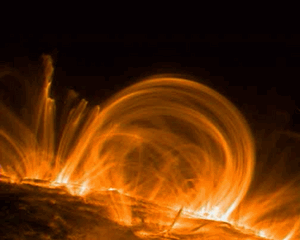
In a way, plasmas can be thought of as like gases which are also metals, because they share some properties with them, and this makes me wonder what mercury vapour is like, since that’s a metal with a markèdly low boiling point. Plasmas are definitely not gases though, and they’re distinct in a number of ways following from the fact that they have separated electrons. Relatively high-pressure gases, such as we would normally experience by breathing, consist of constantly colliding particles, although at any one time a specific particle is unlikely to be doing that. Thinner gases don’t have this though. The interactions within gases consist of these collisions. Plasma particles rarely or never collide. That is, there is a very small chance that an electron could recombine with an ion above a certain temperature, but the electrons and ions each repel members of their own species, and consequently the interactions of plasma are collective rather than binary. They are similar to gases in that without external forces operating on them they will occupy the space available and have no fixed shape or volume. Particles within them interact at a distance. They also have structure in a way gases don’t. Clearly gases do have structure to some extent, for instance there are clouds and layers of gas, but nothing stops gases from mixing with each other. By contrast, magnetised plasma resists penetration by other plasmatic bodies, so for example we have the bow shock of Earth’s magnetosphere resisting the other plasma of the solar wind, and the plasma tubes between Io and Jupiter. Because interactions between particles are collective rather than local, a phenomenon known as collisionless shock can occur. In a gas or liquid, shock waves are formed, and in fact that’s what sound waves are, but they occur because atoms or molecules are pushed together and then rarify, forming a wave travelling at the speed of sound in that medium. In plasmas, a large region can form a relatively stable sheet known as a collisionless shock. The particles don’t need to get very close to each other for this to help because magnetism pushes them around at a distance. There are also magnetic flux ropes and tubes. These are somewhat similar structures seen, for example, in solar prominences. A flux tube is just an elongated region in plasma where there is constant magnetic flux, but a flux rope is a similar region with a helically twisted magnetic field which carries an electrical current. It’s often very clear from the appearance of a solar prominence:
. . . that they’re following magnetic field lines.
In a sense, a vortex in other kinds of fluid is similar to a magnetic flux rope, such as a tornado, but there’s no overriding regional magnetic influence. There are also more complex structures in plasmas which occur across a huge range of scales. Many examples of plasmas observed astronomically are divided into compartments by what are known as current sheets. When several bodies of plasma expand towards each other, they meet and compete for space, and a current sheet forms at the border. Unlike a shock, a current sheet moves slowly and, of course, carries an electrical current, which may be at right angles or parallel to the magnetic field. The magnetopauses of Earth and Jupiter and the heliopause of the Sun are all current sheets. These are where the magnetic field of the bodies in question become balanced with those of their surroundings. These have perpendicular currents, whereas auroræ are sheets with parallel current.
A current sheet can surround a region and preserve the properties of the environment inside that region. For instance, here on Earth the solar wind has little influence on us and has therefore not destroyed our atmosphere, unlike Mars, which lacks a strong global magnetic field, and this is thanks to our magnetosphere. They also operate with ionospheres in a similar way, and in this situation there is ionised material within the ionosphere. Such regions are referred to as cells. In many circumstances, the word “cell” doesn’t imply close similarities to living cells, such as a prison cell or a power cell, but in this case there is quite a close analogy, as the cell isolates an environment with particular characteristics of electrical charge.
In the early ‘noughties, scientists passed a spark through a chamber containing argon plasma and found that it formed isolated spheres with a double layer with electrons on the outside and ions on the inside, isolating a region of argon gas within them. This is very similar to a living cell, with its double layer of lipid molecules aligned by electrical attraction and repulsion. These spheres could grow. They began a few micrometres across and expanded to three centimetres in diameter, by taking argon atoms and ionising them to become part of the current sheet. They also divided in two, to form separate cells. Putting this in biocentric terms, these are plasma cells which can grow, reproduce and metabolise. They may even have been the first cells on this planet, existing within thunderstorms.
Both biological and plasma cells have a barrier surrounding a region with its own protected properties, process materials to become part of their form, grow, divide and separate regions of different electrical charge. The crucial component absent from these plasma cells is anything to carry genetic information. Scientists have also produced globules named “microspheres”. In 1955 CE, Sidney Fox produced protein-like substances from amino acids in solution and they organised themselves into bacteria-sized spheres which separated internal from external environments, showed osmotic behaviour, formed chains and divided like bacteria. To me, the surprising thing is that they were not made of lipids but chains of amino acids referred to as “proteinoids”. These too lacked genetic code, so in both cases, functionally similar structures formed without any complex machinery or genes, and in both cases, even without genes, they share certain unusual functions with organisms.
In the past two posts (this and this), I concentrated very much on “life as we know it”, even to the extent of assuming it would not only be carbon-based but depend on phosphorus as well. Otherwise that would have run way over sixteen thousand words and become rather complicated. The possibility of plasma-based life could be a bit of a game-changer. The plasma cells created in the lab needed high temperatures to form initially, but then managed to maintain their function at a much lower temperature. If plasma-based life is possible, the chances are it could exist in many different forms in all sorts of environments widely regarded as hostile to life due to the focus on carbon-based biochemistry. At some point I will probably do a review of other kinds of life, but plasma is special, because unlike other possibilities it may have direct consequences for us. Among other things, our own bodies have features in common with plasma-based life, because we and all other organisms rely on moving charged particles around and controlling them with barriers. Perhaps a planet whose atmosphere was for some reason wracked with thunderstorms for a time would end up developing this kind of life, but there are other situations where it can be imagined in other forms, such as in stars, nebulæ and magnetospheres.
There is also a second, maybe more far-fetched, possibility. Unlike other states of matter, there is no sharp transition between gas and plasma, but a gradual increase in ionisation, and it’s fairly arbitrary when a substance counts as one. There are also “dusty plasmas”. These consist of small charged motes of dust. There are various types of Transient Lunar Phenomena, often involving lights, but one variety involves mists. Although it isn’t known what causes them, one theory is that radiation causes soil particles to become charged and repelled from the regolith, producing a temporary cloud of dust. This would be an example of a dusty plasma. The spokes in Saturn’s rings may also be dusty plasma. This may be extending things too far, since even ordinary plasma life is pretty sketchy and speculative, but I do wonder, if plasma-based life is possible, whether dusty plasma life also is. It would mean there could be life on dry, airless worlds like our own satellite in the form of clouds of statically-charged dust.
This is where I’m going to take a turn into a very-poorly supported scientific possibility, or impossibility.
We’re familiar with life based on organic compounds and water, which also use electrical charge a lot of the time. There is no organism which doesn’t use charged particles, but as far as anyone knows there are also no organisms which/who consist primarily of charged particles. If there are, they might have to live under special environmental conditions if they were present on this planet. In particular, they could possibly survive in very dry deserts such as the Atacama or the dry valleys of Antarctica, because rain, damp and moisture would be fatal to them. But there is another possibility, and I can only really ask this as a question: could they live as entities within organisms with more conventional biology? I don’t have a firm idea about how this could happen either. Before I go on, I’m going to talk about Stoicism.
Stoicism as it’s generally understood today is a philosophy of life which emphasises that the one thing one has agency over is one’s reaction to circumstances. I think this is a dubious idea and probably also an undesirable one, but it’s still an interesting philosophy which scores over some others. It was originally a Greco-Roman idea associated with psychology, metaphysics and physics, and some believe it influenced Christianity, which could also mean Islam is influenced by it.
Stoic physics maintains that the world begins and ends in a fire, and that souls are tongues of flame from that fire. The cosmos is a self-sufficient single entity, who is God. Everything is material, including things like justice and wisdom, and therefore souls are also material, which is similar to the Jain view of souls. If you swap out the English translation of “fire” and replace it by “plasma”, it becomes much closer to plasma cosmology and the idea of plasma-based life, and there is good justification for that because the Stoics explicitly state lightning and the Sun are special types of fire. Stoicism as a way of life is stated to be able to function without accepting the physics, but there may not be any need to reject that view of the nature of the world to do so. Plasma cosmology is a modern, not generally accepted, view of the Universe which emphasises the significance of plasma in the physics of the Cosmos. Hence Stoicism could be a kind of quasi-religious view of the nature of the human soul and the Universe, linking the two and is surprisingly modern, although I would still say it’s flawed as a way of life because it overestimates the power of the will and doesn’t acknowledge the rôle of passion in living an authentic life.
I do not identify as a Muslim, although Muslims would accept me as أهل الكتاب, one of the “people of the Book” and I no longer see myself as Christian due to the apparent inability of the Holy Spirit to help Christian Trump supporters avoid sin with regard to the Covid-19 pandemic. I did study Islam as part of one of my degree dissertations, so I believe that I am to some extent qualified to report on their beliefs, and in the context of plasma-based life forms Islam has a particularly interesting view. It holds that there are two components to a living being. One is the gross material form, which is seen as the body and in the case of other species of animal constitutes all of their essence. The other is referred to as “fire” in some writings, although as with Stoicism it’s also usually referred to as “wind”, as in the invisible principle which moves the body when alive. Angels and djinn (جن) are seen as pure fire, i.e. pure spirit or soul. Humans alone are seen as combinations of the two, body and soul, and in that respect as superior to either other type of being because we have both dimensions. This is why the angels were ordered to bow down and worship Adam, which Iblis refused to do.
That summary is of course a bit of a bastardisation and distortion, and probably the fact that it isn’t in Arabic, which I don’t know well at all, means that it may even necessarily be inaccurate. To make a more responsible summary, the Islamic philosophical writings concerning the soul and spirit distinguish between nafs (نَفْس) and ruħ (روح) . Nafs is cognate with the Hebrew נֶפֶשׁ , which translates as “soul” and is used in Arabic as a reflexive pronoun, but is also often understood to be the lower self, which incites one to sin. Ruħ is a “higher” soul, although it also means “breath” or “wind”, and the same word exists in Hebrew as רוח. Nafs traditionally referred to the blood and the physical body, so there is a correspondence here between these two concepts and the gross body and “fire” of human nature. There’s also some confusion, at least in my mind, between fire and wind or breath, meaning that the higher soul is conceivably a combination of fire and a mobile gaseous body, and it makes sense to think of this as plasma. Hence, to be materialistic, the movement of charged particles around a living body in a unified way has similarities to plasma and constitutes human life, but there’s an extra category in Islam of detached and possibly morally “unpolarised” beings known as the djinn.
Christianity also compares the spirit to fire, i.e. plasma given the wider interpretation of the word in Greek. Pentecost involved the appearance of tongues of flame on the heads of the faithful. The Holy Spirit is like a fire which purifies and dwells in the committed Christian. Christianity can be interpreted as physicalist in the sense that human consciousness is always embodied because of the resurrection, although clearly God has to be spirit. Hence although it may seem heretical and blasphemous to see the spirit as consisting of plasma, there is some basis for that in Christian anthropology, although to me, with a Christian background, that seems over-literal.
The Creator is unlike any created thing. Accepting that means that the Creator is not a fire or a body of plasma, and I’d go so far as to claim that أهل الكتاب as a whole cannot accept the idea because of the essential difference between the Creator and the created. Stoicism is another matter, as are many other religious, spiritual and philosophical views of the nature of reality, as they can be pantheist. However, there is the burning bush of Exodus and the Tabor Light of Orthodox Christianity, although that is said to be uncreated, so at least as metaphor plasma works as a symbol of the Creator. Outside the Abrahamic tradition there is Zeus, Jupiter or Thor with his thunderbolts, and other species of ape are moved emotionally by thunderstorms, so this intuition may go back a long way and is partly based on the altered ionic conditions associated with them.
Jesus once stated (presumably in Aramaic, so this is a translation):
“When the unclean spirit is gone out of a man, he walketh through dry places, seeking rest, and findeth none. Then he saith, I will return into my house from whence I came out; and when he is come, he findeth it empty, swept, and garnished.“
Although again it seems dangerous and blasphemous to equate πνεῦμα with something physical, the observation is interesting as a plasma-based life form would indeed have to “walk through dry places” to preserve itself. That said, the human body is a decidedly wet place.
It would be easy to cherry-pick folklore on djinn, and to an extent this is what I’m about to do. Belief in them dates from before the advent of Islam, but rather than being condemned as evil, as many Christians did with the spirits pre-Christian people believed in, they are to an extent incorporated within the body of Islam, and even seen as potential Muslims. They are, though, sometimes viewed as the same as demons. Early Islamic science regarded them as animals of a special kind, having only a subtle body. Whether they were detectable by sensory means was also controversial. They’re often seen as essentially invisible and the like, although other accounts have them able to form into the bodies of animals such as onagers. Another tradition holds that they are invisible while they have a heartbeat but when killed, leave behind corpses, which have been described as a cross between a scorpion and a snake. They have been blamed for sleep paralysis and are also sometimes seen as potential succubi or incubi, although not capable of reproduction with humans. Mental illness has also been blamed on djinn possession. They are emphatically seen as created beings and also mortal. Interestingly, they are also associated with sandstorms and thunderstorms.
To an outsider to the tradition, reading the Qur’an can be an odd experience since in it, djinn are simply assumed to exist and mentioned repeatedly. At no point is their nature explained in much detail so far as I can tell, but then there’s no reason why they should be because this kind of sacred text is not amenable to being a zoölogical treatise or textbook of some other kind. They are just part of the furniture, as it were. The book might mention a donkey or a cow, and similarly it mentions djinn as though their existence is completely uncontroversial. I suppose the New Testament does the same with possessing spirits, but I don’t think they’re mentioned much outside the gospels. It isn’t necessary to believe in them to be a Muslim according to the Five Pillars of Islam, unlike angels. Likewise, dragons and unicorns aren’t mentioned either, so they could be consigned to the category of mythical beasts. Since they are also seen as causing illness and not visible to the human eye, they could also be seen as pathogenic viruses or bacteria. They are understood to eat, mate, reproduce and die. They’re also not seen as supernatural. In Shari`a law, humans who claim to be able to see djinn, unless they’re prophets, are not considered reliable witnesses by some scholars, which is not to deny their existence so much as to emphasise their invisibility. They are also, though, seen as inhabiting dingy places and eating rotting corpses and bones, and this description in particular makes them sound more like bacteria or fungi than ethereal beings, and seems incompatible with the notion that they’re plasma entities.
However, it’s possible to distill this and simply paint a picture of what a plasma being might be like if it lived on this planet. It could either be dusty plasma or consist entirely of ions. In the former case it would appear to be a partly transparent somewhat amorphous cloud, which could perhaps also have formed elements within it. In the latter, it would glow in the dark but otherwise have similar qualities, although it might inhabit the upper atmosphere. The dusty ones could form or inhabit dust or sand storms and the luminous ones dwell in or above thunderclouds. It isn’t clear whether the latter could descend to ground level. If they were anything more than very simple organisms, they would have to have persisted for a very long time in their environments, and since they’d be very vulnerable to moisture there wouldn’t be many environments on this planet where they could survive, although they might be able to protect themselves by moving up into the stratosphere when it becomes humid. Antarctica might be a refuge for them because it never rains there. They would be more common in deserts, including that continent. Antarctica is the driest place on Earth and in bases, static build up is a constant nuisance, with electrical equipment being damaged by it, but it isn’t clear whether it’s significant outside as a phenomenon independent of human behaviour. A plasma entity coming in contact with a human being, or simply being near them, could adversely affect their health, although here we are almost literally in tifoil hat territory as that would be how one would need to protect oneself from their influence. It isn’t clear if there would be a way for a plasma-based life form to become parasitic upon a human, since it would have to transition from the dry, rarefied environment outside to the mainly aqueous one inside the body or nervous system. However, it’s easy to imagine that if it did, it could interfere pathologically with one’s health by disrupting the movement of ions, and if it could both transition and had persisted, evolved and reproduced for æons, it could in fact become an obligate parasite, although there may be no evidence for that medically. That doesn mean they don’t exist though. Prions were unknown until fairly recently but are a significant cause of disease in many species of animal.
If there are worlds with plasma-based life forms dominating them, they would probably be quite dry, perhaps like Mars, and possibly very stormy, or at least have gone through a stormy phase. I had hoped to be able to link them to the human soul here, but I can’t find a way of doing it because of the very hostile conditions for plasma which persist in the central nervous system. Nonetheless, it’s interesting that this might be a form of life not as we know it which might even be present on Earth.
Today has been the Summer Solstice in Britain and this time will have been the Winter Solstice in the Southern Hemisphere. It’s a little confusing how the solstices appear to move around. This is mainly because of leap years and the fact that the year is not exactly 365 days long in reality. I think there’s another explanation too, but I have difficulty remembering what it is. It’s also the case that Earth’s axis is precessing, which moves the position in the year of the solstices, and also the eccentricity of our orbit and the position of the points where we’re closest to and furthest from the Sun gradually change, although this may not be directly linked to the equinoctes and solstices.
One of the peculiarities of living in these isles compared to North America is that we’re a lot further north than either people living in North America or we think we are. This is of course because our climate is currently strongly influenced by the Gulf Stream. A dramatic way of illustrating how close to the North Pole we really are is to consider our position relative to the Alaskan Panhandle, which extends from 54°43′ to around 62° North. The southern figure is also the latitude of Hartlepool, and the whole of Scotland is north of that latitude, as is about half of Ulster. The northernmost point of Scotland, Out Stack (and not Muckle Flugga as many claim) is about 60°51′ North, meaning that most of the Panhandle is actually south of the Shetlands. As for the Aleutians, they extend as far south as 51° North, which is even south of most of Kent.
Anyway, one of the consequences of this is that even in England we get a six week period around the Summer Solstice where it doesn’t get properly dark. Today, the Sun will set at 10:42 pm on Muckle Flugga and sunrise tomorrow there will be 3:29 am. Compare that to Le Marais de Samarès in Jersey, which is more or less the southernmost point of any part of the Atlantic which might be considered to be entangled officially with our government, where the sunset will be at 9:17 pm and tomorrow’s sunrise at 5:03 am. The midpoint between those two, or rather the closest point on land to it, is the Northumberland village of Boulmer, where sunrise tomorrow will be 4:24 am and sunset tonight will be 9:52 pm. I feel a bit twitchy about the idea that Boulmer, which is only thirty-seven kilometres from Scotland, is in a sense the midpoint of this political entity. This gives us a maximum apparent length of summer solstice night for these three places, north to south, of four hours and forty-seven minutes, six hours and thirty-two minutes and seven hours forty-six minutes, or so says my brain calculator. However, this isn’t the whole story because the Sun will not just cut out when it sets, and this means, for example, that the stars, or strictly speaking any other stars than the Sun, will not become visible for quite some time sunset and will also disappear considerably before sunrise. And even here in the English Midlands it doesn’t get completely dark.
This might sound wonderful to someone living closer to the Equator, and I admit that I’d like to see the midnight Sun one day, but in fact I find it a complete pain, as do many other people. It makes it difficult for people to sleep and the long days also seem to stir people up and agitate them into “midsummer madness”. Last night I went to bed before sunset, which is always disconcerting. Patients I’ve had with mental health issues, particularly those who are bipolar, often find themselves entering a manic phase at this time of year. It’s sometimes felt like a race against time when a client has started to report problems or behave in a manner which is cause for concern several days before the solstice and knowing that there’s nothing anyone can do to prevent the main precipitating factor from getting worse for a week or more, and double that time coming out of the other side, by which time the person may have done something to themselves which may have a long-term impact on their well-being. It isn’t just bipolar either, because poor sleep is involved in other mental health issues. It’s now thought that the correlation of poor sleep with mental health problems is not causative, but I find myself K-skeptical of that because sleep deprivation clearly does have an adverse influence on it. The worrying and rumination which occur for many when they’re lying awake is not going to get better if it’s too light for them to sleep well, and paranoia and schizophrenia do seem to be triggered by it. This feels sometimes like a train bearing down on one at full speed because obviously we live on a massive great rock with a huge amount of momentum and it isn’t feasible or even desirable just to flip it into an upright position with respect to its orbit, which would in any case probably trigger a mass extinction and cause the ice caps to melt. We can’t live without seasons either.
There’s also the spiritual aspect. Judaism, Christianity and others do have a midwinter festival and this makes sense psychologically because it counteracts the misery of the cold and dark, and also the fact that many sources of food have shut down for the winter so we have to rely on all that is safely gathered in, but a midsummer festival isn’t as celebrated in the Abrahamic tradition today, although of course it is a big thing for Neo-Pagans. Like Xmas, Midsummer is for some reason considered to be several days after the solstice. I don’t know why this is, although if one regards today as the beginning of summer, which it is astronomically (i.e. declared to be so by the astronomical community), summer ought to be over by the start of July. Clearly it isn’t, although it does seem to be rather short here.
The summer solstice is one of those astronomical events which is almost the opposite of an astronomical event, along with the Full “Moon”. It makes it harder to observe the night sky, and in the latter case harder to see details on Cynthia herself as well as fainter objects in the sky at the same time. This issue makes the observation of the Jewish Sabbath more complicated far from the Equator. According to Halakha, which does not speak for all Jewish traditions, the Sabbath ends when three stars are visible in the night sky on Saturday evening. Within the polar circles this may not happen for weeks at a time, and even in England there can be a problem, not least because it tends to be cloudy as well. The alternative is to look at a white and a blue string until it’s no longer possible to distinguish their colours. This too can be a tall order in these parts of the world at certain times of year. As with some other cultures, this links to a timekeeping system where hours vary in length according to the length of daylight and night because of the interval between sunset and when this is no longer possible. In physiological terms it means the point from which the blue wavelength cone cell no longer functions, and in my mind it raises the questions of visual impairment, complete colour blindness and the extent to which the blue string is dyed. In a way, this is not my problem but in another way it is because I want to observe the Sabbath “properly”, even though I’m not Jewish, because mindfulness on the rituals is spiritually significant. In the Church of England, there are a number of sacraments, including the Eucharist and Baptism, and as an ex-deputy church warden it has been my rôle to prepare for both. Pouring water into a font and wine into a chalice are similar experiences, to be done mindfully, almost as a form of meditation, taking care not to spill any and although it’s vital to avoid idolatry, these liquids become charged with spiritual cathexis. The same applies to beginning and ending the Sabbath, and although I also feel that I’m engaging in cultural appropriation here, am I doing so to a greater extent than when I practice Yoga? If it makes it easier for me to behave compassionately towards others by practicing this, I don’t understand why I shouldn’t do it. It’s all rather complicated.
Islam, a proselytising universalist faith to which I ironically feel much less drawn, also has issues when practiced far from the Equator, mainly because of Ramadan. Because in terms of the solar calendar Ramadan cycles through the year, the requirement neither to eat nor drink during daylight hours is difficult to fulfil near the poles because of twenty-four hour daylight for some of the year, although there are rulings regarding this, and also ad hoc practices. Some people, for example, decide to use the time of sunset and sunrise in Mecca to time their fast. A similar problem exists with the qibla for Muslims in low Earth orbit, because this constantly shifts. I was once curious about the antipodes of Mecca and found that it was, as expected, at the bottom of the Pacific Ocean but nonetheless close to Mururoa, since at that location the qibla is in all directions, bringing to mind the possibly apocryphal story about the Sikh guru who fell asleep in a mosque with his feet pointing at the qibla, and on being awakened and made aware of this fact saying “point my feet in a direction where Shabad is not”. I’m afraid my memory of this is rather sketchy and I apologise for that, and for my terminology.
I don’t want to problematise the solstice though. I’m aware that as I’ve been writing I’ve mainly used this post to complain about the negative side of this day. It’s also a day of high energy, with exuberant plant growth, animals foraging over a longer period of time and feeding their young and so forth. It’s also a breeding season for many species, which makes me wonder if it was in the distant prehistoric past. Would this also have been the time of year that non-avian dinosaurs were displaying, performing courtship rituals and tending their young, for example? Is there a way of knowing? Or were there fewer reasons to do so because the seasons were different and the climate was warm throughout the year? Does it depend on that or is the signal simply the longer days, used to coördinate breeding behaviour?
I have occasionally decided to stay up all night near the solstice, notably in ’86 although that year I actually did it on 26th June. Until very recently, I had never seen a sunrise and in my attempt to do so then I also failed because after a while I realised I was looking at a street lamp from a great distance. There is a problem with deciding when sunrise and sunset really happen if you don’t live in a relatively flat and featureless environment, because the Sun will only appear over the skyline and not the horizon, which is an abstract concept in most places I’ve been. However, there are a few places in Great Britain where one can genuinely see the horizon at sea level, without it being interrupted by land, and where this is in the West, a rarer circumstance than the East, it’s possible to witness the “green flash” and the “green ray”. These are optical phenomena taking place at sunrise or sunset, but the chances of being around to see the sunrise are lower. For a second or two as the Sun becomes invisible or visible behind Earth’s limb, and the air is clear, refraction separates the colours of sunlight and Rayleigh scattering – the cause for the sky being blue – is removed from what’s visible to the eye. Because the shorter wavelengths of light are bent differently than longer ones, the visible portion of the Sun is then green-looking. Sometimes this takes the form of a ray projecting from the horizon. It’s also enhanced by shimmering air, which I think probably makes it more likely at sunset when the air is warmer, and also quite rare in Britain. Hence one likely place for it to be seen is in West Cornwall, which is warmer and faces the Celtic Sea rather than the Irish.
To finish, I want to mention in passing an idea used in the excellent ‘Handbook For Space Pioneers‘ concerning what would happen on a planet orbiting one of the companions of α Centauri. Although there are close binaries around which habitable planets might have stable orbits, one would expect most of them to have a second companion at a distance from the first, i.e. the closest, and therefore there would be a period during which there were two suns in the daylight sky and another when the other sun lit the night sky. This would effectively provide conditions close to daylight around the clock when the planet was on the same side of the star as its companion, and since the stars are also orbiting each other this constant daylight condition would shift around the calendar, sometimes occurring in winter, sometimes in summer. In the book, this is almost as important to the ecosystem as the seasons, with some plants only growing when the night sky is also lit and animals emerging from eggs during this period alone, along with more complex animals using the period to feed their offspring to maturity more quickly. This raises the question of what would happen on a planet with two close binary companions within its orbit, such as the Trojan used for a series of stories including one by Asimov called ‘Sucker Bait’. A Trojan body is one orbiting in an equilateral triangle with two others, the most notable examples in this Solar System being the Greek and Trojan “camps” of asteroids sixty degrees behind and ahead of Jupiter in the same orbit. Two similar Trojan stars would provide 240° of daylight to a planet of this kind, meaning that if it had a twenty-four hour day it would average only eight hours of night. If the stars were of different luminosities and/or spectral types, the colour of sunlight would also vary throughout the day, and if there were a significant axial tilt, things would be even more complicated.
But we live on Earth, and sadly will probably never leave, so at least we won’t have to consider how to observe the Sabbath or Ramadan on other planets.
Some time ago in the 1980s I think, I made one of my many attempts to learn Gàidhlig and noticed something rather strange. I already had some knowledge of Hebrew and Arabic from when I was younger, and it suddenly struck me that the Celtic language shared some remarkable unusual features with the other two. From what I can recall, these included verb-subject-object word order, two genders – feminine and masculine – and something I can only vaguely remember about how prepositions and pronouns work. At the time, I didn’t know what to make of it. It seemed to be more than a coincidence because three always counts to my mind as more than chance allows, but it was difficult to think of a way of how it could’ve happened. I eventually settled on a rather vague conclusion that maybe Semitic language speakers had travelled north from the Maghreb into Iberia, which Q-Celtic languages are sometimes claimed to originate, and that they then influenced the ancestor of the Irish language in some way. However, this doesn’t work particularly well as it fails to explain how Welsh and Cornish also have these features. After a while, I just put it down to coincidence and my tendency to see patterns where none exist other than the ones my mind has imposed upon them.
At this point I’m going to veer off into probability to illustrate why three things in common is my threshold for statistical significance. It’s common to plump for one in twenty as the point at which something is considered significant, and scientific experiments often use this. In recent years I’ve seen rather too many dubious-looking scientific papers which seem to go for a much lower limit and I now wonder if there has been a new development in statistical theory which justifies this, or whether it’s more to do with “publish or perish”. Anyway, probabilities multiply, so if you flip a fair coin three times and it comes up heads every time the probability of that outcome is one in two times one in two times one in two. 2³ is eight, still below the point when one decides something is significant, but the probability of something happening is not always one in two. For fair dice, you’d only need to throw a six twice for it to become significant: one in thirty-six is six squared. Taking this the other way, the mean probability for three events to multiply up to one in twenty is of course the cube root of twenty, which is just over one in 2.7. However, this reasoning is faulty because we see patterns as opposed to the absence of patterns, so given the large number of other grammatical features one could pluck out of Celtic and Semitic languages, the ones that don’t fit might be ignored and the calculation then becomes extremely complicated because one then has to consider how to delineate specific grammatical features and how to count them, then work out what the chances are that two sets of languages share three grammatical features based on this and the number of possible options. For instance, with syntax the options, assuming a largely fixed word order which doesn’t always happen, are SVO, SOV, OVS, VSO, VOS and OSV, which is one in six. However, other features are quite arbitrary. There are languages out there with more than two dozen grammatical genders, for example. It’s possible to imagine a language whose every noun has a different gender.
Another pattern which definitely is meaningful which can be plucked out of Celtic languages as they are today is the fact that they and Romance languages, more specifically Italic languages, which are Romance languages plus Latin and its closest contemporary relatives, are closer to one another than they are to other branches of the Indo-European language family. Some of these features are the result of parallel evolution. For instance, all of the surviving six Celtic languages have two grammatical genders consisting of feminine and masculine, and this is also true of all Western Romance languages (though not of Romanian, which still has neuter). Besides this, other Indo-European languages tend to use an ending like “-est” to express the superlative of adjectives, but Italic and Celtic tend to use something like “-issimum” – “best” versus “bellissimo” for example. There are a number of other similarities which may be preserved ancient features lost from the other languages, features acquired because they were neighbours or features acquired in their common ancestral language. These are, though, easy to account for because Italic and Celtic just are obviously related, were spoken near each other and so on. The idea of a parallel between Celtic and Semitic is much harder to explain, which is why it might not exist at all.
Recently, I discovered that my personal will o’ the wisp is not in fact just mine. Professional linguists have noticed this too, and there are even theories about how it might have happened and a number of other features in common. VSO and inflected prepositions are just two of several parallels. I should explain that in Gàidhlig and its relatives, prepositions vary according to who they refer to, so for example “agam” means “at me” and “agat” “at thee”. The origin of these is easy to account for, that the words have simply been run together over the millennia, but few other languages do this. Arabic and Hebrew, on the other hand, do. The languages also do things with these prepositions which other languages don’t. They express possession and obligation with them. “The hair on her” – “am falt oirre” is “her hair” and “I need/want/must have a knife” is “tha bhuam sgian” – “there is from me (a) knife”. That “(a)” indicates something else they have in common: they all have a word for “the” but none for “a”. It’s unusual for a language to have a way of expressing definiteness without indefiniteness. Interestingly, Anglo-Saxon and Old Norse, both spoken in these isles, also had a way to say “the” but not one to say “a(n)”, and this may be a clue as to how these apparent coincidences happened. Breton, however, does have an indefinite article. Likewise, all the languages repeat the pronoun at the end of a relative clause – “the chair which I sat on it” and not “the chair (which) I sat on”. There’s also the way the word for “and” is used, or rather, a word for “and”: “agus” in Gàidhlig (there’s another word, “is”) and “wa” in Arabic (“ve” in today’s Hebrew). In English, “and” is a simple coördinating conjunction like “or” and “but”, but in the other languages it can also be used as a subordinating one. It can also mean “when” or “as”. This is also unusual. “Agus”/”ve” can also be used to mean “but” or “although”, and in fact as I understand it, the Arabic “wa” is the only option to express “but”. Besides this, there’s what’s known as the construct state genitive in English descriptions of Hebrew grammar. Arabic doesn’t say “the man’s house” but “man the house”, or “taigh an duine” in Gàidhlig – “the house man”. This is in spite of the fact that the language in question has a genitive form for the noun in question. This makes approximately eight features found in Celtic and Semitic languages but only rarely in others.
And there’s more. The surviving Celtic languages are unusual among Indo-European languages in having these features, and are in general quite aberrant compared to the others. That said, there are branches of the family which have unusual features for it, such as Armenian, which has grammar more like other languages than Indo-European in that it hangs successive suffixes off the ends of words per idea as opposed to having combined ideas in each suffix (in English we have, for example, a final S for genitive (possessive) and plural and don’t need anything extra). Even so, were it not for the known history and the fact that so much Celtic vocabulary is clearly similar to that of other European languages, nobody would guess Celtic languages were Indo-European. In fact, the very features which they share with Semitic languages are the ones which make them unique in the Indo-European family.
They are also emphatically not related to each other, or at least so distantly related that there are languages native to Kenya and Tanzania which are closer to Hebrew and Arabic and a dead language spoken in present day China which is closer to Welsh (and in fact English) than they are to each other. Semitic languages are part of a family now referred to as “Afro-Asiatic”, which also includes Tamazight, a Berber language, and Ancient Egyptian, spoken five thousand years ago and still nowhere near the speech of the Kurgans at the time which are ancestral to Celtic, Germanic and the like. There are, however, a few theories about how this has happened.
One apparently anomalous circumstance which can be seen from the New Testament is that Paul wrote a letter to the Galatians. These lived in Anatolia, the Asian portion of present-day Turkey, and they spoke a Celtic language. This language was clearly in close proximity to the Semitic lingua franca of that region at the time, Aramaic, as well as various others such as Assyrian. It’s therefore been suggested that the whole of the Celtic branch was influenced by this local connection, all the way across to Ireland in the end. To me, this seems a little far-fetched, but it is true that there’s a concentration of a particular set of genes which marks the Irish, and incidentally myself, as possible wanderers from the Indo-European ancestral land who went as far as possible at the time. This may make the so-called Celts the ultimate invaders in a way and contradicts the common mystical, matriarchal and peaceful image some people seem to have of them. This migration also forms part of another theory, that farming, having been invented in the Fertile Crescent where Semitic languages were spoken, then spread culturally across Europe to these islands and took linguistic features with it. Either of these ideas being true could be expected to imply that all Celtic languages, not just the modern survivors here and in Brittany, had these features in common.
Significantly, the speakers of Celtic languages were probably the first Indo-European speakers to arrive in Great Britain and Ireland. Prior to that, clearly there were other people living here who had their own spoken but unwritten languages. It’s possible that traces of these may survive in place names. It used to be thought that the Picts spoke a non-IE language, possibly related to Basque, but this has now been refuted. The features Irish, Welsh and the rest have in common with Hebrew and Arabic are also apparently shared with Tamazight and other languages of the Maghreb, although to me that’s hearsay – I haven’t checked them out. Consequently, one rather outré theory, is that before the Celts got here the folk of Albion and the Emerald Isle spoke a Semitic language, and Celtic was influenced by this when it got here. However, there doesn’t seem to be much reason to suppose this to be so other than the connection.
Leaving those theories aside, I would bring up the issue of linguistic universals, and particularly implicational universals. Some features are common to all spoken languages. For example, every known spoken language has a vowel like /a/ as in “father” in it, every language which distinguishes questions tonally involves changing the pitch of the voice towards the end of the sentence, and every language has at least some plural pronouns. There’s a particular set of implicational universals around SOV languages which they tend to have in common, such as being exclusively suffixing, to the extent that it used to be thought that there was a so-called “Altaic” language family including Turkish and Mongolian, and some would even include Japanese and Korean in that, but they’ve turned out not to be closely related but have sometimes grown more alike through contact, but they also have many of these implicational universals, suggesting to me some kind of possible “standard” human spoken language with those grammatical features. I would tentatively suggest, and I may well be wrong, that the features Celtic and Semitic languages share are in fact similarly implicational universals. Both of them have an unusual syntax and this may lead them both down the same path.
But there’s an extra layer to this which intrigues me. There used to be a famous Hebrew teacher who introduced the subject as “Gentlemen, this is the language God spoke” (yes, this is extremely sexist but it was a long time ago), and similarly Arabic is considered a particularly sacred language almost designed by God to write the Qur’an. Hence the features mentioned are used in two very important sacred texts, and if I’m going to go all religious and mystical on you, just maybe the Celtic and Semitic languages have a special place in spiritual practices, and this is about that. But leaving that aside, it still seems to me that the most likely explanation for the things they have in common is simply that they are a particular “type” of language, just as Japanese and Turkish are, without needing to have any genetic relationship.
They’re also both really annoying!
The issue of overinterpretation will have to be held over until tomorrow, sorry.



 A Box Of Chocolates