
When I started studying human physiology as a separate subject during my training, I was rather surprised by what it seemed to consist of. The textbook had been set by one of our tutors when he was hungover and had made a rather unsuitable choice, so I won’t mention it, but if you happen to want a good textbook on human physiology, Guyton and Hall’s ‘Textbook Of Medical Physiology’ is excellent. Most of the students on my course ended up using that instead of whatever it was we were supposed to use, and got along a lot better for it. But this is an instant digression, and I shall return to my point, or I would if I’d even made it in the first place.
The book in question began by considering diffusion, osmosis and active transport. All of these involve the movement of substances through a medium, often separated by a membrane, and physiology, and therefore the processes of life as we know it, is ultimately mainly about membranes keeping stuff in, out, separated and moving stuff through them. The surprising thing to me was how important electrical charge was in all this. In the equations which describe diffusion and osmosis there is always an electrical charge factor, because positive and negative charges attract each other and try to become neutral. This means that, other things being equal, sodium ions, which are positively charged, might be more reluctant to move across a membrane if there is a positive charge on the other side, perhaps due to potassium or calcium ions, but chloride ions, which are negative, would be encouraged by such a state of affairs. Entropy insists that things run down and will therefore, left to itself, try to equalise charges on both sides, which could have all sorts of consequences, including of course death. Therefore, there is a process called active transport, fuelled as usual by adenosine triphosphate, where complex molecules floating in the membranes act as gatekeepers, allowing some substances through which wouldn’t be able to get through on their own, and changing shape to do so, thereby opening a channel. The membranes themselves, apart from various molecules embedded in them such as the antigens which determine blood groups or interact with hormones, or the aforementioned active transport channels, basically consist of two layers of fat molecules facing each other and electrically repelled by the water molecules on either side. This importance of electrical charge is one reason body fluids are often salty. When they aren’t, considerable effort may have been expended to stop them from being and there will be some difficulty in keeping the salt away from them, so for instance saliva and milk are both rather non-salty, and this is because they need not to be. Moreover, many conditions are associated with ions being in the wrong place, notably cystic fibrosis, where body fluids are too viscous for this reason.
The book was not good in terms of deriving some kind of understanding of people’s bodies which would actually help the person sitting in front of you in a medical consultation because there was a considerable distance between all this talk of membranes and ions and the soft conscious meatbag with whom one is trying to establish a rapport, although ultimately it is useful. It was more that the work in question had it the wrong way round, and was selected because some of our tutor’s ions were in the wrong places and on the wrong sides of membranes thanks to his choice of tipple the previous evening. However, the book succeeded in giving an interestingly reductivist view of how living things work, and my first surprise was that charged particles were not only esssential to life but also had many rôles in the human body.
There are three well-known states of matter, one further state which is in fact the most common state of atomic matter in the Universe and a number of minor states and phases which are unusual and unlikely to be encountered on this planet unless it’s about to end in some way or have been carefully created by scientists. The three oft-quoted ones are solid, liquid and gas. Solid matter is held together by electrical forces and is very often crystalline on some scale. That is, it has a repeating geometrical motif throughout its bulk. It isn’t always obvious that it’s crystalline. For instance, the calcium phosphate in bones and teeth is crystalline, but the crystals tend to be rather small, and they are hexagonally symmetrical. The alternative is glass, which is amorphous and doesn’t just refer to the stuff windows are made of, which is composed of haphazard particles held together fairly rigidly by electrical forces again, but with no pattern to them. This is why glass is sometimes described as a liquid. Its molecules are able to start moving around as the temperature increases and it will begin to flow but it’s a myth that ancient windows are thicker at the bottom for this reason. It’s actually the result of the way they were initially made, and modern glass will never thicken that way.
Liquids are special. They are only found either in atmospheres or otherwise under pressure, such as within a planet. For this reason, throughout most of the Universe the liquid state doesn’t exist and solids just become gases above a certain temperature with no intermediate state. Liquids have freely moving particles which flow over relatively short periods of time. The dominant theory of matter over the long period during which atoms were not taken seriously was that solids and liquids were both fluid but that solids were just very, very thick. This has some appeal and I’m prepared to believe it’s true, but it probably isn’t. I was going to say that liquids were the rarest state of matter, but they may well not be because the interior of many planets and moons is likely to include a lot of liquid, often water or magma, with solid forming only the crust and the core, although there are also gas giants, which again may have vast interior reservoirs of liquid under pressure. Then again, there’s a lot of dust and rock in the Universe, and that may outweigh liquid. I don’t know.
Gas, though, is fairly common. It generally includes particles pinging about at amazing speed and sometimes colliding with each other. However, there are also collisionless gases, which are atoms or molecules far apart from each other which never get very close because the gas they constitute is so thin. In terms of bulk, as opposed to mass, collisionless gases may be the most widespread state of matter because that’s what the interstellar medium basically is, as are nebulæ, the upper atmospheres of large planets, the entire atmospheres or smaller ones, cometary tails and so forth. But the gas we know well as the air we breathe is also quite common, costituting all of our lower atmosphere and most of the volume of the gas giants. Gas in this Solar System must take up hundreds or thousands of times the volume of our whole planet, and also exceed its entire mass.
However, in terms of mass rather than volume, and considering only atomic matter here because of the existence of neutron stars and black holes, which are made of another kind entirely, by far the most common state of matter in the Universe is the fourth one: plasma. This consists of ionised particles and their electrons moving around relatively freely. At first this might sound like it’s just a special kind of gas, but it has different properties entirely, and also behaves differently than other states of matter. Stars are mainly made of plasma, on the whole, with a few exceptions such as white dwarfs, and since stars are often much larger than planets and are found in countless milliards in galaxies, plasma must surely be the dominant state of matter in the Universe. We don’t come across it very often though, unless the Sun is considered: our chief experience of plasma is probably lightning and nowadays electrical discharges. In a sense the words which are now translated into English from Latin, Greek and possibly classical Arabic as “fire”, which also refer to lightning and the Sun in at least the first two cases, have undergone semantic drift, because over a millennium ago, there was no notion of oxidation and “πυρ” referred as much to lightning and the Sun as it did to flames emerging from rapid oxidation, so it wasn’t in fact as inaccurate as it tends to be construed, and this will become important later.
In a way, plasmas can be thought of as like gases which are also metals, because they share some properties with them, and this makes me wonder what mercury vapour is like, since that’s a metal with a markèdly low boiling point. Plasmas are definitely not gases though, and they’re distinct in a number of ways following from the fact that they have separated electrons. Relatively high-pressure gases, such as we would normally experience by breathing, consist of constantly colliding particles, although at any one time a specific particle is unlikely to be doing that. Thinner gases don’t have this though. The interactions within gases consist of these collisions. Plasma particles rarely or never collide. That is, there is a very small chance that an electron could recombine with an ion above a certain temperature, but the electrons and ions each repel members of their own species, and consequently the interactions of plasma are collective rather than binary. They are similar to gases in that without external forces operating on them they will occupy the space available and have no fixed shape or volume. Particles within them interact at a distance. They also have structure in a way gases don’t. Clearly gases do have structure to some extent, for instance there are clouds and layers of gas, but nothing stops gases from mixing with each other. By contrast, magnetised plasma resists penetration by other plasmatic bodies, so for example we have the bow shock of Earth’s magnetosphere resisting the other plasma of the solar wind, and the plasma tubes between Io and Jupiter. Because interactions between particles are collective rather than local, a phenomenon known as collisionless shock can occur. In a gas or liquid, shock waves are formed, and in fact that’s what sound waves are, but they occur because atoms or molecules are pushed together and then rarify, forming a wave travelling at the speed of sound in that medium. In plasmas, a large region can form a relatively stable sheet known as a collisionless shock. The particles don’t need to get very close to each other for this to help because magnetism pushes them around at a distance. There are also magnetic flux ropes and tubes. These are somewhat similar structures seen, for example, in solar prominences. A flux tube is just an elongated region in plasma where there is constant magnetic flux, but a flux rope is a similar region with a helically twisted magnetic field which carries an electrical current. It’s often very clear from the appearance of a solar prominence:
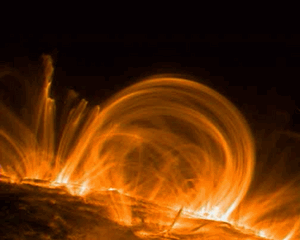
. . . that they’re following magnetic field lines.
In a sense, a vortex in other kinds of fluid is similar to a magnetic flux rope, such as a tornado, but there’s no overriding regional magnetic influence. There are also more complex structures in plasmas which occur across a huge range of scales. Many examples of plasmas observed astronomically are divided into compartments by what are known as current sheets. When several bodies of plasma expand towards each other, they meet and compete for space, and a current sheet forms at the border. Unlike a shock, a current sheet moves slowly and, of course, carries an electrical current, which may be at right angles or parallel to the magnetic field. The magnetopauses of Earth and Jupiter and the heliopause of the Sun are all current sheets. These are where the magnetic field of the bodies in question become balanced with those of their surroundings. These have perpendicular currents, whereas auroræ are sheets with parallel current.
A current sheet can surround a region and preserve the properties of the environment inside that region. For instance, here on Earth the solar wind has little influence on us and has therefore not destroyed our atmosphere, unlike Mars, which lacks a strong global magnetic field, and this is thanks to our magnetosphere. They also operate with ionospheres in a similar way, and in this situation there is ionised material within the ionosphere. Such regions are referred to as cells. In many circumstances, the word “cell” doesn’t imply close similarities to living cells, such as a prison cell or a power cell, but in this case there is quite a close analogy, as the cell isolates an environment with particular characteristics of electrical charge.
In the early ‘noughties, scientists passed a spark through a chamber containing argon plasma and found that it formed isolated spheres with a double layer with electrons on the outside and ions on the inside, isolating a region of argon gas within them. This is very similar to a living cell, with its double layer of lipid molecules aligned by electrical attraction and repulsion. These spheres could grow. They began a few micrometres across and expanded to three centimetres in diameter, by taking argon atoms and ionising them to become part of the current sheet. They also divided in two, to form separate cells. Putting this in biocentric terms, these are plasma cells which can grow, reproduce and metabolise. They may even have been the first cells on this planet, existing within thunderstorms.
Both biological and plasma cells have a barrier surrounding a region with its own protected properties, process materials to become part of their form, grow, divide and separate regions of different electrical charge. The crucial component absent from these plasma cells is anything to carry genetic information. Scientists have also produced globules named “microspheres”. In 1955 CE, Sidney Fox produced protein-like substances from amino acids in solution and they organised themselves into bacteria-sized spheres which separated internal from external environments, showed osmotic behaviour, formed chains and divided like bacteria. To me, the surprising thing is that they were not made of lipids but chains of amino acids referred to as “proteinoids”. These too lacked genetic code, so in both cases, functionally similar structures formed without any complex machinery or genes, and in both cases, even without genes, they share certain unusual functions with organisms.
In the past two posts (this and this), I concentrated very much on “life as we know it”, even to the extent of assuming it would not only be carbon-based but depend on phosphorus as well. Otherwise that would have run way over sixteen thousand words and become rather complicated. The possibility of plasma-based life could be a bit of a game-changer. The plasma cells created in the lab needed high temperatures to form initially, but then managed to maintain their function at a much lower temperature. If plasma-based life is possible, the chances are it could exist in many different forms in all sorts of environments widely regarded as hostile to life due to the focus on carbon-based biochemistry. At some point I will probably do a review of other kinds of life, but plasma is special, because unlike other possibilities it may have direct consequences for us. Among other things, our own bodies have features in common with plasma-based life, because we and all other organisms rely on moving charged particles around and controlling them with barriers. Perhaps a planet whose atmosphere was for some reason wracked with thunderstorms for a time would end up developing this kind of life, but there are other situations where it can be imagined in other forms, such as in stars, nebulæ and magnetospheres.
There is also a second, maybe more far-fetched, possibility. Unlike other states of matter, there is no sharp transition between gas and plasma, but a gradual increase in ionisation, and it’s fairly arbitrary when a substance counts as one. There are also “dusty plasmas”. These consist of small charged motes of dust. There are various types of Transient Lunar Phenomena, often involving lights, but one variety involves mists. Although it isn’t known what causes them, one theory is that radiation causes soil particles to become charged and repelled from the regolith, producing a temporary cloud of dust. This would be an example of a dusty plasma. The spokes in Saturn’s rings may also be dusty plasma. This may be extending things too far, since even ordinary plasma life is pretty sketchy and speculative, but I do wonder, if plasma-based life is possible, whether dusty plasma life also is. It would mean there could be life on dry, airless worlds like our own satellite in the form of clouds of statically-charged dust.
This is where I’m going to take a turn into a very-poorly supported scientific possibility, or impossibility.
We’re familiar with life based on organic compounds and water, which also use electrical charge a lot of the time. There is no organism which doesn’t use charged particles, but as far as anyone knows there are also no organisms which/who consist primarily of charged particles. If there are, they might have to live under special environmental conditions if they were present on this planet. In particular, they could possibly survive in very dry deserts such as the Atacama or the dry valleys of Antarctica, because rain, damp and moisture would be fatal to them. But there is another possibility, and I can only really ask this as a question: could they live as entities within organisms with more conventional biology? I don’t have a firm idea about how this could happen either. Before I go on, I’m going to talk about Stoicism.
Stoicism as it’s generally understood today is a philosophy of life which emphasises that the one thing one has agency over is one’s reaction to circumstances. I think this is a dubious idea and probably also an undesirable one, but it’s still an interesting philosophy which scores over some others. It was originally a Greco-Roman idea associated with psychology, metaphysics and physics, and some believe it influenced Christianity, which could also mean Islam is influenced by it.
Stoic physics maintains that the world begins and ends in a fire, and that souls are tongues of flame from that fire. The cosmos is a self-sufficient single entity, who is God. Everything is material, including things like justice and wisdom, and therefore souls are also material, which is similar to the Jain view of souls. If you swap out the English translation of “fire” and replace it by “plasma”, it becomes much closer to plasma cosmology and the idea of plasma-based life, and there is good justification for that because the Stoics explicitly state lightning and the Sun are special types of fire. Stoicism as a way of life is stated to be able to function without accepting the physics, but there may not be any need to reject that view of the nature of the world to do so. Plasma cosmology is a modern, not generally accepted, view of the Universe which emphasises the significance of plasma in the physics of the Cosmos. Hence Stoicism could be a kind of quasi-religious view of the nature of the human soul and the Universe, linking the two and is surprisingly modern, although I would still say it’s flawed as a way of life because it overestimates the power of the will and doesn’t acknowledge the rôle of passion in living an authentic life.
I do not identify as a Muslim, although Muslims would accept me as أهل الكتاب, one of the “people of the Book” and I no longer see myself as Christian due to the apparent inability of the Holy Spirit to help Christian Trump supporters avoid sin with regard to the Covid-19 pandemic. I did study Islam as part of one of my degree dissertations, so I believe that I am to some extent qualified to report on their beliefs, and in the context of plasma-based life forms Islam has a particularly interesting view. It holds that there are two components to a living being. One is the gross material form, which is seen as the body and in the case of other species of animal constitutes all of their essence. The other is referred to as “fire” in some writings, although as with Stoicism it’s also usually referred to as “wind”, as in the invisible principle which moves the body when alive. Angels and djinn (جن) are seen as pure fire, i.e. pure spirit or soul. Humans alone are seen as combinations of the two, body and soul, and in that respect as superior to either other type of being because we have both dimensions. This is why the angels were ordered to bow down and worship Adam, which Iblis refused to do.
That summary is of course a bit of a bastardisation and distortion, and probably the fact that it isn’t in Arabic, which I don’t know well at all, means that it may even necessarily be inaccurate. To make a more responsible summary, the Islamic philosophical writings concerning the soul and spirit distinguish between nafs (نَفْس) and ruħ (روح) . Nafs is cognate with the Hebrew נֶפֶשׁ , which translates as “soul” and is used in Arabic as a reflexive pronoun, but is also often understood to be the lower self, which incites one to sin. Ruħ is a “higher” soul, although it also means “breath” or “wind”, and the same word exists in Hebrew as רוח. Nafs traditionally referred to the blood and the physical body, so there is a correspondence here between these two concepts and the gross body and “fire” of human nature. There’s also some confusion, at least in my mind, between fire and wind or breath, meaning that the higher soul is conceivably a combination of fire and a mobile gaseous body, and it makes sense to think of this as plasma. Hence, to be materialistic, the movement of charged particles around a living body in a unified way has similarities to plasma and constitutes human life, but there’s an extra category in Islam of detached and possibly morally “unpolarised” beings known as the djinn.
Christianity also compares the spirit to fire, i.e. plasma given the wider interpretation of the word in Greek. Pentecost involved the appearance of tongues of flame on the heads of the faithful. The Holy Spirit is like a fire which purifies and dwells in the committed Christian. Christianity can be interpreted as physicalist in the sense that human consciousness is always embodied because of the resurrection, although clearly God has to be spirit. Hence although it may seem heretical and blasphemous to see the spirit as consisting of plasma, there is some basis for that in Christian anthropology, although to me, with a Christian background, that seems over-literal.
The Creator is unlike any created thing. Accepting that means that the Creator is not a fire or a body of plasma, and I’d go so far as to claim that أهل الكتاب as a whole cannot accept the idea because of the essential difference between the Creator and the created. Stoicism is another matter, as are many other religious, spiritual and philosophical views of the nature of reality, as they can be pantheist. However, there is the burning bush of Exodus and the Tabor Light of Orthodox Christianity, although that is said to be uncreated, so at least as metaphor plasma works as a symbol of the Creator. Outside the Abrahamic tradition there is Zeus, Jupiter or Thor with his thunderbolts, and other species of ape are moved emotionally by thunderstorms, so this intuition may go back a long way and is partly based on the altered ionic conditions associated with them.
Jesus once stated (presumably in Aramaic, so this is a translation):
Ὅταν δὲ τὸ ἀκάθαρτον πνεῦμα ἐξέλθῃ ἀπὸ τοῦ ἀνθρώπου, διέρχεται δι᾿ ἀνύδρων τόπων, ζητοῦν ἀνάπαυσιν, καὶ οὐχ εὑρίσκει. Τότε λέγει, Ἐπιστρέψω εἰς τὸν οἶκόν μου ὅθεν ἐξῆλθον. Καὶ ἐλθὸν εὑρίσκει σχολάζοντα, σεσαρωμένον καὶ κεκοσμημένον.
- Matthew 12:43, 44.
“When the unclean spirit is gone out of a man, he walketh through dry places, seeking rest, and findeth none. Then he saith, I will return into my house from whence I came out; and when he is come, he findeth it empty, swept, and garnished.“
Although again it seems dangerous and blasphemous to equate πνεῦμα with something physical, the observation is interesting as a plasma-based life form would indeed have to “walk through dry places” to preserve itself. That said, the human body is a decidedly wet place.
It would be easy to cherry-pick folklore on djinn, and to an extent this is what I’m about to do. Belief in them dates from before the advent of Islam, but rather than being condemned as evil, as many Christians did with the spirits pre-Christian people believed in, they are to an extent incorporated within the body of Islam, and even seen as potential Muslims. They are, though, sometimes viewed as the same as demons. Early Islamic science regarded them as animals of a special kind, having only a subtle body. Whether they were detectable by sensory means was also controversial. They’re often seen as essentially invisible and the like, although other accounts have them able to form into the bodies of animals such as onagers. Another tradition holds that they are invisible while they have a heartbeat but when killed, leave behind corpses, which have been described as a cross between a scorpion and a snake. They have been blamed for sleep paralysis and are also sometimes seen as potential succubi or incubi, although not capable of reproduction with humans. Mental illness has also been blamed on djinn possession. They are emphatically seen as created beings and also mortal. Interestingly, they are also associated with sandstorms and thunderstorms.
To an outsider to the tradition, reading the Qur’an can be an odd experience since in it, djinn are simply assumed to exist and mentioned repeatedly. At no point is their nature explained in much detail so far as I can tell, but then there’s no reason why they should be because this kind of sacred text is not amenable to being a zoölogical treatise or textbook of some other kind. They are just part of the furniture, as it were. The book might mention a donkey or a cow, and similarly it mentions djinn as though their existence is completely uncontroversial. I suppose the New Testament does the same with possessing spirits, but I don’t think they’re mentioned much outside the gospels. It isn’t necessary to believe in them to be a Muslim according to the Five Pillars of Islam, unlike angels. Likewise, dragons and unicorns aren’t mentioned either, so they could be consigned to the category of mythical beasts. Since they are also seen as causing illness and not visible to the human eye, they could also be seen as pathogenic viruses or bacteria. They are understood to eat, mate, reproduce and die. They’re also not seen as supernatural. In Shari`a law, humans who claim to be able to see djinn, unless they’re prophets, are not considered reliable witnesses by some scholars, which is not to deny their existence so much as to emphasise their invisibility. They are also, though, seen as inhabiting dingy places and eating rotting corpses and bones, and this description in particular makes them sound more like bacteria or fungi than ethereal beings, and seems incompatible with the notion that they’re plasma entities.
However, it’s possible to distill this and simply paint a picture of what a plasma being might be like if it lived on this planet. It could either be dusty plasma or consist entirely of ions. In the former case it would appear to be a partly transparent somewhat amorphous cloud, which could perhaps also have formed elements within it. In the latter, it would glow in the dark but otherwise have similar qualities, although it might inhabit the upper atmosphere. The dusty ones could form or inhabit dust or sand storms and the luminous ones dwell in or above thunderclouds. It isn’t clear whether the latter could descend to ground level. If they were anything more than very simple organisms, they would have to have persisted for a very long time in their environments, and since they’d be very vulnerable to moisture there wouldn’t be many environments on this planet where they could survive, although they might be able to protect themselves by moving up into the stratosphere when it becomes humid. Antarctica might be a refuge for them because it never rains there. They would be more common in deserts, including that continent. Antarctica is the driest place on Earth and in bases, static build up is a constant nuisance, with electrical equipment being damaged by it, but it isn’t clear whether it’s significant outside as a phenomenon independent of human behaviour. A plasma entity coming in contact with a human being, or simply being near them, could adversely affect their health, although here we are almost literally in tifoil hat territory as that would be how one would need to protect oneself from their influence. It isn’t clear if there would be a way for a plasma-based life form to become parasitic upon a human, since it would have to transition from the dry, rarefied environment outside to the mainly aqueous one inside the body or nervous system. However, it’s easy to imagine that if it did, it could interfere pathologically with one’s health by disrupting the movement of ions, and if it could both transition and had persisted, evolved and reproduced for æons, it could in fact become an obligate parasite, although there may be no evidence for that medically. That doesn mean they don’t exist though. Prions were unknown until fairly recently but are a significant cause of disease in many species of animal.
If there are worlds with plasma-based life forms dominating them, they would probably be quite dry, perhaps like Mars, and possibly very stormy, or at least have gone through a stormy phase. I had hoped to be able to link them to the human soul here, but I can’t find a way of doing it because of the very hostile conditions for plasma which persist in the central nervous system. Nonetheless, it’s interesting that this might be a form of life not as we know it which might even be present on Earth.
 A Box Of Chocolates