The Safest Satellite

Calista Flockhart sticks in my mind. She used to play Ally McBeal, and most remarkably she’s the absolute double of a friend of mine who lived in Yorkshire when it was on. I used to commute to Leeds at the time and stay over at her house. But there are three other reasons Ms Flockhart has come to my attention intermittently. She was the “single female lawyer” of Futurama fame, impersonated by Turanga Leela with a stick-on googly eye. She was rather thin, and that used to worry me although I suppose I mustn’t “skinny-shame”. And finally, her name was similar to that of Jupiter’s outermost large moon, Callisto, illustrated above.

I’m sure the actor wasn’t named after the moon, but ultimately the Greek nymph. Once again, Kallisto, or more correctly Καλλιστώ, was one of Zeus’s “conquests”. I can’t help but think that some kind of “me too” moment should’ve come to pass in Olympus at some point, and I’m not really joking. Being a religious figure, Zeus was I imagine seen as a rôle model by many a Greek male, and seems to have spent most of his time raping and sexually harrassing people. Then again, maybe this was around anyway and merely served as an expression of that behaviour. However, just as Ganymede was Zeus’s homosexual lover, so was Kallisto, even though she was female. Zeus transformed himself into the likeness of Artemis to seduce her, meaning that they were lesbian lovers. So we have the two hetero moons and the two gay moons, which in a way is neat. Kallisto’s other claim to fame is that while pregnant she was thrown into the sky to escape the anger of the real Artemis, which stretched her tail and changed her into Ursa Major. ‘Αρκας, their son, became Ursa Minor.

Kallisto means “most beautiful”. When I learnt this, I suddenly realised that the Greek ending for the superlative, -ιστος, was cognate with its English and Germanic equivalent “-est”, although I don’t think you can do much with καλλος in that way. Anyway, I thought it was neat.

Callisto the moon is beautiful if you like that sort of thing. It’s somewhat similar to Ganymede but has an older surface, is a little smaller and is somewhat apart from the other Galileans, taking more than sixteen days to orbit, and therefore having a day more than two weeks long. Due to its separation, it doesn’t undergo the tidal stresses and strains of the others and therefore hasn’t had its surface remodelled at all since it formed. It’s both the most heavily cratered known body in the system and, at least when the Voyager probes visited, the least dense. It continues the trend of reducing density found among the Galileans. It’s also unique among them in orbiting outside the radiation belts, although it’s still within a fairly strong magnetic field. This is what makes it the “safest satellite”. Unlike the others, if humans ever went there landing on Callisto would be basically the same job as the Apollo astronauts did, and if anything there’d be less radiation because it’s five times as far from the Sun, although perhaps Jovian cosmic rays would still be a hazard.

It’s slightly smaller than Mercury, by about twenty kilometres, but still larger than Cynthia and Pluto. By mass, it’s the twelfth largest world in the system, being somewhat more massive than Cynthia and Io. It has the lowest gravity of the Galileans at around an eighth of Earth’s. There are so many craters that it’s hard for any more to fit on. Any new craters would probably overlap with old ones. This has happened because the surface froze before the Late Heavy Bombardment, so it retains a record of how violent the early Solar System was. Extremely, it seems. This also suggests strongly that Jupiter was almost like a second Sun at the time, although by Callisto’s distance, 1 882 700 kilometres away, it was well-frozen. However, an important influence on the inner moons is the tidal tugs on each other, which don’t affect Callisto, so that heating effect is absent. Nonetheless, Io’s density and complete absence of water does seem to indicate it was pretty hot that close.

The place nowadays all seems to be all about peace and serenity, which considering the onslaught it clearly received thousands of millions of years ago and the scars it still bears is pretty ironic. All the other moons have got something going on, Io most of all but the others show signs of activity fairly recently. Callisto doesn’t. It lacks anything like the regiones and sulci of Ganymede or the smooth surface of Europa, which implies that the latter underwent some melting after most of its meteorites hit. Of the four therefore, Callisto has the oldest surface. Nothing ever happens there, at least on the surface.

However, that doesn’t mean it’s boring! There are two gigantic impact basins, Valhalla and Asgard, the former of which is three hundred and sixty kilometres across at the centre and is surrounded, like Asgard, with rings, in this case up to eighteen hundred kilometres from the centre. It is in fact the largest impact basin in the system, comparable in appearance to Mare Orientale on Cynthia and Caloris Basin on Mercury. If the centre of Valhalla was in Glasgow, the outermost ring would cross Lithuania, southern Spain and Kalaalit Nunaat (Greenland), and this is on a moon with less than a seventh our planet’s diameter. On the moon itself it stretches across almost a quarter of the way round its world. The central crater is a palimpsest, a type of crater also common on Ganymede which has been partly eroded over time in one way or another. I personally imagine the cause in this case is that the impactor melted the surface, considering it’s mainly made of ice, but I don’t know what the experts think. The ringed area around it has outward facing slopes with steep escarpments, and although those sound like waves emanating from the impact they’re probably grabens – downward fractured areas like the equatorial rings on Vesta. Further out still, at the edge of the area, the rings are more vaguely defined and consist of troughs.

The other impact basin, Asgard, is a “mere” sixteen hundred kilometres in diameter, making it the size of Greenland/Kalaalit Nunaat. The centres of the two basins are about nine thousand kilometres apart. At its centre is the crater Doh, which has a large raised area at the centre. A third ringed structure is superimposed on it, called Utgard, which is slightly smaller than Adlinda, the third largest. There are also faculæ, which are frosty-looking spots dotted about, of which only one, Kol, seems to be named. The features on Callisto are named after mythological beings and items in Nordic and Inuit folklore.

The presence of the ringed basins on Callisto would be expected to lead to distinctive features on their antipodes, because the shape of the moon would focus the shockwaves on the other side as they travelled across the surface, but I haven’t heard that this is so, even though there are good-quality images of that side.

Considering the number of craters on Callisto, it’s unsurprising that there are also catenæ. These are chains of craters caused by objects breaking up before they reach the surface, which happens due to their size and also when they’re rubble piles, which many small objects are. There are at least eight of these. They occur elsewhere in the system, but are bound to be more common on this moon due to the extreme nature of the cratering. I first learnt the word “catena”, meaning chain, from this context, and eventually noticed the Castilian word «cadena». It may be worth answering the question at this point of why craters tend to be circular. After all, don’t they strike the surface of a body at various angles? If a hard projectile is thrown at a soft surface, it would only produce a round dent if it was perpendicular. The reason craters are circular is that it isn’t the mechanical impact of the object that causes the dent, but the heat and explosion of the energy release, so craters of this kind are more like bomb craters than the kind induced by a pebble hitting some mud. The catena above, Gomul, is actually within the rings of Valhalla.

Ganymede may have a complex interior consisting of alternating shells of ice of various kinds separated by water, and the similarity between the two moons might lead one to expect Callisto to have the same, but this doesn’t appear to be so. Instead, it probably looks like this:

As mentioned in the post about Ganymede, hexagonal ice is the kind we’re likely to encounter on Earth’s surface. The ocean is hundred and fifty to two hundred kilometres deep and since the moon is not geologically active, it has no thermal vents supplying it with energy. In any case, the ice is so thick there’s no chance of penetration. The rock portion at the centre is also even proportionately much smaller than Ganymede’s and there seems to be no magnetic field either. The interior also differs from Ganymede’s in containing a layer of ice VII. Surprisingly, ice VII is actually present on Earth inside diamonds. It can only form with a combination of high pressure and low temperature, so it proved to be a surprise that it was present on Earth, but on Callisto it’s to be expected. It’s fifty percent denser than our own ice and has a cubic crystal habit. This doesn’t mean it has cube-shaped crystals, but that the axes of symmetry are equal and at right angles to each other. Diamonds also have cubic symmetry, so in a way ice VII is like diamond, and it’s also extremely hard, being about as tough as quartz. Its melting point is always at least 82°C and can be above 400, so in many ways this is not like the ice we’re familiar with at all. The moon also gets steadily rockier towards the centre. The lack of activity means there is no magnetic field, which would be generated by currents in metallic liquid. This also means that unlike Ganymede there is no aurora, but there probably wouldn’t be anyway because it’s too far from the radiation belt.

There is an atmosphere, although it’s unsurprisingly extremely thin. It consists of carbon dioxide, and it’s a little surprising even that’s there because left alone it would leave the moon within a hundred hours due to its low escape velocity. It’s thought that there is dry ice slowly subliming from the surface, which also contributes to the smoothing out of the features seen, for instance, in the lower and gentler crater peaks. Ther’s also atomic hydrogen, which stretches higher up from the leading hemisphere.

The question arises here of whether Callisto is actually just a moon, unlike the other Galileans. The recent rival definition of planet requires it to be geologically active, and this is certainly true of Io in particular but also Europa and Ganymede. Callisto, however, is only active in that carbon dioxide seems to be gradually evaporating from its surface and it lacks any apparent internal or surface activity. Nothing much seems to have happened on its ancient surface for over four æons apart from the occasional meteor or comet strike: most of the craters are very old. Therefore, although I doubt anyone has ever considered the question, the body isn’t really a planet, but just a moon. In fact it may even be the largest moon that isn’t also a planet.

Out of all the bodies in the system, strangely Callisto may be one of the most hospitable to humans for exploration and settlement. The level of radiation on the surface is not only relatively low compared to the other Galileans, but actually lower than most of the inner planets and bodies in the asteroid belt except for Earth. This is because it’s over five times further out. It’s also more accessible than more distant moons, and is also fairly large. It’s larger than Cynthia and almost the same size as Mercury. Consequently, it has been considered as a potential target for astronaut visitation. As just mentioned, it’s extremely geologically stable, and there’s an ample source of water on the moon. It could also serve as a base for activities on the other Galileans and Jupiter, which is a good source of fuel for interstellar travel. In fact the moon itself provides this in the form of water ice, which could also be used as a source of oxygen for breathing. The interior, having water in liquid form, is also likely to be warm enough for habitation at some level. NASA carried out an investigation into the possibility in 2003 called HOPE – the Human Outer Planets Exploration – and suggested that it would be possible to reach Callisto by 2040. Of course this won’t happen but it’s nice to dream. I remember noticing that Nigel Calder included Callisto as a major power base in a simulation of Solar System power politics in his 1978 TV series ‘Spaceships Of The Mind’, although I’m surprised enough was known about it that far back to suggest such a situation.

Callisto doesn’t seem to crop up much in science fiction, possibly because not much happens there, but an exception is Asimov’s ‘The Callistan Menace’. This is a story about the mystery of astronauts attempting to visit the moon but never returning. I’m not going to spoil it, but its depiction of the place is quite inaccurate as it’s given a substantial atmosphere even though the author knew it couldn’t have one even back then. It’s also a bit unusual in referring to it as Callisto at a time when usual practice was to number the moons – Callisto is “Jupiter IV”.

Right, that’s it for Callisto. I’m not sure what to do next because Jupiter has something like eighty more moons but the Jovian system has already been covered. I might talk about the Galileans as a group, or I might move on to Saturn.

Vesta – Curry World?

Not to be confused with PC World, Vesta is saddled with a problem a number of other celestial bodies also experience of having weird pop culture associations. There’s Pluto, after which the Disney dog was apparently named, and while I’m at it, as observed in ‘Dazed And Confused’, why does a cartoon dog have another cartoon dog as a pet? There’s also Uranus, whose name can be pronounced as either “your anus” or “urine-us”. And getting back to the original subject, there is Vesta.

I don’t know how widely the fame of Vesta curries extends, but certainly in England the name has been substantially associated with the things White people used to get in boxes from the supermarket in the 1970s CE, and one of my friends reckoned that the TV series ‘Adrian Mole’ succeeded in nailing the working class Leicester experience perfectly when they ate a Vesta. Goodness knows what South Asians would’ve thought of them. Having said that, I’ve never tried them and that’s even though I’ve been reduced to buying samosas from Sainsbury’s because of the cultural desert I seem to live in nowadays. A quick Google confirms that they do still exist. I mean, I liked Marvel dried milk and Smash instant mash back in the day, so maybe I’d’ve liked them, I dunno.

Why, though, has Vesta got the same name as Vesta, or for that matter Vesta or Vesta? There’s a car, a box of matches and a world in the asteroid belt, and that last one I will get round to in a minute, but for now it’s in order to mention the original Vesta. Vesta was the Roman goddess of hearth and home, which of course immediately makes me think of Dexy’s Midnight Runners because my brain doesn’t work properly:

This is the surrealist painter Max Ernst’s 1937 painting ‘The Angel Of Hearth And Home’, which will be removed on request. It’s one of his few overtly political paintings and represents the spirit of chaos spreading across Europe in the wake of the Spanish Civil War. The title is meant to increase the sense of unease and disorientation one feels on looking at it. It is a vaguely humanoid figure with a fierce-looking fanged mouth and a seven-fingered hand sprouting from its knee. It’s actually the opposite of what one might expect from an angel of hearth and home, and more like death. Well, this opposite figure is the Anti-Vesta. The main association people make nowadays is of course with Vestal Virgins, who undertook not to have sex for thirty years while tending the sacred fire in Rome, considered to be vital to the city’s security. Hence they were tending the hearth of the whole Empire. This is part of a theme in asteroid naming in the early nineteenth century, where the names of female figures were chosen who were also somewhat domestic in nature. I’ve already mentioned Ceres, there’s Vesta, and also her Greek counterpart Hygeia, Juno goddess of marriage and childbirth as well as rather more outward-going things like the state, Flora, Hecuba (Priam’s wife), Victoria and so on. They also often have their own sigils at this early stage, but the point appears to have come when there were so many of them that they gave up.

This is Vesta’s sigil, clearly representing the eternal flame. Maybe one day it’ll grace a flag. This is Vesta itself:

I’ve selected this rather dingy picture because it shows two features of the body (I’ll talk about its exact nature in a bit) which are particularly distinctive, namely the streaks and the “Snowman””, which is the cluster of craters on the right hand side of the picture. Once again, then, there’s a body with a number of distinctive streaks, like Phobos.

What, though, is Vesta? Is it an asteroid? Ceres kind of turned out not to be, and Vesta may be the second largest. Whereas Ceres is large enough to eclipse the whole of Great Britain and Ireland, Vesta is only big enough to cover Ireland. It’s also the brightest member of the asteroid belt, bright enough in fact to be visible to the naked eye on occasion, although it wasn’t actually discovered until 1807, which happens on occasion. Uranus is also sometimes visible but wasn’t discovered until the eighteenth century. Then again, for many millions of years there must have been animals on whose retinæ images of Vesta, Uranus and even fainter worlds must’ve registered and influenced their visual cortices, but actually recognising it as something orbiting the Sun is another matter. But in any case, Vesta is the brightest asteroid, if asteroid it be. It’s probably also the second largest body orbiting twixt Mars and Jupiter except that Pallas is very close to it in size and it may therefore not be. It has a diameter of 525 kilometres on average, but is considerably less round than Ceres. This makes it definitely larger than Ireland, and in terms of area it gets harder to work it out, but assuming it to be a sphere, which is definitely not true, it’s slightly smaller than Pakistan. Perhaps surprisingly there is no straightforward formula for working out the perimeter or an ellipse, and therefore I’m assuming that no such formula exists for working out the surface area of an ellipsoid either. It’s larger than Mimas, which I always think of as the smallest round body in the system and as a kind of limit below which I kind of have less respect for objects, which may be unfair. Hence there must be something about Vesta’s substance which enables it to retain non-sphericality at a fairly large size, and I imagine this is linked to its rockiness as Mimas is probably much icier.

Although Ceres is the largest object in the asteroid belt, Vesta is the largest one native to it. The large amount of ammonia on and in Ceres suggests that it was originally in the outer system and only arrived in the belt later. Vesta is not like that and has probably always been there. It takes up nine percent of the mass of the asteroid belt and is quite close to being spherical, but just misses out on being a dwarf planet, although it may be the largest object in the system which is decidedly non-spherical. Unlike Ceres, it actually was discovered by the celestial police force set up to find bodies between Mars and Jupiter, and was the fourth discovered by Heinrich Olbers of Olbers’ Paradox fame (why is the night sky dark rather than bright? This is actually a very important question with massive consequences for the nature of the Universe but I don’t want to talk about it here. It’s basically because space must be expanding). It was in fact the last asteroid to be discovered for a long time, and it’s a little surprising that it was only the fourth to be found because it’s so bright and large. The next one, Astræa, wouldn’t be found until 1845, after all the original discoverers had died, then there was a spate of further revelations after that. Vesta therefore probably counts best as the largest asteroid, unless Pallas is, and traditionally people would’ve said Ceres.

Vesta isn’t like Ceres at all, but it is very much like a number of other asteroids in the belt. Some of these are former bits of Vesta which have chipped off due to impacts, but some have orbits which indicate they could never have been anywhere near it and must therefore have formed separately. It’s also responsible for quite a large number of meteorites which reach Earth, and therefore we actually have samples of it. Some of them are even from quite deep inside the asteroid, so its composition can be ascertained fairly well, and it can be seen from these that the asteroid is layered rather than mixed, as a smaller one would be, meaning that it’s heated and melted internally at some point. Its surface has for some time been known to be basalt, which on Earth comprises ninety percent of igneous rocks. On most rocky worlds in the system, igneous and metamorphic rocks are almost all there is. There are some exceptions, such as the strata on Mars, but on the whole there are no sedimentary rocks and the idea of sedimentary as a category is fairly specific to Earth, although there is, for example, clay and the layers of substance on Io, which aren’t sedimentary but are stratified. However, tuff, which is layered volcanic ash, is sedimentary, so water or any other fluid medium isn’t required.

Vesta and Ceres are kind of in each others’ vicinity. The average distance is 2.36 AU from the Sun compared to Ceres’s 2.77, which is around 61 million kilometres apart, about the same as Earth and Mars. This isn’t particularly close of course and reflects the fact that the asteroid belt is actually pretty sparse, but it is roughly as close as the orbits of Earth and Mars. However, the minimum distance is only five million kilometres, although this can only occur when the orbits are precisely aligned. It wouldn’t happen every orbit or even every thousand orbits, because it would depend on the ellipses shuffling round. Vesta’s orbit is also less tilted than Ceres’s at 7°, so they may not pass as closely to each other as might initially seem. The year is three and two-thirds longer than Earth’s. Vesta actually approached the Sun most closely only a month ago, on 26th December 2021.

Earth is slightly flattened at the poles and bulges at the Equator because of its rotation pulling the substance of the planet outwards during formation, when it rotated much faster and was softer. I’m not sure how much contribution the current centrifugal effect has on it. Nonetheless the deviation from sphericality in our case is only 0.3%. In Vesta’s case, the asteroid is kind of tangerine-shaped and its oblateness is around 22%. Also, its equator is elliptical too. An object whose gravity is so low (2.5% Earth’s, which is somewhat lower than that of Ceres) is able to have higher irregularities on its surface, and therefore Vesta also has a mountain which is almost the highest in the system – Rheasilivia is the biggest crater and unlike those on Ceres has a central peak, in this case two hundred kilometres across and is twenty to twenty-five kilometres high, comparable to the Martian Olympus Mons. The crater surrounding it is relatively enormous too, at five hundred and five kilometres diameter or roughly a “πth” of the circumference. In other words, the crater is actually wider than the asteroid in one of its dimensions, and in a way the asteroid could be looked at as simply the site of the crater. As such the rings of streaks may make a lot of sense as ejecta, although I don’t know for sure that’s what they are.

The streaks, known as fossæ, are troughs in the surface encircling the asteroid at the equator. They include Divalia and Saturnalia, the former being larger than the Grand Canyon and twenty kilometres deep. This scale reflects Vestan low gravity, which allows absolutely larger features which give worlds of this size an almost cartoonish or “cute” appearance, with exaggerated features which look out of scale to humans like the big eyes or other features of an animated or cartoon character. The fossæ are grabens, that is, valleys caused by faulting between which the surface has dropped, caused by the impact of the object which formed Rheasilvia. The central belt of Scotland is an example on Earth. Divalia is around ten kilometres wide and 465 kilometres long, making it four times as long but only a quarter as wide as the Lowlands. The fossæ collectively are in the top twenty largest rift valleys in the system. Earth is actually the world with the most large rift valleys, although the very largest is on Venus. Earth’s largest is the Atlantic. Saturnalia Fossa is associated with Veneneia, a crater overlapping with Rheasilvia and only slightly smaller than it at 400 kilometres diameter. Saturnalia is thirty-nine kilometres wide and 365 kilometres long, possibly longer because its end was lost in shadow when Dawn surveyed the asteroid.

Although Vesta is near Ceres and other asteroids relative to the scale of the system, it’s still pretty remote considering its size. If you were living on Vesta, it would take a lot of resources to bring anything you didn’t already have to you. It’s like a desert island in a way, and has resources of its own. Geologically, it’s stony, unlike Ceres which has a lot of clay stuff going on, and is more like an inner system planet in its composition than Ceres is. It’s like a mini-rocky planet, although it isn’t large enough to be a dwarf planet.

About six percent of meteorites falling here on Earth are from Vesta. This can be determined because they are exactly the same colour, that is, their spectra are identical. This is more common than any other body, even though Cynthia is so close and there are also meteorites from Mars and Mercury, both of which are closer most of the time. The light grey colour of the asteroid can be seen in the meteorites too. Vesta’s brightness is partly due to it being large and close, but it reflects more than 42% of the sunlight falling on it, which is more than any of the large planets except Venus. This is because it hasn’t been subject to “space weathering”, which occurs on bodies with only weak magnetic fields and is caused by the attraction of solar wind particles to the surfaces, where they vaporise iron on the surface, turning it into a dark coating. This means that Vesta is either low in iron or has an appreciable magnetic field. Since samples of the asteroid are readily available, it’s possible to test this by seeing if magnetic specks within the meteorites are lined up, and they do seem to be, meaning that the asteroid must be generating the same kind of dynamo-style magnetic field as we have on our home planet.

This brings up the issue of the innards of the place. NASA’s Dawn mission was able to collect data implying that unlike Ceres, Vesta does indeed have an iron core, which is about 110 kilometres in diameter, which means it must have melted early in its history. There are so many meteorites from the asteroid that it’s possible to mount a similar kind of museum exhibition about its mineralogy as it is of Earth’s, actually better in some ways because its smaller size means relatively deeper samples are available than from Earth. As mentioned previously, the most common such asteroid is known as HED – Howardite-Eucrite-Diogenite. I’ve covered these on the linked post. Incidentally, I love the fact that some are called “diogenites”, which suggests they’re either very messy inside or don’t require much in home comforts. It’s just a shame they aren’t called damoclites, like they’re hanging over us waiting to wreak havoc, although that would be rather geocentric.

I ought to mention the Snowman. This is a short chain of relatively large craters, named from bottom to top of this image, Marcia, Calpurnia and Minucia. Together they form a shape reminiscent of a snowman. The method of relative dating of craters works well here as impacts will cause newer crater borders to impinge on older ones rather than the other way round, making it possible to reconstruct what happened, though without much of a timescale.

Like Ceres, Vesta is a protoplanet, though one not given much chance due to being close to Jupiter. Had it been able to form into a proper planet, what can be seen today would’ve been buried deep within its core, or rather, its substance would’ve been distributed throughout the planet’s interior. It has a relatively short day for an asteroid of five and a third hours and a tilt of around 29°, meaning that again unlike Ceres it has seasons.

One of Asimov’s earliest short stories was called ‘Marooned Off Vesta’. It’s actually his first published story, from March 1939, where a spaceship is hit by a meteoroid, leaving three survivors in a fragment with only enough air for three days but the entire water supply for the spaceliner. They’re near Vesta, where a few people have settled. It was followed up by a later ‘Anniversary’ story twenty years later where the survivors have a reunion and discover something surprising about what they salvaged. It dates from the time when the asteroid belt was thought to be strewn with hazardous débris, which is now known not to be so.

That’s it really. Vesta is the largest proper asteroid, the brightest asteroid and, most remarkably, the source of more meteorites which reach Earth than any other body in the Solar System. That’s it really.

Mars

I’m revisiting this. A few mirs ago (I’ll tell you about that in a bit) I made a Martian calendar for the mir 214. I used the Darian calendar with the Rotterdam month naming system. This brings up the first issue: Mars cannot have real months because its moons take around eight and thirty hours to orbit, and its day lasts less than twenty-five. Therefore the subdivision of the mir – the Martian year – is fairly arbitrary although it can be more freely divided than if it had meaningful moons.

The compilation of the Martian calendar proved to be a bit nightmarish. I bought a new printer to produce the colour illustrations of the pages, and used the trusty old monochrome laser printer to do the rest. The latter did absolutely fine. The former was an inkjet, and reports of its capacity turned out to be a big overestimate. Since I’d worked out the price point based in that capacity being true, I ended up making a loss on every copy. Because of this, I ended up flinging the printer forcefully into the pantry in a fit of rage. Something has really got to be done about the scam that is the inkjet printer, but that’s another topic.

Due to the research I’d had to do to prepare the calendar, the point came when I felt probably more familiar with Mars than I am currently with Antarctica. I began to get a real feel for the planet which I don’t even have for Cynthia, and certainly more than any other planet or moon apart from Earth. It’s kind of like a cross between Cynthia and Earth. Alternatively, it could be looked at as an extreme version of Antarctica without the ice, or a dwarf version of Earth. Its terrain is divided into highlands and lowlands, with one largely monolithic example of each, meaning that unlike Venus with its several plateaux and similar size to Earth, it or Earth with its connected but somewhat separated oceans and six continents, it can be thought of as having a single continent and a single ocean, having in toto a surface area almost exactly the same as the total land surface of our own planet. However, it has a thicker crust and no plate tectonics. This is demonstrated by the area known as Tharsis, named after Tarshish, an old name for the Iberian peninsula.

As a child, I used to think Tharsis looked like someone had stuck a fork in Mars. It’s dominated and was formed by a series of volcanoes in a line with the largest volcano in the Solar System to the northwest, the famous twenty kilometre high Olympus Mons, previously known as Nix Olympica. These have contributed an enormous shield of solidified lava to the surface which on Earth would’ve become a chain of mountains or islands, as with Hawaiʻi, but because the Martian crust is stationary the rock has simply built up, and the lower gravity has allowed it to rise higher than it could’ve done here, and weigh down the crust to the extent that it’s caused a crack to form, known as Valles Marineris, a giant canyon stretching across something like a quarter of the planet. All of these structures dwarf their counterparts on Earth, and since Mars only has about half Earth’s diameter, they dominate the surface. When it’s midday at one end of Valles Marineris, the other end is in darkness and consequently winds blow along its length.

Here’s a relief map of the planet:

The lower elevations are blue, the higher ones red. Tharsis is the red blob on the right. One feature I haven’t mentioned yet is the great basin known as Hellas, which is the deepest dent on the planet and is almost deep enough to have liquid water at its bottom because of the density of the atmosphere there, although it doesn’t quite get there. This is the purple oval in the bottom right quadrant. It can be seen that if the planet was flooded there would be an ocean in the northern hemisphere plus a large lake in the southern. Maps of planets are quite confusing as the convention seems to have changed. Whereas previously south was at the top because astronomical telescopes don’t bother to turn the image the right way up (extra lens means loss of light), it seems to have changed to putting north at the top.

The regions of Mars have names like Chryse (Gold), Argyre (Silver) and Margaritifer (Mother Of Pearl). There was also a complete revolution in nomenclature due to the discovery in the mid-1960s CE that the canals were optical illusions. Before that, Mars was considered to have canals, previously considered to be “channels” but due to translation the word “canali” became “canals” in English, and its features were named according to brightness. When Mariner 4 flew by Mars in 1965, it was a huge shock to astronomers and other space scientists because of how different, and more hostile, it turned out to be compared to Earth and the presuppositions projected onto Mars and Venus more or less demonstrate that the expected panic and other impact conjectured from First Contact are perhaps overestimated. After all, for something like a century it was popularly assumed that there was complex life on both Venus and Mars and intelligent life on Mars and it didn’t cause societal breakdown. The question arises of whether society has changed in such a way that it now would.

Interestingly, the person who “discovered” the “canals” was a draughtsperson rather than an artist, and later cartographers with an artistic background didn’t produce so many of them because they were trained to draw what they saw. Giovanni Schiaparelli was in fact related to the fashion designer, in case you’re wondering, and appropriately enough canals were all the rage for decades. For old time’s sake I’ll reproduce one of those maps:

I could’ve found a better map but preferred to furnish you with the yellowing and disintegrating ’60s paperback I learnt much of my initial astronomy from, for old time’s sake. Note south is at the top, and compare with a modern map:

This is from here. This is not a very clear image but it’s hard to find a cylindrical projection of Mars. The PDF linked is much more legible. The most prominent feature of all, Syrtis Major, the “great bog”, is visible in both. Acidalia Planitia is also named in the older map as Mare Acidalium. Conspicuous by their absence are of course almost all of the canals. The closest one gets is Valle Marineris. It’s hard to imagine how utterly different things have become since the early ’60s in this respect.

The Martian atmosphere is to ours as ours is to the Venusian one, in that it’s below a hundredth of the sea level density of ours and ours is a ninetieth of the solid surface density of that of Venus. In another way, Venus and Mars have similar atmospheres as both are mainly carbon dioxide. This makes them unlike Earth’s primordial atmosphere, which was mainly nitrogen, but before the outgassing, Venus would’ve had a mainly nitrogen atmosphere and most of Mars’s atmosphere has been lost to space. The pressure at the surface of Mars is about the same as Earth’s thirty kilometres above sea level, but because it’s much thinner and the Martian surface more variable than Earth’s, the gravity being lower, the variation in pressure is much greater, but it never reaches the point where ordinary water can be liquid at all there.

Mars is the only surface as far as I know in the Solar System which has both extensive cratering and signs of water erosion. Usually the two would tend to rule the other out. It has teardrop shaped “islands” and branching river patterns leading down from the highlands to the lowlands, but some of those islands are formed by craters:

Many of the craters on Mars are quite eroded, probably by wind:

Such images were first sent back from the 1965 mission, and have no analogues on Mercury or Cynthia. The rims can be seen to be eroded or partly erased by the movement of sand or actually rubbed out by the process of sand-blasting by the wind. Winds on Mars can reach up to half the speed of sound.

I’ve described the process as sand-blasting. Like describing the Martian regolith as “soil”, this can mislead. It looks like wet sand, but is about as fine as talcum powder, is also high in iron, hence the rusty colour, and like moondust also contains substances which on Earth would have reacted with oxygen or water, which makes the scenario in ‘The Martian’ less plausible. It effectively contains bleach. A substance called perchlorate consists of a chloride ion attached to four oxygen atoms in a tetrahedron, and is negatively charged. It’s toxic to humans, causing lung damage, aplastic anæmia (where the body permanently shuts down red blood corpuscle production) and causes underactive thyroid, for which it’s used as a drug to treat overactive thyroid. However, it can also be burnt to release oxygen and finds use as an oxidant in rocket fuel. Its presence in Martian sand makes it harder to imagine what kind of life could survive there. However, this series is not about life on Mars.

The planet is periodically enveloped in a global dust storm. This actually happened while Mariner 4 was on its way there in ’65, when only the Tharsis volcanoes were visible above the clouds. Carl Sagan was very focussed on this, leading to them being referred to as “Carl’s marks”, but it would’ve been pretty disastrous if the storm hadn’t cleared by the time the spacecraft got there because nothing else of interest would’ve been visible. Maybe the idea of the planet being Earth-like would’ve continued for longer. Again, in ‘The Martian’, the dust storm is portrayed as much more destructive than it would in fact have been because although the wind is very fast, the low pressure means it isn’t very forceful. They happen about once every three mirs, although there are more localised ones in between. Like the possible “mists” on Cynthia, Martian dust particles become statically charged in the process of being blown about and rubbed against each other, leading to them sticking to every available surface, including the likes of solar panels, potentially to space suits and moving parts on landers and rovers. This blocks sunlight from reaching solar cells and makes it difficult to design rovers, which also get covered in the stuff. What happens is that the sunlight warms the ground, leading to a temperature inversion similar to the one causing tornadoes here on Earth and this causes dust devils and ultimately dust storms. They tend to be stronger in the southern hemisphere, which brings up another issue I’ll go into in a minute. A very important consequence of the study of dust storms on Mars, which would justify the Mars missions on its own and emphasises the vital rôle of space exploration, is that a model applied to the Martian atmosphere was applied to our own if it was filled with soot after a nuclear holocaust, and predicted the nuclear winter scenario as depicted in the BBC TV drama ‘Threads’. This seems to have contributed to the end of the Cold War. Whether the prediction is valid has become a controversial issue which I don’t want to cover here.

The Martian orbit varies between 1.666 and 1.381 AU (1 AU=average distance of Earth from the Sun), making it the second most eccentric planet after Mercury. Unlike Mercury, Mars has a fair axial tilt which causes seasons. Due to this eccentricity, the seasons are more extreme south of the equator since the surface is tilted away from sunlight which is already weaker in the winter and towards stronger sunlight in the summer there, and the reverse is the case in the north. From here the most obvious effect is a larger southern ice cap in the winter, which I think I’ve managed to see through binoculars. This eccentricity also makes the seasons different lengths in the different hemispheres.

Frost and “snow” makes Mars seem more Earth-like than other planets. Mariner took photos of frost in craters, which is a rare combination over most of the planet but is found in polar craters on Mercury and Cynthia. This frost, however, doesn’t fall but freezes out of the atmosphere and is dry ice, i.e. frozen carbon dioxide. For a long time it was unclear whether there was real snowfall on Mars, in a couple of respects. It wasn’t clear whether there was water ice in the snow or whether it actually fell or just appeared like frost from the atmosphere, which is almost completely carbon dioxide. It’s now thought probable that water ice snowfalls occur every night of the northern summer. Actual flakes, from high in the atmosphere. That said, much of the ice on the surface is dry ice, and just as dry ice sublimes (turns from solid to gas without melting) on Earth, so does it on Mars. The water ice snow situation is less straightforward because it tends to become dusty, allowing it to absorb heat from the Sun. At night, water ice clouds lose heat to space, causing them to cool, thereby becoming denser and falling towards the ground as snow. The temperature difference leads to winds, which blow the snow around and there are in fact blizzards. There’s also virga – precipitation which doesn’t reach the ground.

Although the amount of water vapour in the atmosphere is tiny compared to Earth’s quotient, the thinness of the Martian atmosphere means it’s still almost saturated and there are therefore water-based clouds there. There are no cumulus clouds – “little fluffy clouds” – but other kinds are present such as cirrus, the ice clouds found high in our own atmosphere. There are also wave clouds, fog and hurricanes. Noctis Labyrintus, the network of gorges west of Valles Marineris, fills with fog every morning. There are also orographic clouds, which are clouds caused by mountains or high ground lifting saturated air past the point where it can still hold all the moisture. Entirely separate from the water ice clouds are the dry ice ones, which form when it’s cold enough to drop below -78°C, the freezing point of CO2. I find this quite odd as it’s the actual atmosphere freezing and snowing. This also happens on Triton, Neptune’s largest moon, where the nitrogen atmosphere freezes and precipitates onto the surface.

Mars has dunes. These have ice on them, but this isn’t always so. These particular ones are unlike Earth’s in that they have a kind of network pattern on them, thought to be due to thawing and subliming. There are also wind-blown streaks.

It’s difficult to know where to stop with this. I acquired a lot of information about Mars when I did the calendar and there’s so much I could mention but I feel this is getting somewhat delayed by me adding to it, so now I’m just going to publish it “as is”. So there you go. Lots more about Mars could be said but that’s it for now.

Is Our Celestial Neighbour Boring?

Photo by Pixabay on Pexels.com

Before I get going on this, I want to explain the noun game with this title. Humpty-Dumpty’s dictum, “When I use a word, it means just what I choose it to mean—neither more nor less”, is clearly absurd, which is one reason why non-standard personal pronouns are such a struggle. I try to avoid using the term “the Moon”, because I think it encourages small-mindedness. It isn’t “the moon”. There are hundreds of moons in this Solar System, many of which have proper names. Ours also has proper names, in the form of what it (or she?) has been called in various different cultures, not in the sense of “that big hunk of rock up there” but in terms of deities associated with her. In a sense, we don’t appreciate her enough because there are two contrary forces involved in not giving her a name. On the one hand, it gives a sense of her being special in a way which excludes other special moons, such as those of Jupiter and Saturn. On the other, it paradoxically makes her generic: she’s just “a moon”, the nearest one. When we look at that luminary in the sky, we fail to appreciate that she is both special and not special, and whatever else we do we fail to appreciate her individuality (I’ll come to gender in a minute).

Although there are many deities associated with our sleeping satellite and there’s a good case to be made for calling celestial bodies by non-Western names such as Sedna, the fact is that she’s been associated with several Greco-Roman divinities, including Diana, Selene, Artemis and of course the name I chose for her, Cynthia. Using a name which is in common use as a human given name may seem odd at first but it does happen the other way round with other names for celestial bodies in English-speaking cultures, as with Venus Williams, so it isn’t unknown. Of the names listed, Diana and Cynthia are the most prosaic, although I’m sure there are people out there called Artemis and Selene. The big issue, of course, is that every time I mention Cynthia to people who might not have heard me do so before, I have to explain by doing something like putting “(‘The Moon’)” immediately thereafter, which is quite inelegant.

The gender issue is a side thing. Six of the seven known planets besides Earth in the Solar System have masculine names, as did Pluto when he was a planet. There’s a risk of it sounding like I’m objectifying women by using “she” for Cynthia the satellite, but I do this as part of my aim to reduce the association with sexes and would therefore equally refer to the likes of Mercury and Mars as “he”. Also, in a sense we are all “it” because underlying the interpersonal and emotional elements of our relationships, we are also conscious objects. It is, however, annoying that there are so many masculine celestial bodies.

And I’ve used that word again. “Celestial” bothers me too. Earth is in space. All there is is sky. Space is as much below us as above us. Everyone knows this of course, unless they’re Flat Earthers, but it’s easily forgotten and we have a tendency to revert to the sandwich model of the Universe we probably grew up with as a species. Earth is a celestial body – a heavenly body if you like.

The main theme of this post, though, is to consider Cynthia as a heavenly body among others that we know, that is, other planets and moons in our particular star system, and decide whether she’s boring. That is, if we were observing her as a moon of Venus, say, and sending space probes there and the like, what would we think? Or as a planet in her own solar orbit (which she nearly is)? It definitely seems that some worlds are more interesting than others, and it is quite diverting to have a large world orbiting us at close quarters, whatever it might be. Sarada is very captivated by seeing her sometimes, and I wish I could see past what I think might be disappointment that people haven’t got further into space, or rather further from Earth, than they currently have, because for me that taints it. But imagining Cynthia replaced with Io for instance, with that moon staying in her current state, which arises from the tidal forces acting upon her in the Jovian system due to the proximity of other satellites and the fact that she orbits within the planet’s magnetosphere, it would seem much more interesting stuff would be going on there, such as the volcanic eruptions and the multicoloured surface. Compared to that, our own moon just seems to sit there not doing very much. One of the people who went there said that if he wanted to see something which was exactly the same colour as the surface, he’d go out and look at his concrete driveway. It’s mainly various shades of grey, which is not exciting. Colour isn’t everything of course, and Apollo XVII is known for having discovered orange soil at Taurus-Littrow. Also, one of the most remarkable things about Cynthia is her maria and their distribution – the smooth lava plains which were deposited after the Late Heavy Bombardment which scarred the whole globe with craters, as it did elsewhere in the Solar System, such as on Callisto. The oddest thing about the maria is that until the 1960s CE, nobody realised there were practically none on the far side which can’t be seen from Earth. There are small smooth areas at the bottoms of craters, but no extensive plains. Nobody knows why.

Another mysterious feature is Transient Lunar Phenomena, which I know I’ve mentioned before on here, but anyway. These are temporary changes in light, colour or other appearance, and have the distinction of being something Patrick Moore was the world expert on. Explanations include outgassing, meteorite impacts and statically charged dust being repelled from the surface. Most TLPs have been observed in craters with cracked floors or around the edges of maria. A whole third of them are observed around the crater Aristarchus. They’re difficult to confirm because the same area would have to be observed at the same time by different people, which doesn’t often happen. NASA monitors meteor impacts, which are sporadic but also occur more often around the times of the famous regular meteor showers such as the Leonids or Quadrantids, because the two worlds are in practically the same place.

There’s also an “atmosphere” of dust. Sunlight ionises particles on the surface and they become statically charged, as mentioned above, then fall down to the surface and may bounce. This is happening all the time, with the result that there’s a constant fine mist of dust constisting of transient specks of dust. Additionally there’s a real atmosphere, though very, very thin. It’s estimated that the Apollo engines temporarily added more to the local atmosphere than was there before the landings. There are about a thousand million atoms and molecules per cubic decimetre just above the lunar surface, which is so sparse as to constitute a high vacuum in terrestrial terms. It’s also a ballistic gas: the particles are so far apart that they hardly ever encounter each other and undergo the same kind of bouncing trajectories as dust does there. It consists of helium, which is I imagine the result of alpha particles getting ionised, argon, which is also common in our atmosphere, potassium and sodium, which are relatively high in our upper atmosphere, ammonia and carbon dioxide. In fact, the atmosphere is similar in many characteristics to our own as it blends into cis lunar space, i.e. it’s an exosphere, the difference being that it’s at ground level.

The distance and size of Cynthia are also quite remarkable. She’s proportionately the largest natural satellite by far of an actual planet in the Solar System, as opposed to Pluto whose satellite is considerably larger but is not officially a planet. The closest rival is Neptune and Triton, with a mass ratio around 750:1 compared to Cynthia’s 81:1 ratio compared to Earth’s. In the inner system, only Mars has moons and they’re captured asteroids and very much smaller. The other thing about Cynthia’s size and distance is that she happens to be exactly the same size as the Sun in the sky, which is unknown for any other moon seen from the surface of their planet, although I understand Callisto comes fairly close on Jupiter. This makes solar eclipses possible in the sense that the Sun’s visible surface can be perfectly hidden while still allowing the corona, the solar atmosphere, to be visible. This doesn’t always happen because sometimes Cynthia is too far away, in which case the result is an annular eclipse with the Sun’s surface visible as a thin ring. Eclipses do occur elsewhere but not with such a perfect match, and this is very improbable. Nor does it seem to be directly connected to the necessity for life as we know it to exist on this planet. Although we may well need a large moon, it needn’t as far as anyone can tell be exactly the right size for that kind of eclipse, and this fact has been cited as an example of a possible Easter Egg if it turns out we’re living in a simulation. It could also be thought of as a sign of divine favour. The other thing about this is that because we’re moving apart at about a centimetre a year, it’s a temporary situation which will end in several hundred million years and didn’t happen until a few hundred million years ago, although that was before complex multicellular life existed.

Although Cynthia is very likely to be important for the existence of complex land life on Earth, I don’t want to consider this in this post as this is about her, not life. Just briefly though, tides within the planet’s iron core act as a dynamo and generate the magnetic field which keeps ionising radiation away from our surface and she also has a rôle in stabilising the axis of rotation. However, as with the above considerations, these are things to do with the relationship between the two rather than Cynthia herself. Before I leave thisses orbit entirely though, it’s worth pointing out that she’s the result of the outer layers of the planet which became Earth getting “chipped off” through a collision, and as a result she’s less dense than Earth by a considerable margin. Interestingly, and that’s what we’re looking for, the large bodies of the inner solar system fall into two neat categories regarding density. Earth, Venus and Mercury are all something over five times the density of water, and Cynthia and Mars around three. I don’t know why Mars is less dense, although it may be to do with the increasing temperature as one approaches the Sun causing lighter materials to evaporate. However, there was once an alternate explanation of the formation of Cynthia, where she was formed along with Mars from an initial body whose remnants are found as Earth. This kind of means Mars isn’t so much a smaller Earth as a larger Cynthia with a proper atmosphere, which is a little depressing.

There is magnetism, although Cynthia as a whole has no significant magnetic field, individual parts of the surface do have various magnetic fields, which are based in the crust rather than the core. The field tends to be weakest under the maria, particularly Oceanus Procellarum, and strongest at their antipodes, so the far side is more strongly magnetic than the side we can see. There may also be temporarily magnetised regions when meteorites hit the surface and cause melting. This lack of a global field also means that helium-3 is likely to have managed to accumulate, which is important if anyone can ever get nuclear fusion power to work.

When I look up, I never see a face in Cynthia. In fact, I’d consider it to be somewhat disturbing to see what would amount to a giant skull orbiting our planet, so I’d say that was a blessing. What I do see, independently of the other cultures which claim to see something like this, is a rabbit. This is of course the Far Eastern intepretation, along with a similar native American view that it’s a horned toad (not the lizard but an actual toad with horns). However, I don’t think I see the same bits as corresponding to these for the far eastern and western (who are of course linked) cultures. I see Oceanus Procellarum as the body, Mare Imbrium as the thigh, Maria Nubium & Humorum as the feet, Mare Tranquilitatis as the head and Maria Crisium & Fecunditatis as the ears. As I understand it, the Far Eastern interpretation is more upright and makes Maria Nubium & Humorum a mortar, which may be because they tend to view it from a different angle. I don’t know how the Native American projection works, or indeed if there’s more than one version although I suspect there would be. Cynthia holds the distinction of being the first body to be recognised as celestial to have her features named, and of course the selenography, as it’s known, is known in much greater detail than the “geographies” of anything in trans lunar space, although that gap narrowed somewhat from the 1960s onward.

It’s been claimed that even experts can’t tell the difference between closeup images of Mercury and Cynthia in some areas, and the two bodies bear comparison. Were it not for the maria, a casual observer wouldn’t be able to tell the difference between images of the two, particularly if Mercury was compared to our satellite’s far side. I’m not sure this is so because up until fairly recently only one quality source existed for images of Mercury, the Mariner 10 probe which flew by in September 1974 (and incidentally, briefly appeared to show that Mercury had a moon, which is not so). Compare and contrast these two pictures:

Ignoring external clues, are these interchangeable? Much of the appearance of the two bodies suggests that there is a kind of “standard” small rocky planet, possibly found throughout the Universe, which looks like Mercury, and Cynthia is one of these too. Callisto is a fairly good example:

Although Mercury does have smooth plains, they’re the same shade as the rest of the surface and don’t stand out. Mercury’s surface gravity is close to that of Mars but there’s no substantial atmosphere, partly because the planet is smaller and this makes it easier for molecules to escape the gravitational pull. This higher gravity makes a difference to the appearance of the craters, because when meteorites hit Mercury’s surface, the ejecta and hummocky rings are closer to the centre than they are on Cynthia, and are also more crowded because the material kicked up doesn’t rise as high or go as far. Mercury’s surface is also a lot more varied than Cynthia’s, but I don’t want to get too diverted onto the issue of the planet as opposed to the satellite.

There are quakes, which have several causes. One is the impact of meteorites, and it’s becoming clear that this is a very significant aspect of the place. The other can be divided into several more detailed causes, including tides, which start deep under the surface, and changes in temperature causing rocks to expand and contract. All of them are very mild compared to earthquakes, but they are associated with TLPs. The total energy involved is much less than a thousand millionth of those here, because we have tectonic plates and continental drift and Cynthia hasn’t.

There are “mascons” in the centres of the maria. These are regions of higher density detected when spacecraft orbited during the ’60s. In fact, these are unusually pronounced on Cynthia compared to other bodies in the solar system and amount to variations in gravity of over one percent. This is actually a distinctive feature not directly related to her position or relationship with us. They’re thought to be buried asteroids which have been there since soon after formation.

The dust is definitely worth mentioning. It used to be thought that it might be so deep that there was a risk of astronauts sinking into it like quicksand, but it turned out to be quite shallow, and this has been used as evidence by young Earth creationists. It also gets everywhere and is an inhalation risk like asbestos. It’s never been exposed to oxygen or moisture, so it has different characteristics than the kind of dust found on Earth. It’s technically just very fine particles of lunar soil or regolith, so there’s no definite cutoff between dust and soil. Due to the lack of exposure to water or air, it’s more reactive when it actually does come into contact with living tissue or just a wide variety of substances with which it comes into contact, which makes it a health risk in ways which silicate dust here wouldn’t be, and it hasn’t been smoothed by erosion and is therefore more jagged and has a larger relative surface area over which such chemical reactions can take place. It can jam mechanical equipment and interfere with wiring, and it also becomes statically charged quite easily. It’s nasty stuff, but probably not unusual because the same processes which generate it, meteorite impacts (again!) and radiation gradually breaking up the rocks, and I presume variations in temperature which are much more extreme than they are here due to the almost non-existent atmosphere, will also be operating on Mercury and inner system asteroids, and that implies that there will be similar processes going on once again all over the Universe.

The rock itself resembles certain rocks found on Earth but here it tends to be much rarer because we have weathering and erosion along with continental drift. Here, it tends to be of Precambrian origin and is therefore most common in places like Canada. Unsurprisingly, the maria and highlands are of different composition. In the former, pyroxene is the most common mineral, at about fifty percent of the surface there, and is made up of calcium, magnesium, iron and silicate. It forms yellow-brown crystals. The other common minerals are olivine, gabbro, breccias and anorthosites such as plagioclase. Olivine has pale green crystals and is a mixture of silicates of magnesium and iron which doesn’t survive long on Earth’s surface but is actually the most common mineral here. It releases heat as it combines with carbon dioxide or water and is therefore a potential fuel for heating which is actually carbon-negative, and is found copiously on the surface – a good reason to go back there I’d say. Plagioclase is a feldspar found in the highlands and is also the most common Martian mineral. It’s light grey or blue, so I presume that when we look at Cynthia, that’s what we see away from the maria. It consists of a framework of silicate groups in which are embedded aluminium, sodium and calcium atoms.

Much of the rock and dust is composed of glass, which also acts as an adhesive binding together fragments of other minerals. This is again because of meteorite impacts heating the surface which then cools rapidly, and this makes me wonder whether the same is true on Mercury because it’s hotter during the day but just as cold at night. When I say glass, I don’t mean the sodium silicate used to make windows and bottles on this planet, although lunar glasses do sometimes contain sodium and usually, possibly even always, silicates, but they would be less pure than what we use as glass.

I don’t honestly know if this is interesting or not. It seems plausible that there would be semiprecious stones and crystals in some places, which is quite appealing. Olivine looks quite nice:

By Rob Lavinsky, iRocks.com – CC-BY-SA-3.0, CC BY-SA 3.0, https://commons.wikimedia.org/w/index.php?curid=10448817

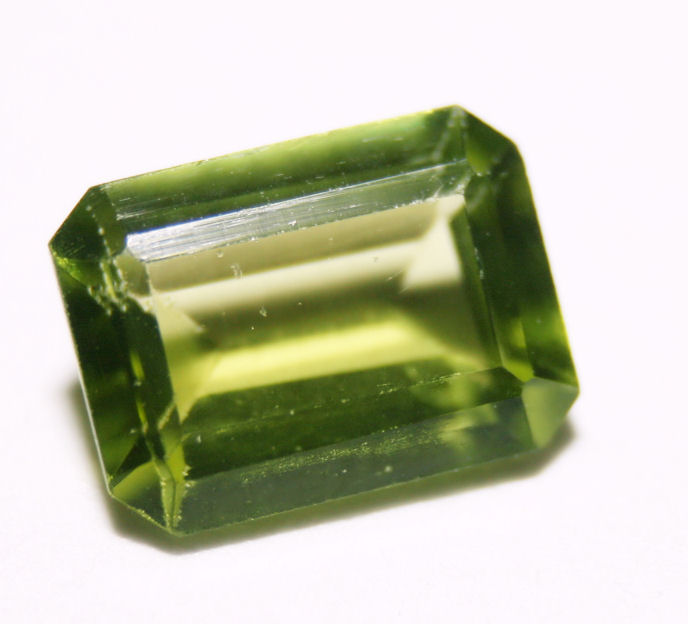
This is actually a gemstone, when it’s known as peridot, and can be cut as such:

However, these kinds of olivine are close to being pure magnesium silicate and I don’t know if that applies to lunar olivine.

The existence of crystals gives me to wonder if there are any objects whose formation resembles living things, such as dendritic patterns in rocks or something like desert rose gypsum. It seems unlikely though, since there’s no water to act as a solvent and the place is very uneventful. It’s also likely that if olivine became easily available, since it’s so common on the surface, that it would cease to be a precious stone and if it can be used as fuel it would more or less have to drop in price.

There are no carbonates or sulphates on Cynthia, and also no hydrated minerals. However, there is a little ice in polar craters, which counts as a mineral there more than it does here in a way. These are craters in permanent shadow, and the same is true on Mercury. There is a general problem with raw materials due to the importance of water in concentrating useful mineral deposits here on Earth. Although the metals are often there in some shape or form, they don’t seem to be in the usual readily-extractable ores found here, and this of course reduces the incentive for going back.

Thus far I’ve mentioned the maria, highlands and craters, but there are other selenographical features. For example, although the maria are not real seas, they are smoother than the highlands, darker and have “shores” like the real oceans and seas here have. This means in particular that they have bays and tend to flood craters, the former being craters on the border of maria. One famous example of this is the Sinus Iridum – the “Bay Of Rainbows” – at the northwest of Mare Imbrium. The maria themselves also have features, including craters which are more recent than their formation and other craters which have become submerged under lava when the maria formed, sometimes called “ghost craters”. Lunar domes are present, previously thought to be “blisters” which had not ruptured to form craters in the days before their formation was attributed to meteorite impact, but they are in fact shield volcanoes with central non-meteoritic craters. The most concentrated collection of these is the Marius Hills, which range between two and five hectometres above the surface of the mare in Oceanus Procellarum. Of course, just saying they’re in Oceanus Procellarum is a bit like saying a geographical feature on this planet is “in the Pacific Ocean”, but unsurprisingly they’re near a crater named after the astronomer Marius, who may have discovered the Galilean satellites of Jupiter although their name suggests he didn’t. Among the hills is a forty metre wide pit apparently opening into a lava tube or rille. Lava tubes are basically long, sinuous lunar caves which form when lava solidifies on the outside but continues to flow out of the hollow tube thus formed. Their roofs can later fall in, forming a channel referred to as a valley or rille. Rilles can also form when parallel faults allow the ground between them to fall, in which case they will be roughly straight.

There are also ridges on maria, formed from the contraction of cooling magma, and these are also found on Mars and other moons and planets. They’re officially known as dorsa. Catenæ are also common elsewhere and consist of chains (hence the name) of craters, formed when tidal forces cause meteors to break up before impact. My impression is that catenæ are not as common on Cynthia as on some other bodies in this solar system, but that may be my imagination.

And there are mountains of course, although here a problem arises. On Earth, the height of a mountain is easily expressed as above sea level, though this can be misleading as it makes Everest seem to be the highest, which it may not be because Earth is not perfectly spherical. On Cynthia, a fairly arbitrary decision has to be made which has been given different values at different times, involving deviation from a presumed diameter of a sphere. Height of the peaks above the surrounding surface is easy to measure because they cast shadows and since the angle of the Sun and the distance are both known, it can be straightforwardly estimated. Mountains can be isolated or parts of ranges. The tallest mountain is Huygens, at 5.5 kilometres. This is a little surprising, as one might expect a body with lower gravity to be able to form higher mountains, which would then be fairly immune to erosion due to the practically absent atmosphere. The highest possible elevation of granite on the surface would be something like eighty kilometres, so this is very much in need of an explanation in my mind, and I would guess it has something to do with there not being the same kind of mountain-forming processes on Cynthia as there are here. That said, Mars lacks them too and yet has a mountain over twenty kilometres high. Isolated peaks unlike anything found on Earth occur in the centre of craters.

So to conclude, is this interesting or not? Mere proximity enables us to observe features likely to be found everywhere, even on planets and moons gigaparsecs from here, but as a body Cynthia does have distinctive features too. The maria being confined to the visible side, the presence of mascons to a greater extent than in other known worlds and the presence of transient lunar phenomena are all interesting. The greyness and familiarity make her seem dull, but there’s more to her than might at first be supposed. If she were a continent, her surface area would be second largest, somewhat larger than Afrika, and maybe in a way that’s a profitable way to think of her. She’s like a seventh continent which happens to be in orbit around the rest, more drastically different from them than Antarctica is to the other five, or perhaps a feature of Earth like the bottom of the oceans, and she is interesting. If you could drive there, she’d only orbit the rest of us nine times, and Concorde could travel that distance in eight days, so she really isn’t that far away, and definitely worth going back to. But I can relate to the dullness.