Planetary Chauvinism

“Chauvinism” is quite an old-fashioned word for prejudice against a particular group. Nowadays each has its own word, generally consisting of the name of the type of group plus “-ism”. It comes from a Bonapartist soldier called Nicolas Chauvin, who insisted on maintaining his support for Napoleon after the Bourbon Restoration, and was then extended to apply to any type of fanatical devotion to or against a group or cause. In the light of the dangers posed by the use of the word “terrorism”, it might be worth bringing it out of retirement to refer to a particular kind of fanaticism which doesn’t currently have an obvious word to describe it, although “fanatic” is a less ostentatious option.

The use of “male chauvinist pig” apparently dates back to the 1930s CE. It has a rather old-fashioned tone to it now, but maybe it deserves reviving. For a start, it doesn’t lend itself to referring to sexism both ways, which is a contentious issue. It can only mean prejudice against women and girls. “Female chauvinism” is also used sometimes. A notable aspect of it is that it refers to the individual in the group to which there is a bias rather than a group, one member of which there’s a bias against. “Racism”, for example, refers to the category of race and not to a specific ethnicity, but very often refers to White racism against others, and this centring on the member of the group responsible for the prejudice is quite helpful conceptually. I don’t think “White chauvinism” is a common utterance, although there’s an interesting Communist pamphlet with that title dating from 1949, but it works quite well as a way of emphasising Whiteness and White fragility. However, the word has long since gone out of fashion in these uses.

A more specific use of the word “chauvinism” seems to have started with the well-known science populariser Carl Sagan in the late 1960s. He uses it to refer to biasses in ideas about extraterrestrial life. Examples would be “carbon chauvinism” and “water chauvinism”. The idea here is that a particular characteristic of life as we know it on this planet leads us to conclude that all life must have that characteristic, and this restricts the places and circumstances in which we might consider or look for other kinds of life. It might even affect how we view life on this planet because of the possibility of a “shadow biosphere”. It’s conceivable that even on, or perhaps in, Earth, there are other forms of life which don’t share our chirality or chemistry. For instance, the phenomenon of desert varnish, a dark coating which forms on rocks in arid areas, has been suggested as the action of undiscovered life forms which are not like the ones we know about, and a more outré suggestion is that silicon-based organisms live within this planet but never come anywhere near the surface. Carl Sagan, if I recall correctly, described himself as a carbon chauvinist but “not that much of a water chauvinist”. That is, he couldn’t conceive of a way biochemistry could emerge if it wasn’t based on carbon, although he did believe in the possibility of other elements substituting for some of our own. Here are a few entries from his Encyclopedia Galactica:

This one appears to have carbon, hydrogen and oxygen like us but lacks nitrogen, sulphur or phosphorus. It also utilises helium, which must be non-chemical. Germanium and beryllium also have no biological rôle on this planet, and it looks like this civilisation has no historical association with planets.

More details of the same explain further. They are not a single species but an alliance of some kind, perhaps symbiotic, and can apparently only survive in interstellar space because they depend on superconductivity, which only occurs at a low temperature.

This is us:

The last entry might be a bit depressing! This was in 1980.

I mention chauvinism now because I’ve had some difficulty wording my writing in this blog recently. There is an issue with the way we can refer to what I’m going to call “worlds” for argument’s sake in this paragraph. We tend to talk about planets as potential abodes for life, including technological cultures, but this is rather misleading. Considering our own Solar System, we have one body which is established to have had life on it for æons, our own Earth, but other worlds have been considered. At the moment the candidates seem to be: the upper atmosphere of Venus; the surface and oceans of Earth (quite a strong candidate that one!); Mars; the upper atmosphere of Jupiter; the interior oceans of Europa, Ganymede and Callisto; the surface and interior ocean of Titan; the interior ocean of Enceladus. There are a couple of weaker candidates in Ceres and Pluto. That gives us four planets, two dwarf planets and five moons. Hence even in our own system the possible places for life as we know it are mainly non-planetary, and constantly referring to “planets” in other star systems as places where life might evolve or appear without technological intervention starts to sound rather prejudiced. Maybe planets tend to be less suitable than other types of world.

The reason for most of these possibilities in our Solar System is that they have internal oceans. Europa and Enceladus in particular have rather suitable ones. Ganymede, Callisto and probably Titan also have liquid interiors but they’re more like Earth’s mantle than oceans, which might make them less friendly to life as the supply of other elements than hydrogen, oxygen and perhaps nitrogen might be very limited or non-existent. The geysers on Enceladus, on the other hand, do contain organic molecules with molecular weights above two hundred daltons, which is slightly larger than glucose, so the complexity may be considerable, and this is the only place off-Earth so far where such large molecules have been detected. Another very common finding, even in places where life is very unlikely, is tholins, which are reddish tarry organic substances present on many asteroids, centaurs, Titan, Europa, Rhea, Pluto and Ceres, although it isn’t clear that tholins are responsible for the red terrain on Pluto. Tholins are like the “cousins” of organic life forms, because they’re generated by the action of radiation such as cosmic rays on simple organic compounds. They’re bound to be common on small solid planetoids and comets throughout the Galaxy, and the question arises of whether we are the black sheep of the family in that we’re the rare exception, or whether life is just what happens instead of tholins in similarly widespread conditions.

It seems moons with sub-“terranean” oceans are a likely place for life to develop provided there’s an energy source and sufficiently varied elements, along with sufficiently low salinity. That last criterion may be surprisingly hard to satisfy. The total amount of liquid water in the Solar System is many times that found in our oceans, and the proportion of water on the moons involved is also much greater than that of the oceans to Earth. The energy source may be the Sun but is more likely to be tidal forces acting on the moon from surrounding large moons or the large planet it orbits, or it may be radioactivity as it is with our planet’s interior. If intelligent life arose in these conditions, it might be blind, unable to produce fire and unaware of anything beyond its ocean, since there would be a thick layer of ice above it. That said, it might also be tempted to drill a hole in that ice to see what’s outside or perhaps follow the course of a geyser or cryovolcano out into space, and it would be easier to leave most moons’ gravity wells than Earth’s, particularly as only Titan among these has a significant atmosphere, since they’re much smaller and less dense than this planet. It’s still possible that some kind of exothermic reaction could replace fire in their technology, but they might be stuck in the stone age if they exist at all.

I’ve already talked about exotic life in neutron and ordinary stars, which are of course not planets either, and there are also “rogue planets”, which wander through interstellar space too far from any stars to become associated with them. These will have been hurled out of star systems at some point, but life could possibly still arise on or in them if there is volcanism, or in any moons of the type mentioned if they’re tidally heated. In a sense these are actually proper planets, because the word planet means “wanderer”, which is what these do rather than orbit, which is what we tend to think of planets as doing. This actually means that etymologically these aren’t planets at all. Not only is Pluto not a planet, but nor is Mercury, Jupiter or Mars. In fact Pluto is in that sense more of a planet than the others because its orbit is more erratic and probably chaotic then theirs. However, it’s a fallacy to take the original meaning of a word as gospel and base one’s arguments on that, as can be seen with the idea that homophobia is misnamed because it’s hatred rather than fear. Maybe “heterosexual chauvinism” would be a better way to describe that combined with biphobia and panphobia.

There is also the question of what a technological species or perhaps intelligent machines would do if it got into space. In the mid-1970s, a plan for a rotary space colony about a mile in diameter (it was an American project, which might explain the units) situated at the L-5 gravitational equilibrium point between Earth and Cynthia was put together, and on this idea was built the expectation that if humans did move out into space, they might not actually be very interested in settling on, for example, Mars, when tailor-made orbital environments could be devised much more easily. It’s debatable whether such habitats are economically viable and the first would depend on the existence of industry on Cynthia to work, but there are different motives for going into space such as rescuing some, and that’s a very small fraction, of the species from a major asteroid strike or some other mass extinction-type disaster, and the motives of aliens would of course be unknown. Nonetheless it makes a lot of sense to bypass planets entirely and just build wheels in space, and beyond that perhaps Dyson spheres and ringworlds. Extending this far enough into the future, perhaps the most suitable places for habitation wouldn’t be found near Sun-like stars at all but the likes of blue supergiants like Rigel or the Pleiades rather than the likes of α Centauri or τ Ceti, because the former have very deep habitable zones and plentiful radiation. These are also the names that turn up in Golden Age science fiction because people have actually heard of these places. ETs might also board space arks, initially to get to nearby stars but take so long to get there that they no longer see the point of disembarking once they reach their destinations, and just carry on voyaging. There’s another answer to the Fermi Paradox: aliens leave their home worlds, establish colonies in space or launch spaceships to nowhere (leaving any place?) and their original abodes just go wild again. Also, we’re looking at the wrong stars for technosignatures.

There is one more really wild possibility: maybe life evolves in space and stays there. Life evolving in space isn’t a particularly new idea. Fred Hoyle and Chandra Wickramasinghe claimed in 1974 that the reddening of distant galaxies attributed to the expansion of space is in fact explained by microörganisms absorbing their light and they weren the first to claim that life here comes from elsewhere. More recently it has been noted that the whole of the early Universe had the right conditions for life, being fairly warm, dense and having all the right elements in close proximity to each other, for the kind of life we know about. Cosmic strings, of course, also existed by this point, so if that kind of life exists at all, it may have done so even before that happened. This is leaving out all the other possible kinds of life, such as plasma, and there have been thoughts about life based on liquid helium or superconductors, although I don’t know how that would work in detail. All of this is very vague.

To finish then, perhaps we think too much about planets when we consider alien life. It is in fact notable that we don’t seem to have a simple word to refer to heavenly bodies which are not stars in general. Maybe if we had a future, we would find ourselves eschewing both Earth and other planets just to live permanently in space and things here could go back to how they were before we evolved. They probably will anyway after we’re extinct. Meanwhile, maybe there are countless civilisations in the Universe trapped under heavy atmospheres or the bottoms of frozen over oceans in eternal darkness who don’t even know there is anything else, while out there between the stars are wraith-like beings thousands of kilometres across with their own societies, or living starships who evolved on their own. It has been said, after all, that the Universe is stranger than we can imagine.
Middle-Sized?

I don’t know if you’ve ever seen the short film “Powers Of Ten”. It starts with a photo of a picnic and zooms out to one hundred million light years, then zooms in to a hundred attometres. It can be seen here:

I have a distinct memory of a different film and wonder if it’s been remade. Despite the date on this I think this is the 1968 version. ‘The Voices Of Time’ was published in 1966. The maximum zoom out is to 1024 and the maximum zoom in is to 10-16 metres, neither of which are absolute limits. Nor does the upper bound correspond to the limits of knowledge at the time so far as I can tell, and a metre is not in the middle of that range. The middle would be somewhere like ten kilometres, which is of the order of the width of Chicago, probably somewhat smaller. The idea of it being in the middle is a bit nebulous-sounding. What I mean to ask is, how big are we in terms of powers of ten, or for that matter any other number, in the scheme of things? Are we as much bigger than the smallest possible length as we are smaller than the largest length, or are we off to one side, and if so, which?

The smallest possible length is the Planck Length. This is 1.616255(18)×10−35 metres. Strictly speaking there is no upper limit because it appears that space will continue to expand for ever, and even if it doesn’t it isn’t because there’s a geometrically ordained maximum size, but the diameter of the Universe is said to be 28 gigaparsecs, which is 8.635317 x 1026 metres. Incidentally, the upper figure has spurious accuracy. While we’re “out here”, I may as well work out the volume of the Universe, and I may have this wrong. The Universe is not spherical but hyperspherical, and its volume corresponds to the surface area of a sphere in the same was as that corresponds to the circumference of a circle. The formula for the circumference of a circle is of course 2πr and the surface area of a sphere is 4πr2, so I, perhaps naïvely, would deduce that the formula for the volume of a hypersphere is 16πr3. It’s a bit difficult to work out what the “diameter” of the Universe means because it isn’t spherical, but assuming it means the diameter of the hypersphere which in practical terms constitutes space, this gives it a volume of 4 x 1081 metres. It’s also worth using these figures to calculate the difference between this and the volume of a sphere of the same size, that formula being (4/3)πr3, which would give the Universe a volume of “only” 3.37158 x 1080 metres, which is only a dozenth of the size. This illustrates the significance of the fact that Euclidean geometry doesn’t apply at this scale, and it also means that a sphere exactly half the size of the Universe is twelve times bigger on the inside than it is on the outside. In Whovian terms, it’s dimensionally transcendental. It’s also possible to stick these two big figures together and work out one in terms of the other: how many Planck volumes are there right now? The answer is a figure with a hundred and eighty-seven digits, which permits an upper limit to the useful value of π, although as time goes by it would drift out of kilter so many more places may in fact be necessary. In the unlikely event that you need this figure, go here, which gives it to a million decimal places. I find this quite reassuring because it suggests that memorising the number in question isn’t entirely pointless, or maybe that’s disappointing.

Why is a Planck Length the shortest possible length? The reason for this originates in the “ultraviolet catastrophe”. It’s been known for thousands of years that when an object gets hot, it glows red, then orange, then yellow, then white. However, nobody knew why for most of our history. Given classical physics, why is it that hot objects don’t simply glow white and get brighter as they get hotter? There would, however, be a problem with them doing this. If they just glowed at the entire range of frequencies of light, this would include all frequencies shorter than visible light and this would be infinite if the variation of frequencies could be any figure at all between any two other figures. Obviously a hot object is not infinitely bright, but why?

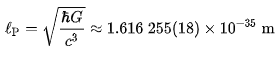
The answer is that there is a minimum difference between frequencies of the light emitted by a hot object. This means that physical reality has a granularity to it. It has, in terms of computer graphics and video, a frame rate and a resolution, all determined by Planck’s constant, h, and the speed of light, c. Light can only be omitted in discrete quantities. There is not an intermediate energy level below a certain fineness and instead energy leaps between these levels without having any values in between. The minimum quantity is known as a quantum, and the energy of a photon is equivalent to its frequency multiplied by h. It solves a lot of problems. For instance, if electrons in orbitals constantly radiated energy over a continuous range, they would spiral into the nucleus and the atom would collapse. Instead, an electron can only have certain clearly defined energy levels. The Planck Length is given by the formula:

. . . where G is the gravitational constant and ℏ is h divided by 2π. The Planck Time is then the time taken for light to travel this distance.

The thing about the Planck Length in terms of scale is that it’s so much smaller than anything significant which seems to be happening, such as the size of the “smallest” subatomic particles. A zoom into the Planck Length would mainly be very boring because it’s nineteen orders of magnitude smaller than the limit in ‘Powers Of Ten’, which is equivalent to a speck of dust compared to something like ten dozen times the diameter of the orbit of Neptune. However, assuming that the film was made in 1968, certain fundamental particles such as quarks had not been established to exist yet, so nowadays it would be possible to go further. At this scale, it’s conceivable that “quantum foam” exists. Spacetime may be fluctuating in nature at these dimensions like a stormy sea, which also suggests that there is energy present in a pure vacuum. How this might be extracted, and whether it would be desirable to do so, is another question. It’s sometimes thought that the Universe is not at its lowest energy level and if that level were to be reduced to zero, for instance by “mining” the energy of quantum foam, that true vacuum would spread out at the speed of light from where it was formed and destroy everything.

Getting back to the question in hand, the smallest possible scale is the Planck Length of the order of 10-35 metres, and the largest possible scale is the Universe itself, whose current diameter is of the order of 1026 metres. This means we are on the large size. Of the sixty-one orders of magnitude possible at the moment, we’re the thirty-fifth smallest and the twenty-sixth largest. Middle-sized is around the thirtieth from either end, which is around ten microns or somewhere between the size of a white blood cell and a red blood corpuscles. Organisms of this size include protists and single-celled algæ. They are to the Universe as the Planck length is to them. Even so, we are close to being middle-sized in the grand order of things in that a factor of a million is not hugely significant when the number considered is around ten decillion. A hundred thousand times bigger than we is the size of a region of England such as the Midlands, and that’s not terrifyingly and incomprehensibly enormous. Therefore we are, very roughly, in the middle.

A More Literary Bit

I don’t know what pretensions I have to dare describe anything I write as appropriate for the above heading, but there it is. Yesterday I made this YouTube video:

Incidentally, I’m thinking of going back to making YouTube videos, but in future they’re likely to include no speaking and I won’t be showing my face on them, if I bother at all.

I found this rather unsatisfactory. I was going for the impression that the rather overgrown back garden was like a jungle at a smaller scale, but there were a couple of issues. One was that most of this wasn’t truly at ground level, and the other was that there seemed to be precious few animals in that video. I may give it another go at a later date. What I wanted was a lush forest-like appearance teeming with animal life, such as spiders, ants, beetles and flies. Something like this but with animals:

We do, to Sarada’s chagrin, have plenty of horsetails in our garden but they’re not forty metres tall. It’s really a testament to them that they’re still around after 300 million years, and to me it raises the question: when you get smaller, is it like going back in time? After all, on a sufficiently tiny level there are no vertebrates, or rather the vertebrates who do exist are great hulking monsters. There’s a frog who is less than eight millimetres long, and in Britain the minimum size seems to be a few centimetres. Mammals and birds as they’re now constituted can’t be smaller than a certain size because they would be physically incapable of eating enough food to keep their body temperatures at the right level to survive, so getting smaller is a journey into the past in terms of the animals all being “cold-blooded”, except of course that as discussed previously a flying insect isn’t really cold-blooded at all if it has to put much effort into flying. However, also at this scale animals don’t so much need to put effort into flying as into not flying, because for them the air is a fairly thick, buoyant fluid which they don’t so much fly through as swim in.

J G Ballard’s novel ‘The Enormous Space’ tells the story of a man who resolves never to leave his house again. As the days go by, his house expands until even the room he’s in is too vast to traverse. It’s been adapted into a TV play by the BBC:

Because of lockdown (I almost gave that a capital letter), some of us have found our homes becoming our worlds like the character in this piece, but to the various denizens of our dwellings they already are. The longest line section (actually geodesic) which can be drawn in the area I have lived my entire life within is about two thousand kilometres long, from Inverness to Rome, so that’s my world, in a way. Reducing this by a thousand gives an area the size of a small town, so for an ant, say, this is their world. The vegetated area of the garden is about twelve metres long, so magnifying that by a thousand makes it twelve kilometres, like a large forest in terms of England today. But this is mainly a bamboo forest with prodigiously high “trees”, since it’s largely grass. The tallest bamboo species is Dendrocalamus giganteus, which is up to thirty-five metres high, and at a scale of one to a thousand this is equivalent to a fairly well-manicured lawn, which we don’t currently have. To an ant, the moderately tall grass in the back garden is something like ten times the height of the tallest bamboo, making it more like a redwood forest, though of course not woody because of the relatively lower gravity.

This is truly a different world. The gravitational acceleration is less important there because the relative masses are a thousand million times lower. An insect could easily fall out of a skyscraper without being harmed, even though the gravity operating on a two millimetre long organism is in a sense a thousand times as strong. The atmosphere becomes a much more important factor, even the dominant one. Water becomes if anything more dangerous because its surface tension not only allows it to be walked on but also to capture an insect permanently even though they wouldn’t sink, and this opens up a whole ecological niche of predators who can prey on the victims of surface tension such as raft spiders and pond skaters. At the same time there are still the more familiar predators and prey in the form of ladybirds, wolf spiders and aphids.

It’s easy to think of oneself as trapped in one’s home, and since I’m a carer that is particularly a hazard for me. However, not only do I continue to have communication with the outside world, but also I have access to the microcosm. Even without a microscope I can observe the relatively large animals living in the house and garden, and when I get down to the middle-sized animals such as the hundred micron Colpoda, which will be present in the soil here like it is all over the place, and the crinoid-like Vorticella likely to be present in the guttering whose stalks are around the same length, the garden is relatively the size of that good old colloquial unit Wales. How could I want for any more? I can also go the other way, though since I live in England with its grey skies, not quite so far. But on a clear night, like anyone else I can realistically see individual stars thousands of light years away. The whole observable Universe is around me and half of it is accessible, though this presumes I have my own observatory and in practical terms is far less so because I’ve only got a pair of binoculars. But even so, I can see the Orion Nebula, 1 300 light years away, and the Pleiades open star cluster, 440 light years from here, and so on.

In the end, then, although it’s important to get out of the house, to some extent it’s what one makes of it, and the scope for what I might call adventure but is probably better called observation, even just from this one small house and garden in an English Midlands town, is vast. Just because the slightly larger than medium scale at which we happen to live lacks, in the East Midlands anyway, rainforests, elephants, lions and whales, doesn’t mean it doesn’t contain an equally fascinating array of wildlife on another level, and just because we’re confined to Earth doesn’t mean we can’t observe a fascinating wider Galaxy. What more could anyone want? Isn’t it great to be middle-sized?

Gnosticism

Trigger warning: Rape.

Here’s some common ground for mainstream theistic Christians and metaphysically naturalistic atheists: something neither of us believe in. Gnosticism is a variety of religion, possibly a form of early Christianity but arguably not, which existed from about the first Christian century until going into decline around the time of the Council of Nicaea in 325 CE. It might have been the other way round, in which case mainstream Christians would’ve been the heretics and they’d be orthodox, but this is how it really turned out.

The word “Gnosticism” is derived from the Greek γνωσις, which both means and is cognate with the English word “knowledge” and the Sanskrit word ज्ञान, jñāna. The general idea is that Jesus provided special esoteric knowledge to a few people, such as his disciples, which can be discovered by analysing what he said. Because history went the way it did, Gnosticism comes across as odd to today’s Christians, and also has a flavour more akin to Eastern religions such as Buddhism than Judaism or the other Abrahamic religions. A possibly over-simplified version of Gnosticism goes as follows: There is an ultimate true God known as the Λογος, Logos, or Word, who rules over all and is ultimately good. This God is hermaphrodite and defined only negatively, for instance as the Unmoved. Several steps down from this God is the Δημιουργός, Demiurge or artisan, carpenter perhaps, who fashioned the physical Cosmos and has trapped souls in matter. This Universe as we know it is therefore effectively the Matrix. This is the origin of the idea that we might be living in a simulation, and the secret knowledge we gain enables us to escape. I often think this makes the film series ‘The Matrix’ and Elon Musk’s and others’ idea that we are in a simulation distinctly unoriginal. Some Gnostic Christians saw Christ as the manifestation of the Logos and contrasted the New Testament God with God as portrayed in the Hebrew Bible as being the Logos and the Demiurge respectively.

Now for a bit more detail.

This is a diagram of the πληρωμα (pleroma). This is literally “fullness” and is a concept used in both orthodox and Gnostic Christianity. It means the totality of divine power. There is, incidentally, a lot of overlap between the concepts of orthodox and Gnostic Christianity and the word is used many times in the New Testament. It contrasts with κένωμα, kenoma, emptiness, and there may be a third contrast with κοςμος, kosmos (more usually spelt with a C in English). I should point out, incidentally, that when I say “orthodox Christianity” I’m actually referring to the version of Christianity which is directly ancestral to the Roman Catholic, Protestant and of course Orthodox denominations of the Church, and not just the Orthodox churches, although at the time what was to become mainstream Christianity was also to become the Orthodox Church. Terminology just is confusing here. A general trend of sophistication can be traced in the New Testament between the earlier synoptic gospels and the later Fourth Gospel and Johannine writings, and this trend continued with Gnosticism becoming more esoteric. Therefore the Pleroma as shown above works like this. The point at the top is the Monad, which seems to be another word for the Logos but I’m not sure (I’ll come back to that). This emanates into νους & αληθεια (I’m having to shift between Greek and English keyboards here all the time, hence the ampersand in the middle of that – it’s quite tiresome!), which are Mind and Truth. The word for “truth” is negative in Greek, meaning something like “non-forgetfulness” or “the state of not being hidden”, hence the “a-“, as in “atypical”, “asymmetrical” and “atheism”, also found in the related Sanskrit. This reflects the tendency in Gnosticism to pursue the via negativa, i.e. describing things as what they are not because the divine passes all understanding and therefore cannot be described positively – we don’t have appropriate concepts for God. This could lead into something interesting, and it will in a bit. Every point in that diagram within or on the larger circle represents one of the emanations of the divine, and the circle itself is referred to as the Boundary, Cross (Stake as in σταυρος), i.e. the same word used for the instrument of Jesus’s execution. The pleroma is where the ‘αιωνης (I’m not sure of that plural) dwell. These Æones (singular “Æon”) are the enamations of the Monad. Emanations are things which are “thrown off” the Monad without it being diminished. I tend to think of them as separate beings but I’m not sure this is correct. A similar idea is found in Zoroastrianism with the 𐬀𐬨𐬆𐬱𐬀 𐬯𐬞𐬆𐬧𐬙𐬀, Amesha Spenta, seven divine and personified emanations of Ahura Mazda representing various virtuous attributes of God. Since these are personified, I assume they are also in Gnosticism, which has thirty of them.

The kenoma could be linked to kenosis, an important concept in orthodox Christian theology. Kenosis is the idea that in becoming human Jesus emptied himself out and “became nothing for us”, and is a useful concept, for example, in the idea that Jesus was gang-raped before the crucifixion by Roman soldiers. One of the most popular posts on this blog is ‘Was Jesus Raped?‘ which goes into this in more detail, but it should be noted that there are many people who describe themselves as Christian now who object to such things as this statue:


A photo of the Jesus the Homeless Statue by Timothy Schmalz outside
Date
22 April 2014, 14:15:07
Source
Own work
Author
Pjposullivan

This statue is sometimes objected to on the grounds that it attempts to debase Christ, and similarly there are attempts on Yahoo! Answers to insult Christians by bringing up the question of him being gang raped. Kenosis focusses on the idea of Jesus becoming the lowest of the low: a homeless man, born in a stable, who happened to be God. The Gnostic concept of the Kenoma is of the emptiness or void outside of the Boundary of the Monad, and is the world as we perceive it by our senses. Each Æon in the pleroma has a corresponding entity in the kenoma.

The reason all this stuff is speculated about is that it’s supposed to be secret knowledge which carries the key to the Universe, and it’s also an attempt to reconcile Christian philosophy with Neoplatonism. My first impulse is to throw all of this into some kind of conceptual dustbin as completely idle and pointless esotericism, but one thing that stops me is the fact that, and this opens me to potential ridicule, I actually believe Nostradamus made successful, unambiguous and accurate predictions, and he based his technique on Neoplatonism. Also, the esoteric has a draw to me: it can be seen in alchemy, the Qabbalah, choirs of angels and the likes of the chakra system in Yoga.

I am, of course, coming out of the dominant strand of Christianity, some of which was to evolve into evangelical Protestantism, and consequently I’ve inherited the dismissive attitude of the early Church from about the fifth Christian century onwards, which regards Gnosticism as heretical. This history of early Christianity may, however, help to explain a couple of notable features of today’s mainstream Christian faith. Christianity as I understand it has an oddly sparse and austere cosmology. Any other world faith seems to have accumulated complex models of the spiritual universe such as many deities, the various worlds of Buddhism, the emanations of Zoroastrianism, the complexity of the Talmud in Rabbinical Judaism and the names of God in Islam. Some denominations of the Christian faith share that kind of concretion, but not the likes of the Society of Friends or Evangelical Protestantism, the two aspects wherewith I have most to do. I also place ethical considerations right at the centre of my life, something which occurred to me when I first looked at the Qabbalah, because the idea there seemed to be that “doing the Right Thing”, which in that case probably meant following the Talmud perfectly, was simply the first stage of the Tree Of Life, whereas to me that makes the entire thing redundant because it constitutes a distraction from that duty and a waste of time and energy. This plainness and austerity, in the context of what became orthodox Christianity, seems like a continuation of the trend which began with the rejection of Gnosticism.

There is, though, an opposite trend which is equally apparent in Evangelical Protestantism, and the fact that these two seem to coëxist in it really puzzles me. If you look at, for example, Judaism, that has a list of thirteen precepts arrived at by Moses Maimonides which sums up its basis, although of course you then have the sophistication of Torah, Talmud and perhaps even the Zohar. Islam has its Five Pillars and Buddhism its Four Noble Truths and Noble Eightfold Path. All of these amount to just one principle: do good deeds in the world and you will achieve a higher state of being. Evangelical Protestantism is markèdly unlike this. It has no “elevator pitch”. In order to do the right thing according to that, you have to repent and commit to Christ, the uniquely fully human and fully divine sinless person who died on the Cross for you in order to atone for the inherited sins of the human race due to the first people’s disobedience from God, and it isn’t good deeds which help here but just the one deed of letting Christ in. Maybe it’s just because I’m closer to it, but all that seems a lot more complicated than other religions. And somehow, this austerity and complexity comfortably occur together as features of Evangelical Protestantism. Which is weird. However, I think this complexity is probably inherited from Gnosticism, because a clear trend can be seen towards it in the chronological order of the New Testament texts.

Modern mainstream Christianity, including in fact heterodox sects such as Jehovah’s Witnesses, emerges from a tradition which defined itself as “Not Gnosticism”, although there are other heresies such as Arianism and Monophysitism, while also inheriting Gnostic features. One legacy is the via negativa, that is, describing the Divine by what it’s not. There is a view that metaphysically naturalistic, scientifically realist atheism is the result of a Christian world view because of its separation between the Divine and the created realms, the latter of which is taken to be amenable to logic and governed by physical laws, and ultimately leading to the redundancy of the concept of God. Some other forms of atheism are remarkably different. For instance, some Indian atheists simply saw karma as a sufficient explanation for everything an therefore rejected the concept of God. But to me the most appealing other option to theism, and probably the one closest to my own theism, is theological non-cognitivism, also known as “ignosticism”, which is the view that religious language, including talk of God, is not about semantic meaning, and therefore that “there is no God” is just as invalid as “God exists”. It’s similar to ethical non-cognitivism – the idea that a sentence like “this is the right thing to do” in fact means “I approve of this, do so as well”. It is also true that the via negativa edges into that, and if I were to reach another set of beliefs from where I currently am, I would probably just decide that atheism and theism are equally crass and ill-conceived. This idea can be traced back to Gnosticism, although it crops up in other belief systems, such as logical positivism. There is no point at which I would ever claim to be atheist, for that reason, unless I change my mind about the idea that there is always a strong emotive element in meaning. My narrative tends to be psychological even though I’m externalist, but ignosticism also works as a way of highlighting the possibility that our notion of God, among other religious ideas, may simply be incoherent.

I don’t consider Gnosticism to be a good thing. To my mind, it removes the distinctiveness of Christianity and makes it more like Buddhism and Hinduism in that it leads one to view matter as evil. This has negative consequences in the real world. For instance, Ayurvedic medicine is influenced by the idea that reincarnation is an undesirable consequence in that it sees in utero development as painful for the fetus and pregnancy as an unhealthy state, so it brings misogyny with it. Women are, for Ayurvedic medicine, undesirable vessels which trap us all in life as opposed to Nirvana. The same kind of thing happens with Gnosticism, since it views matter as evil and something to be escaped. Adopting such an attitude undercuts the urge to make a positive difference to the world, since life is effectively an illusion anyway. The modern Church has also accused transgender people of Gnosticism, which I won’t cover since this is the wrong blog for it: here is a pamphlet from the Christian Institute on the matter, so to speak.

There are opposing views regarding whether the New Testament itself contains Gnostic elements. It had a tendency to use words also used in the New Testament, and the Septuagint, but elaborated way beyond their usual meaning, which accords with its esotericism. The Fourth Gospel (“John”) of course mentions the Logos in a prominent position and there seems to be something odd going on with its prose style which I’ve never been able to put my finger on, possibly chiasmus, which might be used to extract some kind of hidden meaning. Analysing the texts of the gospels themselves, some claim that earlier and later versions can be distinguished in such as way that Jesus was viewed differently as time went by. Specifically, the Gospel of Thomas, a non-canonical gospel which, however, appears to be Q, an early long-undiscovered apparent source for other canonical gospels, seems to focus on the idea that the Kingdom of Heaven is at hand and doesn’t refer to the idea of the End Times. This could reflect on a change in attitude when the apparently promised imminent end of the world didn’t happen. To my mind, it seems that paradoxically the idea that the world was about to end is a later idea, although this may not be sustainable considering the apparently apocalyptic focus of much contemporary Judaism. It’s also possible that Paul was influenced by Gnosticism, because his focus was on the Gentiles, who would at the time have been more comfortable with Greek ideas, although the Jews were themselves quite Hellenised at this time. He may even have been Gnostic himself, referring to “knowledge” in such texts as 1 Corinthians 8:10 –

Εαω γαρ τις ιδη σε τον εχοντα γνωσιν εν ειδωλειω κατακειμενον ουχι η συνειδησις αυτου ασθενους οντος οικοδομηθησεται εις το τα ειδωλοθυτα εσθειν;

For if someone with a weak conscience sees you, with all your knowledge, eating in an idol’s temple, won’t that person be emboldened to eat what is sacrificed to idols? 

I don’t know about you, but to me this looks a bit contrived, since the “knowledge” might simply be the usual Pauline theology of salvation.

To conclude, if Gnosticism had become the dominant form of Christianity I don’t think it would’ve been a good thing. Even as it stands, Christianity may have been instrumental in the fall of the Roman Empire because people simply didn’t care about the world any more, and with Gnosticism it would’ve been even more so. It’s popular in certain circles and has influenced Christianity as we know it, pun intended, but it isn’t a good thing. It’s still quite interesting though.