«Je ressens la pluie d’une autre planète»

It’s a trite cliché that artists have to draw what they see, and with twentieth and twenty-first century art it seems to be false. Perhaps with Fauvism an artist might attempt to concentrate on how she might see a particular shade or hue and paint it as that colour throughout, or at least that’s the impression (!) I got. In fact it seems to be nothing like that, but it does force the viewer to see the geometrical components of a scene while retaining one’s emotional relationship therewith, or maybe the artist’s feelings. Cubism, a couple of years later, concentrates on geometry while removing emotion.

Right now I feel that my tour of the Solar System has to some extent placed me in the second category, but only somewhat. I expect, if someone had genuinely visited other worlds, if their experience of Earth on their return would be more emotionally charged. I’m sure they’d never be the same again.

There will be something like poetry. Where it starts is another matter.

In the park near us, there’s a small fountain in a pond. Its drops describe a series of parabolas. These parabolæ radiate from the central showerhed and rise maybe fifty centimetres from the water surface. They remind me, right now, of nothing so much as a volcanic eruption on Io. With its exceedingly tenuous atmosphere and gravity less than a fifth of Earth’s, the fountain of ejecta from Io’s volcanoes resembles the fountain in the park but is cyclopean in extent, being over 150 kilometres high. However, the same laws of physics govern the movement and form of the drops. This was the first alteration in perception I became aware of.

Swerving into herbalism territory, like most Western herbalists my stock-in-trade substantially comprises a series of bottles containing what probably look like thick brown liquids to most people. These are usually ethanol and water solutions containing dissolved active ingredients of the plants in question. I could go into more depth about the more subtle distinctions herbalists perceive in the appearance of these tinctures, but for quite a number of them the residue remaining if some is spilt and the solvents evaporate becomes a tarry, often reddish-brown substance which is often a mixture of tannins and other compounds. Tannins are generally linked rings of organic molecules with hydroxyl and oxygen groups. Bakelite is another example of a substance made of these phenolic rings, and the brown or black appearance of a caster, mains plug or saucepan handle is often due to this. And out there in the depths, or maybe heights, of the outer Solar System are countless worlds covered in tholins, which are in some ways similar to this residue, though not necessarily phenolic. The sticky, reddish-black tincture residue is substantially similar to the same stuff coating the surface of many TNOs.

Another parallel with herbalism occurs when certain worlds are cold enough to have frozen nitrogen on their surfaces, such as Pluto and Triton. This brings tholins into contact with the element, leading to the formation of organic compounds containing nitrogen. These are quite similar to alkaloids. Alkaloids are a group of compounds which each have some of the following characteristics: they all contain nitrogen and have a markèd physiological action, tend to have rings including a nitrogen atom, and originate from plants. There are exceptions to the last two and the function of the alkaloid for the plant in question isn’t clear – they may act as reserves of fixed nitrogen. Alkaloids include caffeine, nicotine, atropine and cocaine. There are research programs to find novel alkaloids in rainforest plants for medical use, a race against time thanks to deforestation. Well, heinous as that may be, it so happens that many outer system worlds are coated in nitrogenous organic compounds, and this is just me but I do wonder if there are many such compounds out there. Maybe there could be heroin mines on Charon. The Universe doesn’t care about that.

The way tholins spread across the surfaces of the likes of moons and asteroids is reminiscent of how mould, lichen or plants colonise a new habitat. They are, as I’ve said before, a fork organic chemistry can take when free from technological influence instead of coming alive. It’s literally true to say that there’s an organic quality to tholins. Alternatively, maybe the way tholins went on Earth involved a freak accident with them coming to life. Consequently, when I look at a road surface, wall, pavement or other stone-like artifact, I see a parallel to the surface of a distant planet, where reddish-brown tar is gradually being deposited, just as moss and lichen gradually creep across these fresh plains. The difference is that in spite of the amazingly gradual encroachment of lichen at about a millimetre a decade, it’s still thousands of times faster than the rate of tholin deposition.

I don’t know if you’ve ever been to Dungeness. This area of Kent, held constantly in place by shingle lorries shuttling to and fro 24/7, is an example of a rare type of habitat known as a shingle bank whose largest examples on Earth are it and Cape Canaveral. The delicacy of this landscape is such that walking across it will leave footprints visible decades later due to the slow-growing foliose lichen living there. It has to be said that putting one of NASA’s main launchpads there is rather questionable, and much of what I’ve been able to write about in this series is contingent on environmentally questionable launches from that location. Dungeness at least has a lot in common with the lunar surface in that the footprints and human influence there, and doubtless in Cape Canaveral too, are extremely durable. Dungeness has been compared to “the surface of the Moon”, and this could equally well be inverted to comparing the surface of a distant planet to Dungeness. Titan in particular springs to mind.

On the whole, the view from moons, planets and asteroids on the Universe is either obscured or clear. There is a strong tendency for conditions to be close to extreme here. Either the sky is completely clear or completely cloudy. This is not universally so. For instance, on Mars clouds do occur but on the whole the sky is empty of them. Earth is cloudier than Mars but not as cloudy as Venus. This is one situation where I may not be aware of conditions outside the British Isles and over much of the planet the sky is either usually clear or mainly cloudy, but there are even so areas where there are, for example, little fluffy clouds in a blue daytime sky. The clouds on this planet are usually mainly water ice or water vapour, but the volcanoes are usually silicate rocks.

It needn’t be this way. Martian clouds are generally either water ice or dry ice, i.e. carbon dioxide. On the outer planets they’re various, sometimes evil-smelling, substances like ammonium hydrosulphide or hydrogen sulphide. On Titan they’re methane, and form a largely uninterrupted deck of obscurity. One notable thing about all these clouds is that none of them actually constitute a substantial part of the world in question’s atmosphere. Our own atmosphere, for example, is not mainly water vapour, and if it was this planet would be very like Venus and completely uninhabitable with no rivers, lakes, seas or oceans, because steam is a much stronger greenhouse gas than carbon dioxide. Likewise with the prominent clouds elsewhere in the Universe. Even so, there are circular storms, thunderstorms and plenty of cloud types approximating our own, as well as the same formations. On Mars, Earth and perhaps elsewhere, a peak can push a body of air up past the point where it starts to form clouds, and on its leeward side chains of clouds can develop in similar manners. This is of course not always so. Rain clouds of any kind whose drops actually reach the ground are only found on Titan and Earth in this star system. Something like snow is more common, but is sometimes the atmosphere itself freezing. Hence when you look at the sky, you’re seeing clouds like those on countless billions (long scale) of worlds throughout the cosmos.

These processes and structures can be composed of less expected materials in other star systems. A particularly easy kind of planet to detect by the method of looking for light being dimmed by a large body passing frequently between us and the star is the “Hot Jupiter”. These are, as the name suggests, somewhat Jupiter-like planets, but differ from our own largest planet in that they orbit their primaries in a couple of days and are far hotter at their cloudtops than any planet’s surface in our own system. Consequently, although they too have clouds “like” ours, they’re actually made of substances like droplets of molten titanium or quartz, or perhaps crystals of the same. Meanwhile, circling the Sun and doubtless innumerable other stars further out than Earth, the converse situation exists, with volcanoes made substantially of water ice and erupting water instead of silicate, while the clouds are made of ice or water vapour instead. This is as extreme compared to a world like Enceladus, Titan or Pluto as the silicate clouds are to us.

Taking the comparison a bit more deeply, the water that erupts out of volcanoes in the outer system emerges from a mantle of flowing slush analogous in the same way to our own rocky mantle, which does flow but is not really fluid as we understand the term as it’s extremely viscuous, but just as far out moons hide internal water oceans beneath a superficial veneer of ice, though sometimes a very thick crust thereof, so does our home world secrete a deep ocean of rock. It’s easy for us to imagine that somewhere like Europa or Enceladus could be concealing a vast reservoir of sea water replete with its own version of fish because we are ourselves familiar with that from our own seas. Extending that to our own mantle, who are we to say that there are no “fish”, perhaps silicon-based, hundreds of kilometres beneath our feet? After all, the ocean of rock is hundreds of times larger than the ocean of water on our home world. This can only be speculation, at least right now, and it’s hard to imagine how it could become anything else. Maybe there is an extremely hot Earth-sized planet whose lava oceans do contain life forms, or maybe not, but we’re looking for “life as we know it” when the one thing we really do know about life elsewhere is that we know nothing of it, or even of its existence.

And perhaps we will never know. Clearly nothing we’re aware of now could rule out the presence of other life off Earth, because we have an example of life here, but although there are numerous reasons we could project onto the sky that might make it implausible, it’s entirely possible that we’ll simply never know if we’re alone in the Universe, and that might apply even if we embarked on an exploration of it. Even if our entire Galaxy proved to be lifeless apart from us, there might be no particular reason for it other than luck, and another galaxy, such as Andromeda, could have life, and if not that a different galaxy so many gigaparsecs from us that we’ll never know it exists. Right now there doesn’t seem to be any kind of mathematical or scientific argument which would be able to give us an answer to this question. It’s rather like the existence of God. You can be “theist”, believing that there is life elsewhere. You can be “atheist”, observing the Universe and the physical laws which decide what can be in it and deciding that life is just a fantastically improbable freak accident, thus committing yourself to the probability that terrestrial life is all there is. Or, you can be agnostic, and simply withhold an opinion on the matter, while holding out for the possibility that there is or is not on a kind of faith-like basis. It’s even possible that we will never know if there’s life within our own planet.

Getting back to precipitation, there is a line from the TV series ‘Wonder Woman’ which seemed highly dubious when I first heard it. A man from the future visits the late 1970s and remarks to her that there are planets made of diamond where a stick of wood would be a previous commodity. At the time I suppose I assumed that other planets were more like our own than they in fact are, because remarkably for such a soft and unscientific franchise as ‘Wonder Woman’, with the likes of disappearing handbags and invisible aircraft, this is in fact so, and you don’t even need to look outside our own star system to find such planets. Both our ice giants are probably so rich in diamonds that they’re as common as icebergs in the Arctic or hailstones on a spring day, and wood would naturally be unheard of. Wood is also associated with life of course, and we have no idea how specific it is to Earth. If it is, it’s like blue john, which only occurs in one place in our Solar System and probably for many light years further than that, in the Derbyshire Peak District.

Water has influenced the appearance of the Peak District in a couple of significant ways which give the area its distinctive character. One is through the erosion of potholes and other caverns and another is the various effects of glaciers, such as causing lakes to form by blocking rivers and the presence of isolated boulders a long way from their original locations. It isn’t clear what actually happened there in that respect during recent ice ages, but it seems that ice-related erosion and weathering relatively close to melting point where ice expands as its temperature falls is likely to be characteristic of Earth as an ongoing process rather than anywhere else in the system, although during certain relatively short-lived catastrophes this does seem to become significant. The difference here is that in many places the temperature has fluctuated around the range where this takes place, making it a dynamic and repetitive process.

Looking up, we may see Cynthia. I’ve been rather startled to find recently that for some reason flat Earthers perceive her as luminous! She looks like nothing so much as a ball of grey rock to me. A varied and beautiful one to be sure, but not luminous. This impression, though, is not confined to our satellite. The other planets in the system do in fact look like bright stars to the naked eye. Even so, there are noctilucent clouds, which are so high in our atmosphere that they reflect sunlight considerably later or earlier than sunset or sunrise. It’s simply that unexpectedly daylit items in the night look so bright by contrast that they’re practically luminous, but not literally so. It illustrates how much the human eye can adjust to light and darkness that Cynthia can appear to shine. Yes, there is moonlight. Also, the light from the white door in our bedroom reflects onto the blue-painted wall, almost bringing us back to Fauvism.

When Sarada became aware that I tended to get bogged down in details, she recommended a book to me which I very much enjoyed: ‘The Mezzanine’, by Nicholson Baker. Baker’s book, which can hardly be described as a novel, focusses on the minutiæ of the quotidian in a manner possibly reminiscent of «A la recherche du temps perdu». Whereas I find the latter unhealthily self-absorbed (though I haven’t read it), the former caught my attention and was easy to relate to. It has no real plot and has been described as having a “fierce attention to detail”. As a young adult, I used to write long descriptions which I couldn’t turn into stories. Fortunately, Baker has succeeded in getting a work using a similar approach published. Most of our experience, mine at least, consists of such thoughts and unfinished mental doodles. One difference is that ‘Mezzanine’ finishes these. The approach taken is somewhat reminiscent of a minor poetic movement of the late twentieth century called “Martian Poetry”.

Martian Poetry is a small and fairly transient subgenre of poetry whose most famous piece is Craig Raine’s ‘A Martian Sends A Postcard Home’. This can be found here. It can take a while to puzzle out, but refers to such things as books, telephones and sleeping together. It’s a series of riddles, but more than that. Published in 1979, it uses unusual metaphors to make everyday objects and experiences fresh and unusual. It’s a little like the real-life ‘Man Who Mistook His Wife For A Hat’ and it raises the question in my mind of who the narrator is. When I wrote the previous post, I realised I’d created a problem. I had no idea who the aliens describing Earth were and I had to come up with a semi-feasible model of their own world, anatomy and physiology before I could begin to portray our home planet. In particular, I had the alternatives of making their comfort temperature hotter or colder than ours, and chose colder because more of our own star system, and in fact the whole Universe, is colder than Earth’s surface rather than hotter. Once I’d done that, I had something I could relate to and a perspective from which to conceive of Earth as others see it. Craig Raine, unsurprisingly, doesn’t do that. We can, however, glean something about the narrator because of the metaphors used, which can be contradictory. For instance, he uses the word “caxtons” to describe books, which he sees as avian, multiwinged creatures. This is a spiky-sounding word with its C and X, and calls to mind a rustly, fluttering thing which one might imagine capable of flight, and certainly it confers that capacity to its reader’s mind, but calling it after the fifteenth century printer anchors it in human life, and even in England. Nor does Craine play fair with the reader when he later describes mist as making the world “bookish”. The problem Craine sets himself is that of not being able to make the narrator Martian enough, because that would seem to make the poem less comprehensible.

I tried fairly hard to find another example of a Martian poet, but all I could uncover was Christopher Reid’s ‘The Song Of Lunch’, and even then I was only able to see the Emma Thompson and Alan Rickman TV movie version. It has a somewhat similar quality but as the action, such as it is, proceeds, it injects elements of plot and tension into the story and is much more conventional. It can currently be viewed here.

What makes these different from my own perspective of seeing a fountain in the park and thinking of the plume on Io’s Tvashtar Patera is specificity. I’m looking at the world in a kind of Cartesian way. I see the parabolas described by the water and consider the similarity, which does make me view them afresh, but there are only specific and sparse details and the comparison is with a specific alien environment. This cognitive estrangement can, however, be broadened and make the whole world surreal. I can remember one guy describing the experience of going swimming as stripping naked, putting on a pair of turquoise pants and immersing himself in a bluish liquid in a large blue room with various other similarly-attired people, and this is indeed surreal, and is more general than the constrained and sporadic examples I’ve mentioned above.

Neurodiversity has sometimes been described as being on the wrong planet, and there’s a website, wrongplanet.net, with this name. But which planet is wrong? Maybe it’s this one. “We” who are neurodiverse might be on a planet which, as a whole, treats us badly and makes assumptions which the rest of us will never be able to guess. This planet could be morally wrong. However, that’s unfair. In fact it isn’t the planet which treats neurodiversity so much as Homo sapiens. And the planet we come from isn’t wrong either. It’s actually the same planet: a conjoined twin Earth with as much right to life as Neurotypical Earth.

That brings us to the Véronique Sanson «chanson» quoted above. The line from Kiki Dee’s English version of the song has always puzzled me – “I feel the rain fall on another planet”. It comes across as a complete non sequitur. Sarada says I’m overthinking it. The original makes more sense: I have undergone such a life-changing experience that I am sensitive to the whole Universe. Now I have a grandchild (and a teenage grand-niece as of the other day, incidentally, which makes me feel really old), and I’m not comparing the experience of considering the Solar System’s other worlds in their own right to losing one’s virginity, but yes I am. I haven’t undertaken a project as grand as the so-called “Grand Tour” because all I’ve done is sit in the living room and typed stuff about the likes of Enceladus, but even that relatively mild enterprise has changed the way I see the world, and we all know about the Overview Effect, so who knows what would await us out there culturally or psychologically if any of our species crossed the lunar orbit?

Pluto’s Kingdom

In the furore following from Pluto’s demotion after Eris’s discovery, a few people argued that Pluto of all places deserved to be called a planet because it had a moon. In fact it has at least five: Charon, Kerberos, Hydra, Nix and Styx, not in that order. It certainly seems to make sense that if a world is hefty enough to have its own companions, it ought to count as a planet, but in fact that isn’t how it works, and there are actually a couple of reasons why having moons almost makes a world less planet-like, if by “planet” you mean a solid or fluid spheroidal body with a relatively strong gravitational pull.

Only two of the universally accepted major planets have no companions: Mercury and Venus. These are notably the two next to the Sun, so the reason may be that they lack the gravitational “oomph” to maintain them. Matter circling either wouldn’t have to be very far out before it felt the Sun’s pull more strongly than the planets’. That said, both of them have respectable gravitas of their own and are far more than just a bunch of rocks loosely bound together. This last is the point really. A small object is less able to hold itself together and is therefore more likely to be a collection of stones or chunks of other matter, highly porous and riddled with caves and liable to lose some of itself or not accumulate nearby bits of matter in the first place. Therefore, in a way, if a body has a few moons, this could be more a sign of it not being a proper planet rather than the other way round. The other reason is basically the same but proceeding from the other end. Many Kuiper Belt and scattered disc objects are binary, and quite possibly more than binary. The same is true to a lesser extent of the asteroids. Being binary is therefore a characteristic of agglomerations of matter which are too small to hold together, but confusingly, having moons is also a characteristic of large planets able to pull loads of stuff towards them which is either already in clumps or forms into planet-like worlds in their own right. Hence Pluto having five moons, one of which is very large indeed compared to the planet (yes, planet) itself, doesn’t count towards its possible planethood.

All this aside, Charon is so large that if it orbited alone it would definitely count as a planet, at least if Pluto does. Earth is notorious for having an unusually large moon, if moon it be, of an eighty-first of its density. Charon far outdoes this, and in doing so consequently outdoes all the other planets in this respect, whose moons are generally well under a thousandth of their mass. Charon’s mass is a little under an eighth of Pluto’s, which is deceptively small as it should be remembered that the diameter relates to the cube root of this figure. After all, Cynthia is a large disc in our sky because it’s a quarter of Earth’s diameter, not 1/81. If the ratio applied to Cynthia and Earth, the former would be considerably larger than Mars, and it might even be habitable, which raises the question of whether such double habitable planets exist out there somewhere. Charon is 1212 kilometres in diameter. Cynthia, like many moons, always shows the same face to us, and the same is true of Charon and Pluto, but in their case the situation is mutual. Both worlds face each other at all times.

I’ve allowed Charon to be overshadowed by Pluto in my own mind, and know relatively little about it. The story of its discovery and naming is quite remarkable. The mythological figure Charon is of course the entity who ferries the souls of the dead across the River Styx into the Underworld, and Pluto being king of the aforementioned domain, one might fancy that the motivation for calling the moon that was clear. However, this is not in fact so. The man who discovered Charon, James W. Christy, actually named it after his wife Charlene Mary, whom he calls Char, and had no idea that the Ferryman was called that too. This gives me pause for thought, because it doesn’t seem to work like one would expect it to naturalistically. It’s reminiscent of the fact that before Saturn was believed to have rings, saturnine herbs were those which had prominent rings, and it’s almost as if the names of celestial bodies are “out there” waiting to be discovered rather than invented, like the non-existent American states of Jefferson and Superior. I won’t dwell too long on this here, but a similar phenomenon is manifested in western astrology where hypothetical planets have been used which have turned out to be real, particularly Pluto.

On 22nd June 1978, Christy noticed that his image of Pluto was not circular, and also that it changed shape on a regular, predictable basis:

Pluto appeared to have a lump on its side which appeared and disappeared. Since the planet is far too big to be irregular, it was correctly concluded correctly that it has a moon, and that that moon takes almost six and a half days to orbit Pluto, or rather, that the two of them take that long to orbit each other. Of all moons and planets in the system, other than small irregular ones, Pluto and Charon are respectively the first and second largest worlds in their companion’s skies, even larger than the Sun in Mercury’s sky (which actually isn’t that large though). Due to captured rotation, that’s also the day length for both Pluto and Charon, and it makes Pluto the only planet to have captured rotation with its satellite, to the extent that it actually counts as a planet, not because of the IAU but because it’s binary and almost orbits Charon rather than the other way round. Axial inclination can also be guessed at fairly reliably with this because the two are likely to circle over each others’ equators, and it’s 57°, exceeding 45° and leading to different variations in day length and the like for the two. Any tilt over 45° involves a peculiar set of circumstances where the polar circles are closer to the equator than the tropics are, though at such a distance from the Sun it’s questionable whether it makes much difference. One thing which definitely does make a difference on Pluto is the atmosphere snowing onto the surface in the autumn and evaporating again in the spring, bearing in mind that the dates for these are more than a dozen decades apart. Speaking of dates, there are 14 205½ Charonian (or Plutonian) days in their year.

The two share many characteristics. Some of these are also shared with Triton, which is closer to Pluto in size and mass than Charon is, but the conditions on the two are even more similar because of their gravitational influence on each other and being the same distance from the Sun, having the same axial tilt and day length and so forth. It’s actually slightly awkward to talk about Charon separately from Pluto, but I’ve written quite a bit about the latter already and don’t want to go over it again. New Horizons managed to take photos of the two together, like this:

This picture is a bit misleading, as it’s effectively taken through a telephoto lens. It wouldn’t be possible to see this similarity near either world because the two are almost 20 000 kilometres apart and Charon is considerably smaller than Pluto even though they are closer in size than any other planet-moon combination. Even so, Charon is notably duller and has a reddish cap over its north polar region, whereas Pluto’s is closer to its equator. This red substance is, however, the same, and seems to have been shed from Pluto and deposited on Charon. Unsurprisingly, it consists of tholins, which are as I’ve said before an organic mixture of dark red tarry stuff which reminds me of the deposits made by herbal tinctures, partly because they actually are quite similar. Tannins in particular spring to mind. To repeat myself from elsewhere on this blog, tholins are the alternative route taken in the Universe by organic chemistry to organic life. The question of how often organic chemistry becomes biochemistry is another question, but there are clearly countless examples of tholins in the Universe judging by how many there are orbiting the Sun. Methane is also deposited on the surface from Pluto. Before any of the stuff gets there, though, it’s been part of Pluto’s atmosphere, and is therefore deposited faster near perihelion. Also, we finally get an answer to why trailing hemispheres are more heavily coated than leading ones: it’s because of gravity. Trailing hemispheres simply bear the brunt of falling material because the material has fallen further by then. The north cap is called Mordor Macula, “macula” meaning “spot”, as in “immaculate” – “spotless”.

Unlike Pluto, whose surface is largely solid nitrogen, Charon’s surface away from the tholin cap is mainly water ice but there are also patches of ammonia hydrates. Also unlike Pluto, there is effectively no atmosphere, so the snowing and sublimating processes on that planet don’t occur here. The south pole is also rather dark, but the north is darker. Although Charon doesn’t have a persistent atmosphere, substances on its surface do sublimate, becoming gas. It’s just that its gravity isn’t strong enough to hold on to any of them. The southern polar region was actually imaged with the help of “plutoshine”, as it was night time there when New Horizons visited, so image processing involved removing the tint of Pluto’s light to restore it to how it would’ve looked if sunlit.

Charon does actually seem to be geologically active, with geysers similar to those on Triton, shedding water ice and ammonia nitrate. This must’ve happened last less than thirty millennia ago, probably a lot less, because the ice deposits are still crystalline and haven’t changed to the glassy form expected after such a long period of time. The different composition of the geyser plumes also means that the moon is different beneath the surface and has geological layers, which was previously controversial as it is quite small. It’s likely that the moon is geologically active due to Pluto raising tides within it, a possibly mutual process, which raises the question of whether there’s substantial heating and an internal water ocean, which it’s becoming apparent is very common in the Universe. Scientists believe that in the distant geological past, it did indeed have an ocean within it but that this froze and expanded, leading to the formation of the enormous canyons visible on its surface in the image at the top of this blog post. This is one way in which water, as a geologically significant compound, behaves differently and leads to different land forms than other substances which melt and freeze. On Earth, water is currently not often a geologically significant “rock”, except at high altitudes and within the polar circles. Beyond the frost line of the Solar System, it often is, and unlike the other liquids, which are often gaseous at Earth-like temperatures, it expands on freezing, leading to geology very unlike ours. Although there are some other substances which expand on freezing, such as bismuth and gallium, they don’t generally occur in bulk. In the case of Charon, water ice is a major and significant mineral which contributes to the landscape and interior in a way something like silicate or carbonate rock does on or in Earth.

More precisely, the reason for those canyons is that as the interior of the moon froze, it expanded and fractured the surface, leading to the formation of a number of features referred to as “chasmata” – “chasms”. These include Tardis, Serenity, Nostromo, Caleuche, Mandjet, Argo and Macross. Many of these have a rather obvious naming scheme, which is fun. Caleuche, which is named after a mythical boat which sails the coast of Chile collecting the souls of the dead, is a Y-shaped canyon thirteen kilometres deep, among the deepest chasmata in the system. Mandjet is thirty kilometres wide, four kilometres deep and 385 kilometres long. Serenity is two hundred kilometres long as a chasma but runs an additional two hundred as an unpaired escarpment. All of these chasmata run around the moon’s equator, separating the northern Oz Terra from the southern Vulcan Planum, which is named after Spock’s planet. Oz is a kilometre higher than Vulcan over its whole surface. Both Oz and Vulcan extend across into the portion of the moon which was dark when New Horizons got there, but it seems likely that each occupies an entire hemisphere. Vulcan is less heavily cratered, suggesting that there’s recently (relatively) been geological activity there which has erased them by remodelling the surface. However, there are some craters and also central mountains, including Kirk and Kubrick. Spock, Sulu and Uhura are also represented thus, as well as Clarke (Arthur C Clarke). The entire area seems to have been covered by a large flow of liquid over the entire hemisphere, probably water.

Other craters include Vader, Pirx, Alice, Organa, Dorothy, Nemo, Skywalker, Ripley, Revati, Sadko, Nasredin, Cora and Kaguya-Hime. I do wonder how people whose religion includes some of these figures feel about the avowèdly fictional characters represented here, but perhaps the day will come when the Vulcan and Jedi world views become official religions too, if they haven’t already. There is another macula, Gallifrey, through whose middle Tardis runs. This means, oddly, that the confusion the Bi-Al Medical Foundation receptionist shows in the ‘Doctor Who’ adventure ‘The Invisible Enemy’ could be explained in a fangirlish way by the presence of this feature, which creates an Ontological Paradox similar to the one created by K-9’s motherboard, introduced in the same episode.

That, then, is Charon, which deserves considerable attention as the largest and best-known of Pluto’s moons. However, there are four more to be covered, and this raises a question: how do they orbit? All other known satellite systems with more than two members consist of a relatively large planet and a number of much smaller moons, and although the orbital dynamics can be somewhat peculiar, such as coörbital moons regularly swapping positions, Pluto-Charon is a different matter. There are two relatively similar masses and other moons in the immediate vicinity. It was calculated at one point that there could be stable orbits in such a situation if an object was at least 3.5 times closer to one mass than the other or if it was at least 3.5 times the maximum separation between the pair, and there are also improbable but stable orbits of various kinds between them such as a figure of eight. Ternary star systems usually have two close companions and a third, much more distant one: this is true, for example, of the Centauri system, where Proxima is much further away than A and B are from each other. The Pluto-Charon system is unique as far as is known in the Solar System in this respect.

Where, then, are the other moons?

This is an image taken by the Hubble Space Telescope three years before New Horizons reached Pluto, and was used to plan the mission. It’s notable that Charon and Pluto actually look fainter in this image than Hydra and Nix, or at least smaller. Styx doesn’t seem to be far away enough to maintain its trajectory. This picture shows that the moons are outside the Pluto-Charon region, separated by a small gap but all relatively close to each other, in an arrangement which reminds me slightly of the TRAPPIST-1 system where several planets are within the habitable zone. They don’t seem to be spaced any way like the Titius-Bode Series and although there is a space between the inner two and the rest, the relative distances of the others are not like those of ternary stars. It also raises two questions in my mind: is this similar to how planetary systems might be arranged around binary stars? Also, is this where Earth’s other moons would be if we had any?

There’s a further surprise. At least two of them are merged double moons themselves, namely Hydra and Kerberos. Going off on a tangent for a moment, bearing in mind that scientists now have sufficient reliable information to establish that two of the small moons of Pluto are former double moons, what the heck do flat Earthers and people who believe, and I quote, “space is fake” think is going on here? Why would NASA, other space agencies and the global astronomical community bother to put in that kind of detail about an entirely bogus cosmos? On the other hand, it is also true that esoteric blind alleys have been known to become highly elaborate, so maybe they think it’s along those lines. Also, fictional universes can be very intricate too. It just strikes me as highly implausible that something like this would be made up and makes me wonder about how flat Earthers think.

Anyway. . .

Hydra and Kerberos are former double moons, and this is evident from their shapes. This is Hydra:

This shape is similar to the comet being studied by the Rosetta probe, and in the comet’s case it’s thought to result from the merging of two bodies. This is that comet, known as 67P:

In the comet’s case, it’s been suggested that the shape results from the heat of the Sun eroding the nucleus. However, each lobe has concentric strata, suggesting that it was originally two bodies which got stuck together. Were it only one, it would have layers indicating a former, more regular form. Hydra is fifty-one kilometres long. Like all the small moons, Hydra is shiny with water ice, and is the outermost moon at a distance of 64 738 kilometres from the barycentre, which is outside Pluto. It’s probably receded from Pluto-Charon due to tidal forces. The name is a bit unusual and sticks out because it isn’t named after a humanoid mythological figure, and this principle also applies to the next moon in.

Which is Kerberos, named after the four-headed (the snake forming the tail has a head) guard dog of the Greek Underworld. Isaac Asimov once suggested that the tenth planet should be called Cerberus so that a mission approaching the Solar System from the great beyond would encounter the system’s guard dog first. To that end, it makes more sense that Hydra be called Kerberos and since the latter was already known to be closer to Pluto than Hydra when it was discovered, its name lacks elegance in a way. There are no good images of the moon:

This image gives the impression that the moon has done something naughty and needs to have its identity protected, but it can again be seen to have two lobes, suggesting again that it’s the result of the collision of two former moons. The two-lobed “dumb bell” appearance is quite common and approached by orbit-swapping moon pairs of moons near other planets. It’s about nineteen kilometres long and averages 57 783 kilometres from the barycentre. This figure combined with Hydra’s gives some indication of how close together the outer moons are, as these are the two outermost and there’s a highly unstable region close to Pluto-Charon, so there isn’t much space between them for moons to exist. Kerberos was named after an online poll and was not the most popular choice, and it’s spelt that way because there’s already an asteroid called Cerberus. The final choice was made by the IAU. Hmmm.

The next moon in, Nix, also has a story behind its name, which has again been re-spelt. Nyx is the Greek goddess of night, but since there was already an asteroid with that name, it became Nix in Pluto’s case, which is the Coptic spelling: “Ⲛⲓⲝ”. There’s actually a pretty good image of Nix from New Horizons:

To me, the brown smudge closest to the camera, which is eighteen kilometres across, looks like tholins, and there are also white bits which I imagine are water ice. Nix is almost exactly fifty kilometres long. Like all the smaller moons, Nix doesn’t have captured rotation but tumbles, so all these four moons have no north or south in the rotational sense.

The innermost small Plutonian moon is Styx, and if you thought Kerberos had a poor image, just look at this:

It can be conjectured to be elongated like Nix and is the dimmest known object in the Solar System at a magnitude of 27. That is, it’s as dim compared to a star like Vega as Vega itself is to the Sun, from Earth of course. I’m a little surprised by this because I would’ve thought Adonis, for example, would be dimmer, since that asteroid is only two hundred metres across, but that’s actually hundreds of times brighter at 18. Styx is a sensible name because crossing its orbit brings one into Pluto’s kingdom, more or less, and it’s also the next moon out from Charon. Styx’s longest dimension is sixteen kilometres, so it’s smaller than the oft-employed Isle Of Wight yardstick. It takes twenty days to orbit the barycentre, 42 656 kilometres away.

All of the outer moons have orbital resonances with each other. Styx is almost in harmony with Pluto-Charon too. This brings up the question of their probable mode of formation. All are grey, unlike Pluto, and are thought to have been formed in a similar manner to Cynthia, with an impact from a large body kicking up débris from the surface which later fell into orbits and coalesced. These orbits would’ve been closer to Pluto than they currently are. Interestingly, three of the moons were named in 1940 in a SF story by Peter Hamilton: Cerberus (sic), Charon and Styx. Their orbits are fairly chaotic and not fixed over millions of years.

Next time I’ll turn to the other largish worlds beyond Neptune. We’re really approaching the end now. Thank you for your patience.

Living On Pluto

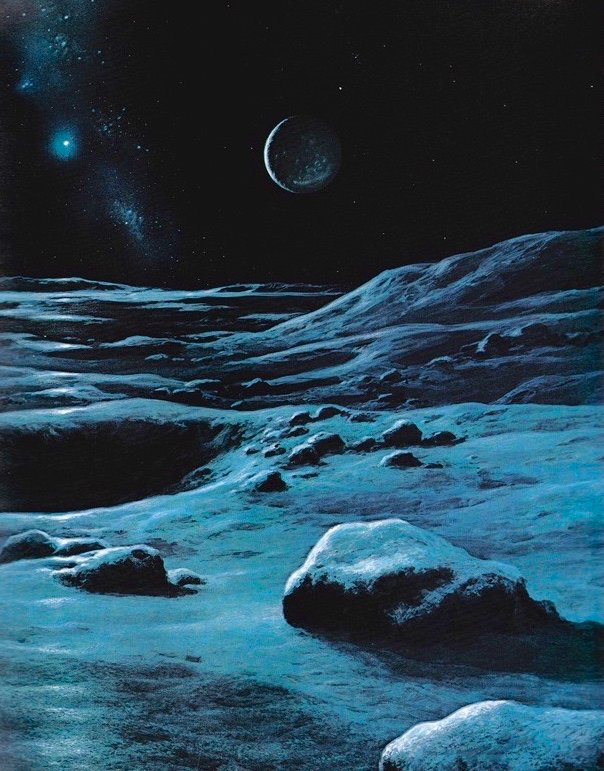
(c) Ludek Pesek 1980, will be removed on request

Several of the planets, or former planets, in this Solar System have a kind of iconic symbolism to them. Saturn is the “classic” planet with the ring round it. If you want a symbol of a planet, it serves well, mainly because otherwise a symbolic planet would just be a circle with no particular significance. Mars and Venus benefit from being next to Earth, Venus being the “planet of love” and Mars the “planet of war”, which is why we get invaded from Mars a lot in old sci-fi. Saturn, Uranus, Neptune and Pluto have all also been seen as the “outer limits”: as new discoveries were made, each of them was demoted from this position. In ‘Last And First Men’, Olaf Stapledon has the human race move to Neptune to escape the Sun’s increasing radiation about an æon from today, and although he acknowledged the existence of several planets beyond Neptune, he was writing just before Pluto was discovered and hence his Neptune occupies that rôle right then. Saturn worked very well in this niche because of its prominent rings, forming a kind of pale around it which reinforce the idea of limits. But for many of us alive in the last two-thirds of the twentieth Christian century, Pluto fills that slot.

Pluto has a remarkable astrological history which makes me wonder about the nature of that approach as opposed to the science of astronomy. Astrologers have been known to call Pluto “Lowell-Pluto” to distinguish it from the other astrological Plutos, Pagan-Pluto, Wemyss-Pluto and Thierens-Pluto, each named after their respective astrological advocates. The first of these is associated with Scorpio, like the Pluto we’re most familiar with, and was designated in 1911, nineteen years before Pluto was discovered. Wemyss-Pluto is far out, with a sidereal period several times that of Pluto as we know it, of 1 566 years, and rules over Cancer rather than Scorpio, and Thierens-Pluto is a renamed Osiris, a hypothetical planet paired with I*s*i*s (not sure what search algorithms do with that sequence of characters sans stars), and is one of four trans-Neptunian planets. All of these are known as hypothetical planets in astrology, and some have been given ephemerides (tables of their movements and conjunctions etc.). I won’t cover all these in enormous depth, but just want to observe that it’s interesting that astrologers “discovered” Pluto under that name long before it officially received it. Traditionally Scorpio was ruled over by “Negative Mars”, which makes sense because of the red giant Antares – “anti-Mars” – in that constellation. Negative Mars is nocturnal, feminine and negative as opposed to the Martial attributes of diurnality, masculinity and positivity. In astrology, there is a negative planet for each positive one, also referred to as feminine planets, although as I understand it this idea is not currently used.

Astrologically, Pluto is a disrupting and disturbing influence in keeping with the original idea that there had to be a massive planet beyond Neptune which was perturbing the orbits of planets further in, and also Pluto is a bit of an oddball, considered as a planet, because it isn’t a gas giant, unlike the four planets beyond the asteroid belt. Besides that, its orbit brings it closer to the Sun than Neptune for a dozenth of its year. Being associated with the underworld, partly because of its name, it also has associations with crime and “degeneracy”, and also obsessions. The era of its discovery is also considered significant. There have been attempts to write an extra piece for Holst’s ‘The Planet Suite’, composed before its discovery, which to my uneducated ear sounds appropriately atonal and modern, perhaps like Charles Ives or Messiaen.

Pluto, then, is Ultima Thule. Ultima Thule is the most distant location for the Greco-Roman world and it isn’t clear if it’s a real place. The Orkneys, among other islands, have been suggested as its real world equivalent. The original name was Thule, but it became metaphorically associated with the most distant possible place, hence “ultima”, meaning “last” or “final”. The back of beyond, in other words. The name Ultima Thule was also applied to a very distant trans-Neptunian object, 486958 Arrokoth, visited by the New Horizons probe after Pluto. It’s also given a name to the sixty-ninth element, thulium, I’m guessing because it’s the rarest of all the stable rare-earth elements, or was considered to be so at the time of its discovery. Thule was also used in Nazi ideology as the name for a far northern original homeland of the Aryan folk, and due to that association the name is no longer used for the object encountered above, Arrokoth, which was named officially by a Pamunkhey tribal elder in a ceremony in November 2019.

The “Ultima Thule” idea clearly has great power, and for a long time Pluto was a modern version of this notion. For instance, in ‘Not The Royal Wedding’, one of the ‘Not The Nine O’Clock News’ books, Brezhnev’s share of the royal wedding cake was described as the size of “a microbe’s frisbee seen through the wrong end of a telescope well beyond Pluto”, i.e. something very small indeed, and also distant. This is of course just one of countless examples of “Pluto as metaphor” used between 1930 and 2006, in which it has the attributes of being very cold, dark and distant. In fact this doesn’t quite work as well as might be thought, but before I go into that it’s fair to observe that one reason Pluto is such a potent symbol is that very little was known about it for a very long time, allowing all sorts of thoughts to be projected onto it from a great distance, with little accountability in a way, because it seemed unlikely that anyone would ever find out much about it.

I can’t help thinking that if the International Astronomical Union had decided to demote Pluto earlier, it would’ve been less likely that New Horizons would ever have been sent there. It was launched only seven months before the decision, and plans must have been underway for many years before that, so the mere act of changing Pluto’s status right then probably wouldn’t’ve been enough to do it, but had that happened long before, or if Pluto had never been considered a planet, I don’t believe the mission would’ve taken place. It’s fine to send a spacecraft to some Kuiper Belt objects, and also interesting and useful, but I don’t think it would’ve been good publicity for NASA to do that if it had never been regarded as a planet. The sheer distance probably makes it seem like an excessive mission to the minds of many non-astronomical folk, and it might therefore be associated with the idea that it was a waste of money. Nevertheless, we got a mission and I’m very happy personally that we did.

The surface temperature of Pluto is -226 to -240°C. Although this is colder than Uranus, that rather than Pluto is now deemed the coldest planet in the Solar System. NASA gives a temperature of -233°C. There’s no denying it’s cold. Only three elements would be gaseous at that point: hydrogen, helium and neon, although on a hot “day” fluorine would be close to achieving that. However, it’s still above the ambient temperature of almost all the Universe, which is -270°C, and of course well above absolute zero. There’s a remarkable story by Larry Niven of an astronaut who has frozen on Pluto but whose nervous system becomes superconducting during the day when the temperature gets high enough and is therefore still conscious, waiting perhaps centuries to be rescued, unable to move, which sounds like a recipe for madness or Hell, rather appropriately for a planet named after the kind of the underworld. Not a fiery Hell though.

It’s often said that the Sun is just a star from that distance. That is true, because it’s forty times as far as Earth from it, meaning that it wouldn’t show a visible disc to the naked eye, but on the other hand the Sun would still be hundreds of times brighter than Cynthia at its brightest, and would illuminate the dwarf planet about as strongly as the light we experience just after sunset. The surface wouldn’t look poorly-lit to us there. There would also be the light from Charon, a relatively extremely large and close moon, which is locked into the same position in the sky at all times, and is therefore invisible from the other side, and of course the other moons.

The coldness of Pluto has sometimes been represented in paintings of its surface in the form of the likes of snow and icicles. Whereas this communicates, mildly, the conditions there, it seems unlikely that it ever actually snows there at all. On Neptune’s moon Triton, the nitrogen atmosphere snows in the eighty-two year long winter. A point needs to be made here about Pluto’s climate and the influences on it. Pluto is not strongly illuminated by the Sun, but has a very eccentric orbit and a considerable axial tilt. Because of the weak radiation at that distance, the tilt, which would normally strongly influence the weather and seasons, such as they are, is less significant than the highly elliptical orbit. The axis tilts between 102° and 126°, which can also be thought of as being 54° and 88° but rotating in the reverse direction to most of the planets, and this means it has overlapping polar and tropical zones rather than polar, temperate and tropical ones. It sounds a bit weird to talk about Pluto having a tropical climate, and this is only relative as of course the maximum temperature at the equator at midsummer during its closest approach to the Sun is still enormously colder than the midwinter temperature at our own South Pole, which is true in fact of every planet from Jupiter outward though not necessarily their moons, but on Pluto water is effectively a kind of rock anyway so it’s not like we’re talking about rain and snow. Also, water ice is not the main constituent of the surface but frozen nitrogen with some methane and carbon monoxide. It’s easy to think of the carbon monoxide as a poisonous gas, but again, since its freezing point is -205°C, once again it’s something of a technicality that it happens to be toxic to us life forms living thousands of millions of kilometres away on a world so hot that we have oceans of molten rock, comparatively speaking.

Pluto’s day lasts getting on for a week. 6.4 days is a more accurate figure. The star that is the Sun would therefore be below the horizon in some places for more than three days at a time, and because of the highly tilted axis it would be in the sky for over a century, followed by more than a century of night. And it would in fact look very different when it wasn’t there because the night would be dark like ours, though perhaps lit by an extremely large and close moon in the sky, permanently hanging in the same position.

What, then, would it be like to live there? There is actually a more pressing question here: what would be the point of living there? Why would anyone bother? It took New Horizons nine and a half years to reach it and it takes five hours to send a signal at the speed of light over that distance, so people are not really going to be having real time conversations with anyone on Earth, or for that matter Neptune. There seems to be no practical reason at all to go there. Jupiter is a rich source of hydrogen and helium, Mars is relatively nearby and might once, or maybe even still, has life on it, but living on Pluto wouldn’t be much different from living in a space habitat that far out with the added difficulty of making it hospitable rather an building a friendly environment from scratch. There’s also a serious lack of useful resources within easy reach, and the surface gravity is extremely low at only a fifteenth of hours, meaning that unless something was done to maintain muscle mass, bone density, cardiac health and the like, living there would be a life sentence. You’d never be able to return to Earth, assuming you’d come from here in the first place. I think probably the main motive would be to do something extreme, a little like walking to a pole. It’s a Ranulph Fiennes-type thing to do. I can imagine the rest of the human population of the Solar System rolling their eyes at people choosing to live on Pluto and wondering what the heck the point of it all was.

This is not to say that the place has no merits. Its orbit is sufficiently large that the Centauri system would actually just about visibly shift position in the sky through the year, although only people who lived to 120 would be able to experience that and it’s hardly noticeable. There may be at least two active volcanoes there, Piccard and Wright near the south pole. There may also be a very deep internal ocean of water, which could conceivably have life in it. The whole world is smaller than our moon at 2376 km diameter, giving it a surface area about the same as Russia and a little larger than Antarctica. The micronation of Aerica claims part of Pluto as its territory, which seems to be another “Ultima Thule” thing, and the Empire also claims a made-up planet called Verden.

In some ways, the world is quite rich in resources, if by “resources” you mean the likes of water and oxygen. You’d never go short of those. However, if you wanted metal or many other minerals essential to life, you might get a bit stuck unless you took them with you and kept them in a closed cycle. Nitrogen is fine, but there’s the usual issue with phosphorus and possibly even sulphur. If the ocean exists and there is any cycling between the mantle and crust, there might be some heavier elements in the form of salts where water ice outcrops exist. There are nitrogen glaciers fed by the thin atmosphere precipitating out in the “winter”, whatever that is, which tend to smooth out craters. Unlike elsewhere in the Solar System, this ice would be soft and gelatinous. There do appear to be winds of some kinds because there are streaks of red material. It isn’t clear what that red material is, because it isn’t tholin. You could even get something like fossil fuels from the place because there’s methane ice on the surface.

What I have in mind, then, is a kind of horizontally-oriented rotating wheel oriented somewhere either in sunlight lasting a century or so, or in a region where the day-night cycle is about six days. It would need to rotate to keep the inhabitants healthy. It could be warmed by burning methane or hydrogen, and there would be no concern regarding sources of water, oxygen or nitrogen, but other materials, including metals, would be sparse and this suggests that the base would need to be made out of some kind of synthetic material, which I would call plastic except that this makes it sound like it’s weak and flexible whereas I have something much tougher in mind. There would be relatively little risk from ionising radiation because there’s nowhere for it to come from.

But as to whether there would be any point, apart from proving it’s possible, I do not know.

Nine Planets Again?

Schlegel, Finkbeiner and Davis (1998)

Removed on request

In 2006 CE, the International Astronomical Union declared a new definition of “planet” which excluded Pluto because it didn’t satisfy the new criteria. These were:

  1. It had to orbit the Sun (or presumably another star or it’s very silly).
  2. It had to be almost round (so no doughnut-shaped planets?).
  3. It had to have cleared the neighbourhood around its orbit.

They did this because a number of large new objects had recently been discovered which were round and two, I think, were more massive than Pluto, but they didn’t want to call them planets because it would’ve led to a very large number of bodies ending up being called that. They also introduced a new category of “dwarf planet”, which included Ceres, previously regarded as an asteroid, and also Pluto and others. It does make sense to do this, although I don’t understand why they didn’t just carry on with the term “minor planet”, referring mainly to asteroids, or perhaps “planetoid”, which they’d also used a lot.

The least clear of these three criteria is “clearing the neighbourhood”. This means that a body has no other bodies of comparable size other than its moons or other bodies under its gravitational influence such as Trojan asteroids. These are asteroids which orbit 60° ahead of or behind a planet in the same orbit which are pulled there by the gravity of the Sun and the planet concerned, examples being Achilles and Hector with Jupiter. Arguably this criterion either makes Cynthia a planet or Earth not a planet, and whereas I’m fine with the former I don’t think the latter is sensible.

The word “planet” has been applied differently during different times in the history of astronomy. When the large Galilean moons of Jupiter were discovered in the early seventeenth century, they were referred to as planets, and this also happened when Ceres was discovered in 1801. A similar process to the one leading to Pluto’s demotion then ensued, with lots more “planets” being discovered until it was decided to call them minor planets or asteroids.

It’s actually quite nice to think of Cynthia as a planet because it increases the number of known planets in our Solar System to nine again, and also means the Apollo astronauts landed on another planet rather than just a moon, and it also bolsters the idea that it should have its own name. It’s the largest body within the asteroid belt which isn’t considered a planet. Leaving that aside though, one issue with Pluto not being a planet is that most people have grown up with the idea that it is one, and it’s hard to let go of apparent certainties arrived at in childhood. Its demotion is akin to the youth of today liking different music or something. To quote Abe Simpson, “I used to be with ‘it’, but then they changed what ‘it’ was. Now what I’m with isn’t ‘it’ anymore and what’s ‘it’ seems weird and scary. It’ll happen to you!”. And it did. It happens to all of us.

I exploited this idea in my Caroline Era alternate history with the discovery of Persephone and subsequent visit by Voyager III. This body is in fact either Eris or Sedna, I can’t remember which. There is also an eleventh planet according to the Caroline Era astronomers, which is whichever one this isn’t, and this could’ve happened. It isn’t an alteration to the solar system, just to what we call things, and the name Persephone has been hanging around waiting to be attached to a new outer planet for a very long time now.

When Neptune was discovered, its mass and position explained some of the vagaries of the Uranian orbit but not all. Neptune also takes more than a gross years to orbit the Sun, so it was too slow-moving to plot its orbit accurately for quite some time after its discovery. Therefore, it was conjectured that a further planet must exist beyond the orbit of Neptune. Two planets were proposed, one by the well-known Percival Lowell who elaborated the Martian canals. He proposed a planet seven and a half times Earth’s mass with a mean distance of around 6 500 million kilometres from the Sun and a period of 299 years. It would have had a diameter of around 25 600 kilometres. Those figures, which turned out to be very wrong for Pluto, are worth remembering because they suggest something else, but I’ll be coming back to this. The other proposal was from Edward Charles Pickering. He suggested a planet with a mean distance of 8 200 million kilometres from the Sun and a period of 409 years. Obviously it couldn’t be both. Incidentally, this is where “Planet X” comes from. It was Lowell’s name for this planet while it was still undiscovered. Then, after a lot of searching using photographic plates to detect the movement of the body against the background of the stars, Clyde Tombaugh detected something moving in approximately the right position. After a competition, the eleven year old Venetia Burney decided it should be named Pluto, because it was far out, dark and gloomy and therefore appropriately named after the god of the underworld, which also happened to begin with Percival Lowell’s initials.

Both astronomers had predicted a highly elliptical orbit in comparison to the other planets, and in fact its orbit is indeed considerably more elliptical than any of them apart from Mercury, and was still quite a bit more eccentric even than that. For a long time, Pluto’s satellite Charon remained undiscovered due to being very close to Pluto in both distance and size, and consequently there was no easy way to calculate its mass, so it seemed that in order to yank Uranus around sufficiently from that distance it had to be practically a solid ball of iron, probably the densest element found in large enough quantities to make up an entire planet. If Charon had been found earlier, its orbital period would’ve indicated that Pluto was in fact not very dense at all and mainly made of ices, so when it was discovered in 1978, or more likely somewhat later when its month became known, it was realised that Pluto was not nearly massive enough to account for it. Its density is only 1.88 grammes per cm3 rather than more than four times greater as it had had to be assumed. So it looks like Pluto was actually just discovered by chance and has nothing to do with perturbing Uranus. Astronomers just happened to be looking really hard at the patch of sky it was by chance crossing at the time. It was in fact fainter than expected too, because they thought it would be larger, and the size of Pluto was also overestimated for a while for the same reason as its mass. In fact, to fulfil requirements it would actually have had to be more than twice as dense as the densest atomic materials in existence. Note that that doesn’t mean “known”. The densest elements are already known because the strength of the nuclear strong force compared to the other forces in atomic nuclei allows the heaviest stable elements to be determined, and they’ve already been discovered in the form of osmium and iridium.

Pickering believed that his planet and Lowell’s were not the same, and that both existed. To return to his “Planet P” as he called it, it’s of a type which is nowadays referred to as a “Super-Earth” or “Mini-Neptune”, and these are notable by their apparent absence from our Solar System. Of all the planets discovered in the Galaxy by the current rather flawed method, the most common of all are of this type: considerably larger than Earth and considerably smaller than Neptune and Uranus. It is in fact an unresolved problem in astronomy that the apparently most common type of planet also seems to be completely absent from our own system. Some have suggested that at some point a Super-Earth did indeed orbit with us but was slung out of the system entirely, or way too far out to be easily detected, æons ago, which is why we seem so atypical.

Before I go on to the next bit, I want to talk about Uranus and Neptune, both of which were “precovered”, i.e. noted before it was realised they were planets. William Herschel published his ‘Account Of A Comet’ in 1781, where he thought he’d found a comet but it turned out to be Uranus. This planet is actually just about visible to the naked eye and could easily be mistaken for a star. Neptune is too faint for this to happen, although I wonder if nocturnal animals can see it as well as Uranus, so the idea of it being discovered when it was may be preceded by perhaps 200 million years or more, although that would only be an early mammal happening to notice a light in the sky rather than a genuine discovery. It is, though, possible that Neptune was recorded as a star by various astronomers before it was actually found to be a planet.

And this brings us up to date, because as you probably know, a ninth (tenth‽) planet may have been discovered through old telescope photographs. The IRAS project, from a satellite launched in 1983, was an infrared sky survey operating for nine months. As seen highlighted in the image at the top of this post, it may have found a new solar planet. The object in question is in roughly the right place for Planet 9 but may not be a planet at all because it’s close to the galactic plane, where there’s a lot of dust and stars, making observations rather difficult. If it is a planet, it’s about 225 AU from the Sun (33 750 million kilometres or one light day and seven light hours from it) and has a mass at least five times Earth’s. If that difference is average it would take more than three millennia to orbit the Sun and the last time it was in the position it was in 1983 would’ve been in the late Bronze Age. It may well not be a planet at all.

The reason Planet 9 might exist is that the Pluto-like bodies orbiting between 150 and 300 AU out – those are average distances by the way and the orbits are far from circular – seem to be clustered on one side of the Sun but are too far out to have their movement disturbed significantly by the gas giants we know about, so the idea is that there is a planet even further out which influences their motion. Although I’m in the Dunning-Kruger zone with this, I have my doubts because it seems to me that the bodies we know about are all currently near their closest approach to the Sun because otherwise they’d be too dim and slow to be detectable, and it could be an artifact of a small sample size. I may well be wrong about this. If it exists, the planet in question would be about five times Earth’s mass, as stated above, but also 400 to 800 times further out than us as opposed to 225. However, Pluto was discovered because of looking in the right place accidentally, so although the hypothesised planet is too close, it doesn’t mean it isn’t there. Presumably it could mean there’s yet another one further out. Some people are uncomfortable calling it “Planet 9” because they see it as insulting to Clive Tombaugh. I feel a strong urge to call it Persephone. It isn’t the hypothetical Tyche, because that would be larger than Jupiter and has been ruled out by observation at any distance closer than 10 000 AU. Tyche would actually be fairly warm incidentally, because it would be large enough to heat itself – it would be only slightly cooler than Saturn.

A super-Earth at that distance, though, would be very cold. I’m not sure how cold exactly, but it would be between -270°C and -195°C. Planets of this type are either water worlds or “gas dwarfs”. At that distance it seems unlikely it would have oceans because they’d be frozen solid, but one depiction of a gas dwarf is that it would be like this:

By Pablo Carlos Budassi – Own work, CC BY-SA 4.0, https://commons.wikimedia.org/w/index.php?curid=112487881

It could also have moons, which I find interesting because they could be warmed by tidal forces and if not, might have neon-rich atmospheres if they’re large enough.

The subject of Super-Earths and/or Mini-Neptunes is worth holding over for a post in itself, so I won’t go into more detail here, and I really think this is going to turn out to be nothing, but it’d be nice to discover another planet in our Solar System and perhaps resolve the problem of why we don’t seem to have one of this type. Alternatively, maybe a planet at that distance is far enough out to have been a rogue planet wandering between the stars or to have belonged to another solar system entirely which passed too close to the Sun and had one of its planets captured, which is exciting as well because it means we’d be able to study a planet from another star at relatively close range. It’s still over a thousand times closer than the nearest star though.

So to conclude, because good science always goes for the most boring option, I don’t think this is Persephone, but it’d be nice if it was.