Why The Apollo Missions Probably Happened

This is in a sense a break with my usual practice of alternating posts on the Solar System and other matters, but this tends to have a different status in people’s minds than the other issues. I need to find a picture of the lunar rover before I continue.

Right, done that:

I believe this image, being taken on NASA’s behalf, to be in the public domain. If not, it will be removed on request.

Before I get going on this, I want to say that I feel like I’m playing a “pronoun game” here, though not with pronouns. Sometimes, people who don’t want to out themselves or their significant others to the person they’re talking to will try to avoid using their pronouns. This can lead to all sorts of verbal acrobatics which can in fact cause people to notice what they’re doing when they wouldn’t’ve done so otherwise, and it needs to be done skilfully in order to prevent this. I feel a bit like this now because most of the time I try hard not to use the word “Moon” as a proper noun for the world closest to our own. You may have noticed, incidentally, that two entries ago I did in fact use the word, but it was in reference to a period of time rather than the neighbouring planet, as in “many moons ago”. There’s actually quite a tradition for referring to it euphemistically, and the Latin word “luna” is in fact a shortened form of “lumina”, meaning “lights”. This is because the previous word, “mensis”, came to mean “period” in the sense of menstrual flow and something like prudishness or sexism led to the word sounding obscene or tabu in some way. Moreover, there’s the fine Germanic tradition of kennings, which are substitute terms used for poetic or picturesque purposes in early Germanic literature, including Old English and Old Norse. For instance, the sea might be referred to as a “whale road” and a battlefield as a “raven feast”. There are a couple of kennings, rarely used, for that bright thing in the night sky. I should also say that although I’ve committed myself to calling it (her?) Cynthia, I actually think Selene works better and there are other options including Diana and Artemis, or perhaps words from non-Western cultures such as Tsuki-Yomi. The reason I do this? Just as I omit the article when referring to Earth, I want to foster a cosmic perspective and therefore refer to Cynthia by an actual name rather than making it “special” because it happens to be the nearest permanently associated spheroidal body of non-artificial origin to our own, but paradoxically at the same time ensure that it has its individuality recognised as something which is more than a mere adjunct to Earth. After all, as far as I know it’s the only “moon” in the Solar System which feels a stronger gravitational pull from the Sun than Earth, so in a sense it isn’t even a moon but a coörbital planet with Earth.

Whatever you want to call it, my position is very standard, the consensus in fact: thirty humans left low Earth orbit and travelled to orbit around Cynthia. Of these, a dozen set foot on the surface. One crew failed to do so due to an accident with their spacecraft. This is the “normal” view. The minimum view compatible with the facts, but quite contrived, is that thirty humans left low Earth orbit and travelled to orbit around Cynthia, six LEMs were deposited on the surface, there was a major series of sample return missions, spacesuits and the lunar rover were developed to function in a vacuum and that any filming or photography that took place was of an evacuated chamber on Earth. This is the absolute minimum the Apollo crew must have done which is compatible with what can be demonstrated. It isn’t sufficient to claim that there was merely filming in a studio or out in the open on Earth because vacuum conditions can be seen to be present in the images. I’m agnostic about the idea that showing them in slow motion could’ve led to the impression of lower gravity. It actually does seem feasible that that could’ve been done.

What isn’t feasible may be a strawman. This is the claim that the astronauts either didn’t leave Earth or travel past the Van Allen belts and that the filming was done by Stanley Kubrick in an ordinary film studio or outside in a remote area on Earth, or by anyone else. That particular position is completely untenable, but to be fair I’m not sure any serious person makes that exact claim. The real claim, so far as I can tell, is that the astronauts stayed in low Earth orbit and automatic probes were sent on a sample return mission, and also deposited laser reflectors, seismographs and other instruments. Also, that the aim was not to race against the Soviet Union but to unite humanity. This claim is closer to the absolutely minimally plausible one but it’s still implausible as such.

I’m not aiming to duplicate what’s been said on clavius.org here. That would make this redundant, and in fact after many years of attempting to debunk the idea that the Apollo missions were hoaxes on Yahoo Answers and elsewhere, I found I was repeating myself and might as well just direct them there. The point of this blog post is to be personal about it, and outline what I personally find convincing about the proposition that humans travelled there and set foot on it, because the emotional involvement and thorough understanding of the claims might be more convincing.

I should make the usual claim that science never aims to prove anything. Science can only disprove things because inductive inference is fallacious. An unbroken past string of conjunctions between events without any counter-examples can in theory be interrupted at any stage in the future. This makes inductive inference strictly speaking illogical, and rules out the possibility that science can prove anything. Logic and maths, however, can produce provable propositions. For instance, any planet with an unbroken fluid surface, either in the form of an atmosphere or an ocean, must at any time have at least two stationary locations where there is no current or wind. That’s a mathematically provable fact. What can’t be proven is whether there are any such planets. We seem to be living on one, but we can’t prove it because that’s in the realm of science. Hence nothing I say from now on constitutes proof that anyone at all went there.

I’m going to number my points in case anyone wants to respond to specific ones.

  1. Argument from personal incredulity:
    This is not a scientific argument so much as a possible explanation as to why I believe they went and others don’t. It doesn’t relate to whether it actually happened or not.
    I have no desire to deprecate the achievement of travelling to the lunar surface, landing on it and returning to Earth alive. That said, I wonder if one reason people tend to be sceptical is that they find it such a remarkable achievement that they don’t believe it. The radius of cis lunar space is less than ten times Earth’s circumference. I realise they didn’t travel straight up and down, but this fact is probably a factor in the ease I have in believing they went there and returned, and set foot on the lunar surface. A friend of mine has said that the reason they faked this and not a Mars landing is that it isn’t as far beyond believability. My view is that if they had aimed to fake it, they may as well have gone the whole hog and faked a Mars mission instead. The fact that the claim they only went to our natural satellite seems a lot more modest and credible than that to me, so my emotional reason for believing in it is that it really doesn’t seem like that big a deal to me.

2. Cataracts. Opacity in the lens of the eye usually begins to develop at about the age of 60. Here is a reference:

jstor.org/stable/40305968

At the time of this study, thirty-nine former astronauts had developed cataracts. Of these, thirty-six had been on high-radiation missions such as Apollo. I presume the others were on Skylab but that’s just a guess. Nine astronauts have been on Skylab missions and thirty on Apollo missions which allegedly left Low Earth Orbit. Of these individuals, some started to acquire cataracts within five years of their mission and others took more than a decade to do so.

The youngest Apollo astronaut was 36 and the oldest 47. Even developing cataracts at fifty-seven is younger than average.

To me, this strongly suggests that all Apollo astronauts left low Earth orbit and got beyond the Van Allen belts.

  1. The change in how the lunar landscape was represented:

There was a famous artist called Chesley Bonestell, who did matte paintings for Hollywood and also paintings of space. He provided the backdrops for ‘Destination Moon’ in 1950 and ‘2001 – A Space Odyssey’ in 1968. All of his illustrations up until 1968 show a craggy, jagged landscape without much dust because of the lack of erosion from wind and water expected there. The Apollo images show soft undulating hills and a great deal of dust. In popular culture, the lunar landscapes shown in the Anderson productions ‘UFO’ and ‘Space 1999’, dating from 1969 and 1975 respectively, show the same kind of landscape depicted in the Apollo photographs.

Leaving the Apollo photographs aside as potentially unreliable, there are images of the lunar surface from Lunar Orbiter 2 in 1967 and the Surveyor landers from 1966. These show the same kind of landscape as the Apollo images. If the claim being made is that no lander or orbiter has been genuine, one is left with the need to explain why the representation of the lunar landscape changed in popular culture after 1968. However, if the claim is merely that no Apollo astronauts have walked on the lunar surface, it’s possible that this representation on the Apollo photographs and elsewhere is the result of the Surveyor and Lunar Orbiter images. It does, however, strongly suggest that images of the lunar surface have been successfully obtained.

4. The trajectory of dust behind the wheels of the lunar rover (see photo at top of post).
When a wheeled vehicle raises dust in an atmosphere as dense as Earth’s, that dust hangs in the air as a cloud before gradually returning to the surface. The dust behind the lunar rover didn’t do this but rapidly described a parabola, meaning that it was not moving through a substantial atmosphere. If the rover was being filmed in a studio, that studio would have to be airtight and have had all of the air pumped out of it for that to happen. If it was possible to do that, it doesn’t seem much of a stretch for them to have gone all the way. They would, for example, have had to have spacesuits and a lunar rover which would have been able to function in a practical vacuum. Otherwise, there needs to be another explanation as to why the dust behaved in that way.

5. Moondust is distinctly hazardous and harmful, and unlike most kinds of dust we’re familiar with on Earth. It isn’t subject to weathering or erosion, or to reaction with water or the gases in the air. This makes it very abrasive and toxic, because it has very sharp corners and edges and is also likely to undergo chemical reactions with substances in the human body, particularly in the lungs, respiratory passages and on the skin. It’s often claimed that the rocks (with the exception of that one piece of petrified wood) are from Antarctica, where there are lunar meteorites. The dust, however, seems never to have been in contact with Earth’s atmosphere because it has these properties. For this substance to be both authentic and present on Earth without astronauts going there, there would have to have been a sample return mission. There have been such missions, pursued by the Soviet Union at about the same time as the Apollo missions and later by the ESA and China, and the maximum mass returned was 1.7 kilogrammes in 2020. The Soviet missions in 1970-72 managed to return 101 and 55 grammes. The Apollo missions returned between 22 and 101 kilogrammes. This is of course a much greater quantity. Artificial lunar soil has been created however, so once again this isn’t a clincher.

This is what Earth dust looks like:
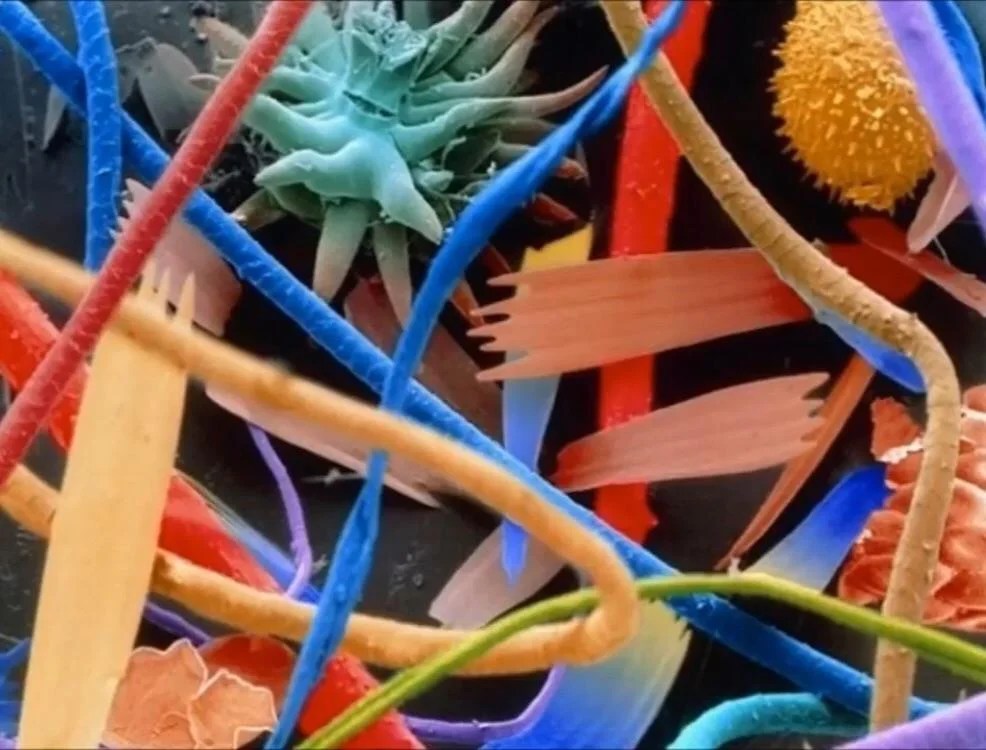

6. In order for NASA to pull this off, they would’ve had to convince China and the USSR that they were going there unless the Cold War situation the public perceive is inaccurate and the other two countries were in on it. It therefore seems necessary not only to believe that Apollo was a hoax but also that there was a global conspiracy between the great powers of the twentieth century. If this happened, why would the USSR and China not also be allowed to fake their own missions? I am in fact somewhat sympathetic to the idea that the situation in the Cold War was faked to some degree although I’m aware that nuclear warheads very probably do exist due to friends in the peace movement who have broken into missile silos.


7. My father was an amateur radio enthusiast in the 1960s. In the ‘70s, he played me reel-to-reel tape recordings of an Apollo mission. The delay in the conversation increased with the passage of time and much of the conversation seemed ad lib and casual, suggesting that it was not scripted. As far as I know, the Apollo astronauts had little acting experience – I haven’t looked into this. Since this was recorded off the NASA Deep Space Network (no, I don’t know how he managed to do this but I do believe he succeeded), it was apparently clear that the signals were being broadcast from a transmitter which was constantly moving first around Earth, later across cis-lunar space, then in lunar orbit and finally from the lunar surface. I unfortunately cannot confirm any of this now, but am asking you to trust me that these tapes existed and that the direction of the signals was as I described them, and the distances involved accorded to such a journey with the appropriate delay in reception. If you prefer, you can disregard this last point as mere hearsay, but I do know this happened.

Other justifications could be made of course. However, these are mine and it was suggested I set them down, so here they are. None of them prove we went. However, the minimum plausible set of circumstances is that a number of astronauts left Earth orbit, travelled to lunar orbit and deposited artificial objects on the surface including laser reflectors and undertook a major sample return mission on a scale greater than anyone has succeeded in doing since, and also that special technology had to be developed in the form of a lunar rover, an evacuated hangar and spacesuits in order to fake a landing. I personally think the simplest explanation is that we did go.

None of this proves we did that. However, the probability that we didn’t would be multiplied by each of these points, which makes it increasingly improbable that we didn’t go.

Caring For My Father – A Long Term Lockdown

My father, ten years ago

In keeping with the apparent interest I seem to get in talking about myself, today I’m going to be posting about my current “main thing”, which is that I care for my elderly father.

About five years ago, my father ceased to be able to look after himself on his own, largely due to a fall and mobility issues, so Sarada and I moved back in with him. I don’t know what one needs to do to affiliate oneself officially to some kind of caring organisation or whatever, and I don’t know its financial and legal consequences, so I haven’t done that. I do know that that means I’m not paying National Insurance via that route, which is a slight concern. Anyway, here’s a description of my day:

I get up at 6:30 am, shower and start to get my father’s medication and breakfast ready. He’s now confined to his bedroom. At 8 am during the week and 8:50 on Sundays, I get him up, dress him, change his incontinence pants and serve him breakfast, then wash and shave him. It’s this way round because he’s diabetic and I don’t want to leave him without medication or food for too long. He then watches television until he falls asleep and I put him back to bed. Then I make him lunch, which he has at 12:30 pm. Around 1:30 pm, he goes back to bed until about 3:30, then I get him up again, he watches more TV until I give him tea at 5:30 pm and he then goes back to bed at 7 pm on average. He’s at his most mentally active in the evening. I give him a hot water bottle and a banana at 8 pm and a paracetamol at 9. Averaging once a day, he uses the commode, which is always a struggle. It isn’t arduous but it does tend to tie me to the house.

Although I encourage him constantly to exercise, he’s very unkeen and it’s not clear whether this is because he’s just not capable of doing so or has given up. Psychologically, this is a bit complicated. In recent months I’ve had to try to lift him in and out of bed and have for some reason hurt my elbows in the process of doing so. He sometimes also needs me in the night for various reasons. I am attempting to help him to socialise more, but it isn’t easy because many of his friends have died or are similarly indisposed to himself.

Because I’m a health care professional, I’m able to attend to his needs in a somewhat different way to many other people. For instance, I look at the circulation of his hands and feet, examine his feet, look for bedsores, take his pulses, occasionally do mental state examinations, measure the movement of his joints, inspect his stools and so forth. I will shortly also be regularly testing his blood glucose. I hope that I’m gradually acquiring transferable skills as I do all this but don’t know how they could be assessed or certified. I’m also aware that being in this situation is tending to reduce my social capital, which is rather concerning to me and I don’t know how to address this.

When the lockdown began last year, it made hardly any difference to my life. That was substantially what I’d been doing anyway up until that time for a number of years already. The main difference was that I went shopping less often but bought more stuff. A while before that, he used to leave the house regularly on his mobility scooter to go to a café once a day and have the occasional meal out. One of the issues is that he has an authoritarian parenting style and it’s therefore sometimes difficult to get him to serve his own interests, and because he was in a managerial position for much of his career, he’s used to telling people what to do, which may not work well in current circumstances because of his mental state.

Speaking of which, he is lucid much of the time. Since I consider him a patient, I have to be careful with how much detail to go into with this and other aspects of his health. However, it won’t be a surprise to note that his balance is poor, as is his mobility, hearing and vision, although in some respects his eyesight is still better than mine. He is unable to stand.

Requests to social services and the NHS for extra help have largely resulted in them providing us with equipment. We have a rotunda, which helps him get in and out of bed and onto and off the commode, and a hoist which he paid himself which we cannot for the life of us work out how to use. There’s no sling and it mainly just gets in the way. He doesn’t have the upper body strength to lift himself up on it. Any advice on this would be most welcome. We also have our own draw sheet which makes things more hygienic and also makes it easier to move him in and to and from the bed, and there’s a bed rail.

There are a few reasons why I don’t mention this situation very often. One is that it seems to be an invasion of privacy. However, I think it’s important to recognise what may be going on quietly in homes all over the country where people are reaching the end stage of their life in a rather invisible way. Just as disabled people used to be hidden behind the scenes from an early age, nowadays we tend not to see the elderly very much beyond a certain stage unless we’re close relatives or work with them. It seemed significant that social services were keener to provide mechanical aids such as walking and toilet frames and the other things I’ve mentioned than personal services. On the one hand, this is probably due to wanting to maintain independence to the greatest extent for as long as possible, but it also seems to give out the message that things are more important than people. I imagine this has been looked at quite carefully but I don’t know.

The kind of personal provision available for the elderly appears to fall into two broad categories. Either someone comes in for a short period every day or the client (patient? Don’t know what to call them) goes into a nursing home and possibly loses their estate to pay for it. Neither of these seem at all adequate and it’s tempting to conclude that once someone is no longer considered economically productive, they’re seen as a drain on resources. On the other hand, it’s important to recognise the responsibility relatives and their community may have towards them, which are however often quite hard or impossible to address because of the economic and social pressures on those people. People talk about the “squeezed middle” a lot, referring to the middle class, but there’s also a generational “squeezed middle”, where people have responsibilities towards both parents and children. This is even more the case now that children find it impractical to leave home as young as they used to.

An additional problem in my life is that my parents separated fifteen years ago. This means that I have little opportunity to visit or attend to the needs of my mother, although she is far more able than my father and lives in sheltered accommodation. I often think that the later stages of a life-long marriage are more like a mini-care home where each spouse attends to the needs of the other which they can’t satisfy themselves. This also emphasises something a friend of mine once said about having an older partner: eventually the relationship you have with their body becomes primarily medical. I still think it was necessary for my parents to divorce but it does sometimes occur to me that in an ideal world, where perhaps everybody has a Qualcast Punch, they could’ve stayed together and looked after each other, or rather my mother could’ve looked after my father. She is an ex-nurse. Or is she in fact a nurse? Does it ever leave you?

A major issue for me in the past year is that it’s been difficult to get out to exercise. Although it doesn’t happen that often, my father sometimes does need me during the time I would previously have been running, between 5:30 and 6:30 am. This leaves me in the rather paradoxical position of not being able to exercise due to having to heft an eighty kilogramme weight around on a regular basis, and I’m not sure why that doesn’t help me keep fit. Really I should concentrate on Yoga and dancing, but somehow I don’t. I do not know why this is.

One advantage of taking care of an elderly parent, particularly a family member, is that it’s possible to see the health trends likely to affect oneself and the lifestyle factors which have led to them. For instance, like many people his age, my ninety-two year old father has very poor balance, so I’ve decided to compensate for this by practicing asanas which require balance. He was always quite active when he was younger, which considering his current predicament is a little concerning, particularly considering that that very predicament is currently preventing me from exercising, or is that an excuse? In any case, he has Type II diabetes (mellitus for completeness’s sake), for which I also have an increased risk, but unlike him there is no added sugar at all in my diet.

There are similarities to taking care of babies and small children but as I’ve been told regarding people with a learning disability, one difference is that with most children there’s a prospect of them becoming more capable, but this is a decline, although not a steady one. For instance, at the moment he has a cold, which I unfortunately gave him because I thought I was having a Covid-19 vaccine reaction, which wouldn’t’ve been infectious but turned out just to be a cold, so he’s not hugely capable right now, though probably will become more so again in the near future. However, “use it or lose it” needs to be borne in mind here because it becomes harder to regain capabilities in older people. There’s also a psychological aspect to whether one can gain strength or other capabilities because one may simply prefer not to have to confront the possibility that one may not be able to, or it may simply be too much effort to get it back even if it is technically within one’s capacity, and here the relationship comes into play because I am not assertive, and particularly not assertive with my father, which means that although I do try to encourage him I probably don’t do it as much as I might with other patients. This is one argument for having carers who are not relatives. Another difference with children is that adults are much heavier and harder to dress and change, and let’s just say their digestion is different and move swiftly on.

At some point this will end and I don’t know what things will be like coming out the other side. My main concern is that my mother gets the attention she deserves afterward, as right now I don’t think I can provide that. His life seems very limited and I do want to do what I can to improve it, particularly on the social side, but right now the Covid situation has been making things harder.

The question arises of what would happen in an ideal world, which is where we get back to the Qualcast Punch Problem: ideal for whom? Ideal in which way? Maybe in an ideal world nobody would get old, and at ninety-two my father has had a good go at that, but of course he did eventually do so. Then the question arises of whether that’s because we’re living in ‘Logan’s Run’ or we’re talking about Struldbugs from ‘Gulliver’s Travels’, which would still be an affliction. ‘Εος asked Ζευς to grant her lover Τιθονιος immortality, and her wish was granted, but she forgot to ask for eternal youth as well, with the result that he ended up completely paralysed and babbling to himself sealed in a room forever, so that wasn’t a good outcome. Getting a bit less extreme about this, maybe we just want the oldest generation to maintain the maximum quality of life for as long as possible without too much time seriously impaired, at least insofar as that can’t be remedied either socially or technologically. The question of ageism therefore arises, but we all seem to ascend a pyramid of ever fewer acquaintances as we age. For instance, retirement means the social life aspect of paid work is lost, and not being a member of a religious community (my dad’s non-religious) is another issue for many.

Making things a bit clearer, there seem to be the following factors:

  • Ageism, including structural and institutional ageism. Some people recommend that you don’t retire if you can avoid it, for your own sake (personally it might be nice to have something to retire from but of course I’m not normal).
  • Medical help for the accumulation of health conditions, and here the question arises of whether pure ageing exists or whether it’s simply the accumulation of health issues, many of which could be avoided if one is forewarned and in the right situation.
  • Technological help for the disabled.
  • Whether the responsibility for taking care of the elderly falls on the person concerned making their own provisions, society or their friends and relatives (and realistically that means relatives because of the pyramid effect I just mentioned).

I wouldn’t want a relative of mine to become institutionalised just because they were unable to look after themselves. There is an element of institutionalisation in what I’m doing now, in that I may have encouraged my father to become more dependent upon me than he needed to be. Because of past experiences, I’m not good at judging my strengths and weaknesses but I’m aware that a number of patients seemed to end up “needing” me more than they should’ve done, so I may not in fact be the best sort of person to care for the elderly after all. This is not to say that he genuinely doesn’t need me to some extent so much as that managing his decline could have had a shallower gradient. This is again an argument for a non-relative to become a carer. And in fact, given that we have a large number of underoccupied homes and also homeless people, a solution suggests itself there which would apply to at least some of them: some of the homeless people should care for the seniors incapable of caring for themselves. Incidentally, I would also expect this situation to have been exacerbated by the recent increase in “grey divorces”. So does that mean that previously there were people stuck in unhappy marriages and caring instead? It definitely seems that way.

The question of medical help could be answered by health care researchers and professionals crying, in an exasperated manner, “well, we’re trying as hard as we can!”, and of course they are, but they’re doing it in a capitalist society where treating conditions is more profitable than curing or preventing them. Extending life without also doing something about the economic system is just going to increase the inequality between people’s life expectancies according to income and wealth, because wealthier people are more easily going to be able to afford the treatments involved.

Technological help is another aspect. My father can get help for his mobility and is not short of money, and we have external devices which help him such as the commode and rotunda. There could, in theory, be internal devices such as hip and knee replacements, which he hasn’t got, cochlear implants, cataract lenses and a insulin pump. He could also have a self-raising bed. He doesn’t seem to want any of these things, and I wonder if this is to do with not liking change. If that’s common, there’s a psychological barrier to extending quality and quantity of life in that respect.

I’m happy to continue in this rôle for as long as required. I also consider it to be meaningful and useful. But the question also arises of who else out there needs care. Some time ago, a survey of the British public put long term care for the elderly as the top priority, which I actually disagree with because I see preventative medicine as more important. Even so, I can see the argument, and even agree with it to some extent. The obvious option, at least for people who can’t realistically call on family, friends or neighbours to help, would seem to be some kind of publicly-funded care service where there was regular meaningful social contact, and this might sound like it would cost the Earth but there are ways to provide it affordably, and also, the country spent over a trillion (short-scale – sounds more impressive that way) bailing out the banks and hundreds of billions will ultimately be spent on nuclear weapons systems, so perhaps we can use an affordability argument if it ever gets its priorities right. There’s also a demographic issue because boomers and to a lesser extent Gen-Xers are two bumps in the population. Boomers are soon going to hit the age when many of them will need care, and Gen-Xers will do so in the 2040s. The problem isn’t going away. In theory, by doing what I’m doing I’ve removed myself from the wage economy and am not providing the same amount of tax revenue or added value via paid work as I might have been previously. Although because of the way my life has gone, this isn’t actually true of me, it is true of most other people in this situation, and when it isn’t, the usual reason is because they haven’t had as successful an employment career, although they may well have had a successful parenting “career”, or still be having one.

So what do I want?

I want this country to provide a long-term care for the elderly service which is actively offered to all people over a certain age, which will be publicly funded without excuses about being unaffordable, because it isn’t, and provides social contact as well as practical help. Even if this existed though, we wouldn’t be interested in using it, and that should probably be borne in mind because the willingness of family and community to provide proper support will also be there and that will make it a lot cheaper. It’s also likely to be used more by single and divorced people, so there’s a substantial portion of people in long-term relationships who can also be taken out of the equation. I’m not an expert in this by any means, and I probably should look into ideas in this area, so maybe this is being offered by some political parties or being suggested by think tanks, charities and pressure groups, but I don’t know. I would rather go into this naïvely, as I do with many things at first, because I prefer to make up my mind about what I think without insidious coercion from others. That’s not to say that the ideas out there are not perfectly good, but it’s just important to approach this from the right angle.

Anybody know what they actually are?