
Before I get going on this, I want to explain the noun game with this title. Humpty-Dumpty’s dictum, “When I use a word, it means just what I choose it to mean—neither more nor less”, is clearly absurd, which is one reason why non-standard personal pronouns are such a struggle. I try to avoid using the term “the Moon”, because I think it encourages small-mindedness. It isn’t “the moon”. There are hundreds of moons in this Solar System, many of which have proper names. Ours also has proper names, in the form of what it (or she?) has been called in various different cultures, not in the sense of “that big hunk of rock up there” but in terms of deities associated with her. In a sense, we don’t appreciate her enough because there are two contrary forces involved in not giving her a name. On the one hand, it gives a sense of her being special in a way which excludes other special moons, such as those of Jupiter and Saturn. On the other, it paradoxically makes her generic: she’s just “a moon”, the nearest one. When we look at that luminary in the sky, we fail to appreciate that she is both special and not special, and whatever else we do we fail to appreciate her individuality (I’ll come to gender in a minute).
Although there are many deities associated with our sleeping satellite and there’s a good case to be made for calling celestial bodies by non-Western names such as Sedna, the fact is that she’s been associated with several Greco-Roman divinities, including Diana, Selene, Artemis and of course the name I chose for her, Cynthia. Using a name which is in common use as a human given name may seem odd at first but it does happen the other way round with other names for celestial bodies in English-speaking cultures, as with Venus Williams, so it isn’t unknown. Of the names listed, Diana and Cynthia are the most prosaic, although I’m sure there are people out there called Artemis and Selene. The big issue, of course, is that every time I mention Cynthia to people who might not have heard me do so before, I have to explain by doing something like putting “(‘The Moon’)” immediately thereafter, which is quite inelegant.
The gender issue is a side thing. Six of the seven known planets besides Earth in the Solar System have masculine names, as did Pluto when he was a planet. There’s a risk of it sounding like I’m objectifying women by using “she” for Cynthia the satellite, but I do this as part of my aim to reduce the association with sexes and would therefore equally refer to the likes of Mercury and Mars as “he”. Also, in a sense we are all “it” because underlying the interpersonal and emotional elements of our relationships, we are also conscious objects. It is, however, annoying that there are so many masculine celestial bodies.
And I’ve used that word again. “Celestial” bothers me too. Earth is in space. All there is is sky. Space is as much below us as above us. Everyone knows this of course, unless they’re Flat Earthers, but it’s easily forgotten and we have a tendency to revert to the sandwich model of the Universe we probably grew up with as a species. Earth is a celestial body – a heavenly body if you like.
The main theme of this post, though, is to consider Cynthia as a heavenly body among others that we know, that is, other planets and moons in our particular star system, and decide whether she’s boring. That is, if we were observing her as a moon of Venus, say, and sending space probes there and the like, what would we think? Or as a planet in her own solar orbit (which she nearly is)? It definitely seems that some worlds are more interesting than others, and it is quite diverting to have a large world orbiting us at close quarters, whatever it might be. Sarada is very captivated by seeing her sometimes, and I wish I could see past what I think might be disappointment that people haven’t got further into space, or rather further from Earth, than they currently have, because for me that taints it. But imagining Cynthia replaced with Io for instance, with that moon staying in her current state, which arises from the tidal forces acting upon her in the Jovian system due to the proximity of other satellites and the fact that she orbits within the planet’s magnetosphere, it would seem much more interesting stuff would be going on there, such as the volcanic eruptions and the multicoloured surface. Compared to that, our own moon just seems to sit there not doing very much. One of the people who went there said that if he wanted to see something which was exactly the same colour as the surface, he’d go out and look at his concrete driveway. It’s mainly various shades of grey, which is not exciting. Colour isn’t everything of course, and Apollo XVII is known for having discovered orange soil at Taurus-Littrow. Also, one of the most remarkable things about Cynthia is her maria and their distribution – the smooth lava plains which were deposited after the Late Heavy Bombardment which scarred the whole globe with craters, as it did elsewhere in the Solar System, such as on Callisto. The oddest thing about the maria is that until the 1960s CE, nobody realised there were practically none on the far side which can’t be seen from Earth. There are small smooth areas at the bottoms of craters, but no extensive plains. Nobody knows why.
Another mysterious feature is Transient Lunar Phenomena, which I know I’ve mentioned before on here, but anyway. These are temporary changes in light, colour or other appearance, and have the distinction of being something Patrick Moore was the world expert on. Explanations include outgassing, meteorite impacts and statically charged dust being repelled from the surface. Most TLPs have been observed in craters with cracked floors or around the edges of maria. A whole third of them are observed around the crater Aristarchus. They’re difficult to confirm because the same area would have to be observed at the same time by different people, which doesn’t often happen. NASA monitors meteor impacts, which are sporadic but also occur more often around the times of the famous regular meteor showers such as the Leonids or Quadrantids, because the two worlds are in practically the same place.
There’s also an “atmosphere” of dust. Sunlight ionises particles on the surface and they become statically charged, as mentioned above, then fall down to the surface and may bounce. This is happening all the time, with the result that there’s a constant fine mist of dust constisting of transient specks of dust. Additionally there’s a real atmosphere, though very, very thin. It’s estimated that the Apollo engines temporarily added more to the local atmosphere than was there before the landings. There are about a thousand million atoms and molecules per cubic decimetre just above the lunar surface, which is so sparse as to constitute a high vacuum in terrestrial terms. It’s also a ballistic gas: the particles are so far apart that they hardly ever encounter each other and undergo the same kind of bouncing trajectories as dust does there. It consists of helium, which is I imagine the result of alpha particles getting ionised, argon, which is also common in our atmosphere, potassium and sodium, which are relatively high in our upper atmosphere, ammonia and carbon dioxide. In fact, the atmosphere is similar in many characteristics to our own as it blends into cis lunar space, i.e. it’s an exosphere, the difference being that it’s at ground level.
The distance and size of Cynthia are also quite remarkable. She’s proportionately the largest natural satellite by far of an actual planet in the Solar System, as opposed to Pluto whose satellite is considerably larger but is not officially a planet. The closest rival is Neptune and Triton, with a mass ratio around 750:1 compared to Cynthia’s 81:1 ratio compared to Earth’s. In the inner system, only Mars has moons and they’re captured asteroids and very much smaller. The other thing about Cynthia’s size and distance is that she happens to be exactly the same size as the Sun in the sky, which is unknown for any other moon seen from the surface of their planet, although I understand Callisto comes fairly close on Jupiter. This makes solar eclipses possible in the sense that the Sun’s visible surface can be perfectly hidden while still allowing the corona, the solar atmosphere, to be visible. This doesn’t always happen because sometimes Cynthia is too far away, in which case the result is an annular eclipse with the Sun’s surface visible as a thin ring. Eclipses do occur elsewhere but not with such a perfect match, and this is very improbable. Nor does it seem to be directly connected to the necessity for life as we know it to exist on this planet. Although we may well need a large moon, it needn’t as far as anyone can tell be exactly the right size for that kind of eclipse, and this fact has been cited as an example of a possible Easter Egg if it turns out we’re living in a simulation. It could also be thought of as a sign of divine favour. The other thing about this is that because we’re moving apart at about a centimetre a year, it’s a temporary situation which will end in several hundred million years and didn’t happen until a few hundred million years ago, although that was before complex multicellular life existed.
Although Cynthia is very likely to be important for the existence of complex land life on Earth, I don’t want to consider this in this post as this is about her, not life. Just briefly though, tides within the planet’s iron core act as a dynamo and generate the magnetic field which keeps ionising radiation away from our surface and she also has a rôle in stabilising the axis of rotation. However, as with the above considerations, these are things to do with the relationship between the two rather than Cynthia herself. Before I leave thisses orbit entirely though, it’s worth pointing out that she’s the result of the outer layers of the planet which became Earth getting “chipped off” through a collision, and as a result she’s less dense than Earth by a considerable margin. Interestingly, and that’s what we’re looking for, the large bodies of the inner solar system fall into two neat categories regarding density. Earth, Venus and Mercury are all something over five times the density of water, and Cynthia and Mars around three. I don’t know why Mars is less dense, although it may be to do with the increasing temperature as one approaches the Sun causing lighter materials to evaporate. However, there was once an alternate explanation of the formation of Cynthia, where she was formed along with Mars from an initial body whose remnants are found as Earth. This kind of means Mars isn’t so much a smaller Earth as a larger Cynthia with a proper atmosphere, which is a little depressing.
There is magnetism, although Cynthia as a whole has no significant magnetic field, individual parts of the surface do have various magnetic fields, which are based in the crust rather than the core. The field tends to be weakest under the maria, particularly Oceanus Procellarum, and strongest at their antipodes, so the far side is more strongly magnetic than the side we can see. There may also be temporarily magnetised regions when meteorites hit the surface and cause melting. This lack of a global field also means that helium-3 is likely to have managed to accumulate, which is important if anyone can ever get nuclear fusion power to work.
When I look up, I never see a face in Cynthia. In fact, I’d consider it to be somewhat disturbing to see what would amount to a giant skull orbiting our planet, so I’d say that was a blessing. What I do see, independently of the other cultures which claim to see something like this, is a rabbit. This is of course the Far Eastern intepretation, along with a similar native American view that it’s a horned toad (not the lizard but an actual toad with horns). However, I don’t think I see the same bits as corresponding to these for the far eastern and western (who are of course linked) cultures. I see Oceanus Procellarum as the body, Mare Imbrium as the thigh, Maria Nubium & Humorum as the feet, Mare Tranquilitatis as the head and Maria Crisium & Fecunditatis as the ears. As I understand it, the Far Eastern interpretation is more upright and makes Maria Nubium & Humorum a mortar, which may be because they tend to view it from a different angle. I don’t know how the Native American projection works, or indeed if there’s more than one version although I suspect there would be. Cynthia holds the distinction of being the first body to be recognised as celestial to have her features named, and of course the selenography, as it’s known, is known in much greater detail than the “geographies” of anything in trans lunar space, although that gap narrowed somewhat from the 1960s onward.
It’s been claimed that even experts can’t tell the difference between closeup images of Mercury and Cynthia in some areas, and the two bodies bear comparison. Were it not for the maria, a casual observer wouldn’t be able to tell the difference between images of the two, particularly if Mercury was compared to our satellite’s far side. I’m not sure this is so because up until fairly recently only one quality source existed for images of Mercury, the Mariner 10 probe which flew by in September 1974 (and incidentally, briefly appeared to show that Mercury had a moon, which is not so). Compare and contrast these two pictures:


Ignoring external clues, are these interchangeable? Much of the appearance of the two bodies suggests that there is a kind of “standard” small rocky planet, possibly found throughout the Universe, which looks like Mercury, and Cynthia is one of these too. Callisto is a fairly good example:

Although Mercury does have smooth plains, they’re the same shade as the rest of the surface and don’t stand out. Mercury’s surface gravity is close to that of Mars but there’s no substantial atmosphere, partly because the planet is smaller and this makes it easier for molecules to escape the gravitational pull. This higher gravity makes a difference to the appearance of the craters, because when meteorites hit Mercury’s surface, the ejecta and hummocky rings are closer to the centre than they are on Cynthia, and are also more crowded because the material kicked up doesn’t rise as high or go as far. Mercury’s surface is also a lot more varied than Cynthia’s, but I don’t want to get too diverted onto the issue of the planet as opposed to the satellite.
There are quakes, which have several causes. One is the impact of meteorites, and it’s becoming clear that this is a very significant aspect of the place. The other can be divided into several more detailed causes, including tides, which start deep under the surface, and changes in temperature causing rocks to expand and contract. All of them are very mild compared to earthquakes, but they are associated with TLPs. The total energy involved is much less than a thousand millionth of those here, because we have tectonic plates and continental drift and Cynthia hasn’t.
There are “mascons” in the centres of the maria. These are regions of higher density detected when spacecraft orbited during the ’60s. In fact, these are unusually pronounced on Cynthia compared to other bodies in the solar system and amount to variations in gravity of over one percent. This is actually a distinctive feature not directly related to her position or relationship with us. They’re thought to be buried asteroids which have been there since soon after formation.
The dust is definitely worth mentioning. It used to be thought that it might be so deep that there was a risk of astronauts sinking into it like quicksand, but it turned out to be quite shallow, and this has been used as evidence by young Earth creationists. It also gets everywhere and is an inhalation risk like asbestos. It’s never been exposed to oxygen or moisture, so it has different characteristics than the kind of dust found on Earth. It’s technically just very fine particles of lunar soil or regolith, so there’s no definite cutoff between dust and soil. Due to the lack of exposure to water or air, it’s more reactive when it actually does come into contact with living tissue or just a wide variety of substances with which it comes into contact, which makes it a health risk in ways which silicate dust here wouldn’t be, and it hasn’t been smoothed by erosion and is therefore more jagged and has a larger relative surface area over which such chemical reactions can take place. It can jam mechanical equipment and interfere with wiring, and it also becomes statically charged quite easily. It’s nasty stuff, but probably not unusual because the same processes which generate it, meteorite impacts (again!) and radiation gradually breaking up the rocks, and I presume variations in temperature which are much more extreme than they are here due to the almost non-existent atmosphere, will also be operating on Mercury and inner system asteroids, and that implies that there will be similar processes going on once again all over the Universe.
The rock itself resembles certain rocks found on Earth but here it tends to be much rarer because we have weathering and erosion along with continental drift. Here, it tends to be of Precambrian origin and is therefore most common in places like Canada. Unsurprisingly, the maria and highlands are of different composition. In the former, pyroxene is the most common mineral, at about fifty percent of the surface there, and is made up of calcium, magnesium, iron and silicate. It forms yellow-brown crystals. The other common minerals are olivine, gabbro, breccias and anorthosites such as plagioclase. Olivine has pale green crystals and is a mixture of silicates of magnesium and iron which doesn’t survive long on Earth’s surface but is actually the most common mineral here. It releases heat as it combines with carbon dioxide or water and is therefore a potential fuel for heating which is actually carbon-negative, and is found copiously on the surface – a good reason to go back there I’d say. Plagioclase is a feldspar found in the highlands and is also the most common Martian mineral. It’s light grey or blue, so I presume that when we look at Cynthia, that’s what we see away from the maria. It consists of a framework of silicate groups in which are embedded aluminium, sodium and calcium atoms.
Much of the rock and dust is composed of glass, which also acts as an adhesive binding together fragments of other minerals. This is again because of meteorite impacts heating the surface which then cools rapidly, and this makes me wonder whether the same is true on Mercury because it’s hotter during the day but just as cold at night. When I say glass, I don’t mean the sodium silicate used to make windows and bottles on this planet, although lunar glasses do sometimes contain sodium and usually, possibly even always, silicates, but they would be less pure than what we use as glass.
I don’t honestly know if this is interesting or not. It seems plausible that there would be semiprecious stones and crystals in some places, which is quite appealing. Olivine looks quite nice:

This is actually a gemstone, when it’s known as peridot, and can be cut as such:
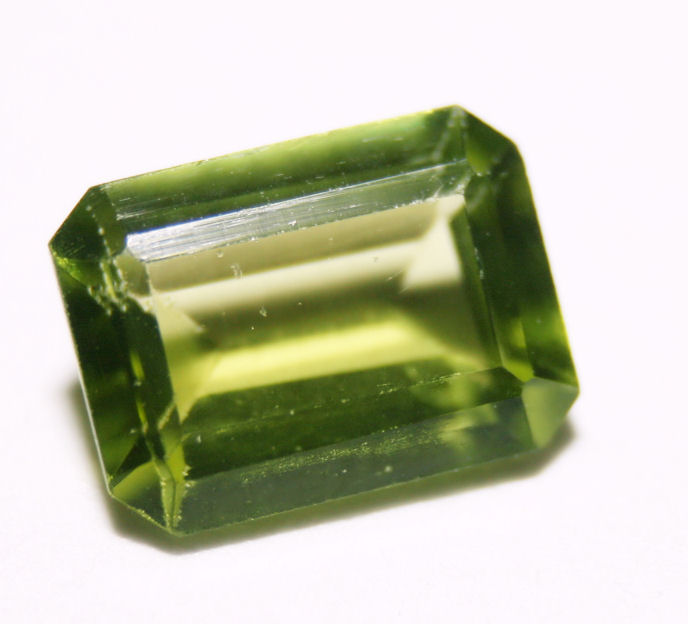
However, these kinds of olivine are close to being pure magnesium silicate and I don’t know if that applies to lunar olivine.
The existence of crystals gives me to wonder if there are any objects whose formation resembles living things, such as dendritic patterns in rocks or something like desert rose gypsum. It seems unlikely though, since there’s no water to act as a solvent and the place is very uneventful. It’s also likely that if olivine became easily available, since it’s so common on the surface, that it would cease to be a precious stone and if it can be used as fuel it would more or less have to drop in price.
There are no carbonates or sulphates on Cynthia, and also no hydrated minerals. However, there is a little ice in polar craters, which counts as a mineral there more than it does here in a way. These are craters in permanent shadow, and the same is true on Mercury. There is a general problem with raw materials due to the importance of water in concentrating useful mineral deposits here on Earth. Although the metals are often there in some shape or form, they don’t seem to be in the usual readily-extractable ores found here, and this of course reduces the incentive for going back.
Thus far I’ve mentioned the maria, highlands and craters, but there are other selenographical features. For example, although the maria are not real seas, they are smoother than the highlands, darker and have “shores” like the real oceans and seas here have. This means in particular that they have bays and tend to flood craters, the former being craters on the border of maria. One famous example of this is the Sinus Iridum – the “Bay Of Rainbows” – at the northwest of Mare Imbrium. The maria themselves also have features, including craters which are more recent than their formation and other craters which have become submerged under lava when the maria formed, sometimes called “ghost craters”. Lunar domes are present, previously thought to be “blisters” which had not ruptured to form craters in the days before their formation was attributed to meteorite impact, but they are in fact shield volcanoes with central non-meteoritic craters. The most concentrated collection of these is the Marius Hills, which range between two and five hectometres above the surface of the mare in Oceanus Procellarum. Of course, just saying they’re in Oceanus Procellarum is a bit like saying a geographical feature on this planet is “in the Pacific Ocean”, but unsurprisingly they’re near a crater named after the astronomer Marius, who may have discovered the Galilean satellites of Jupiter although their name suggests he didn’t. Among the hills is a forty metre wide pit apparently opening into a lava tube or rille. Lava tubes are basically long, sinuous lunar caves which form when lava solidifies on the outside but continues to flow out of the hollow tube thus formed. Their roofs can later fall in, forming a channel referred to as a valley or rille. Rilles can also form when parallel faults allow the ground between them to fall, in which case they will be roughly straight.
There are also ridges on maria, formed from the contraction of cooling magma, and these are also found on Mars and other moons and planets. They’re officially known as dorsa. Catenæ are also common elsewhere and consist of chains (hence the name) of craters, formed when tidal forces cause meteors to break up before impact. My impression is that catenæ are not as common on Cynthia as on some other bodies in this solar system, but that may be my imagination.
And there are mountains of course, although here a problem arises. On Earth, the height of a mountain is easily expressed as above sea level, though this can be misleading as it makes Everest seem to be the highest, which it may not be because Earth is not perfectly spherical. On Cynthia, a fairly arbitrary decision has to be made which has been given different values at different times, involving deviation from a presumed diameter of a sphere. Height of the peaks above the surrounding surface is easy to measure because they cast shadows and since the angle of the Sun and the distance are both known, it can be straightforwardly estimated. Mountains can be isolated or parts of ranges. The tallest mountain is Huygens, at 5.5 kilometres. This is a little surprising, as one might expect a body with lower gravity to be able to form higher mountains, which would then be fairly immune to erosion due to the practically absent atmosphere. The highest possible elevation of granite on the surface would be something like eighty kilometres, so this is very much in need of an explanation in my mind, and I would guess it has something to do with there not being the same kind of mountain-forming processes on Cynthia as there are here. That said, Mars lacks them too and yet has a mountain over twenty kilometres high. Isolated peaks unlike anything found on Earth occur in the centre of craters.
So to conclude, is this interesting or not? Mere proximity enables us to observe features likely to be found everywhere, even on planets and moons gigaparsecs from here, but as a body Cynthia does have distinctive features too. The maria being confined to the visible side, the presence of mascons to a greater extent than in other known worlds and the presence of transient lunar phenomena are all interesting. The greyness and familiarity make her seem dull, but there’s more to her than might at first be supposed. If she were a continent, her surface area would be second largest, somewhat larger than Afrika, and maybe in a way that’s a profitable way to think of her. She’s like a seventh continent which happens to be in orbit around the rest, more drastically different from them than Antarctica is to the other five, or perhaps a feature of Earth like the bottom of the oceans, and she is interesting. If you could drive there, she’d only orbit the rest of us nine times, and Concorde could travel that distance in eight days, so she really isn’t that far away, and definitely worth going back to. But I can relate to the dullness.
 A Box Of Chocolates